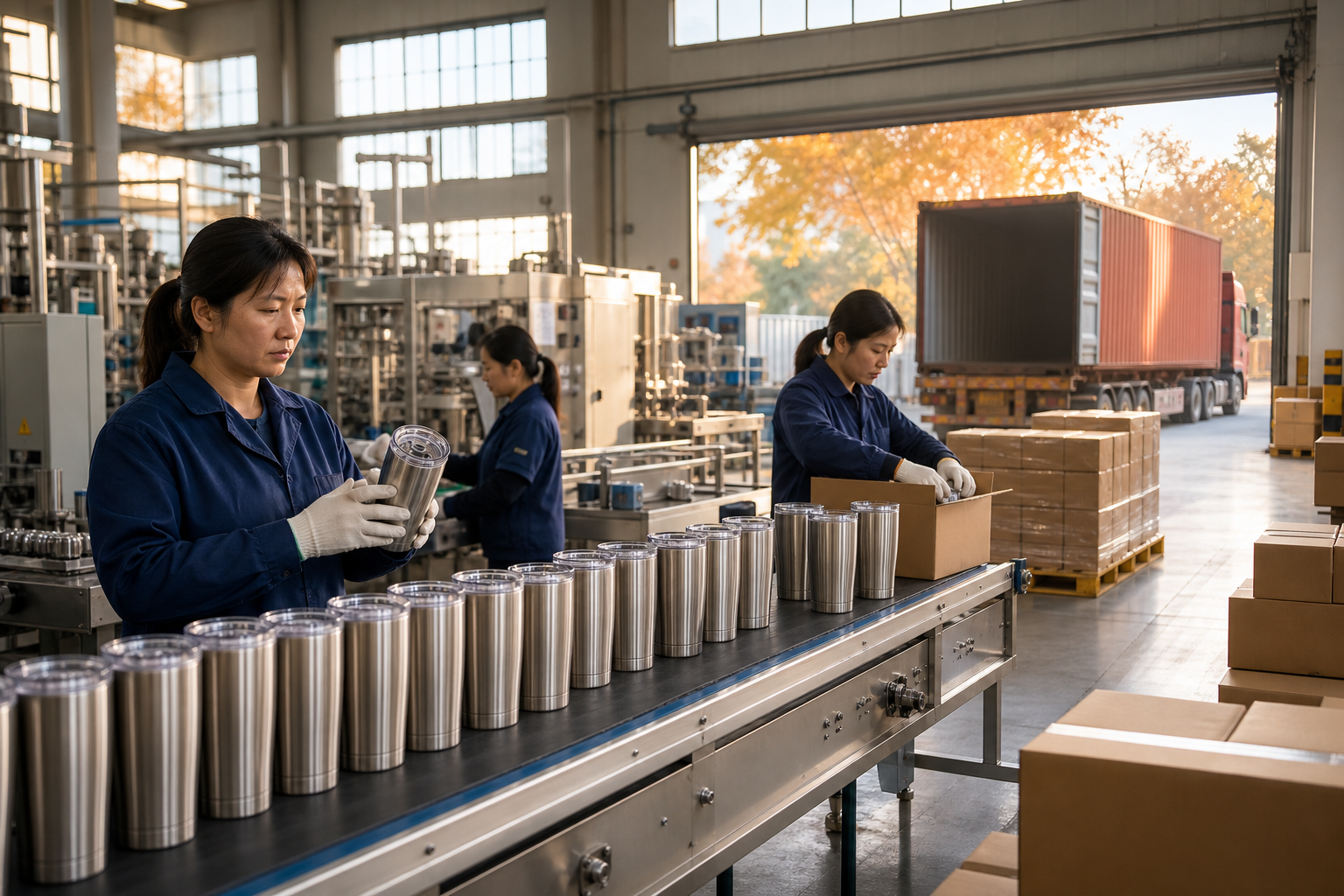
Key Takeaways
- For most custom drinkware, plan 40 to 55 days from PO to handoff during drinkware peak season lead time.
- Ocean freight to North America can add 18 to 35 days in Q4, and holiday shipping spikes often add 7 to 14 more days.
- A Zhejiang factory with 300,000 units/month capacity can still sell out specific lines if you book late; capacity is not the same as available production slots.
- If your program needs new artwork, packaging, or FNSKU labeling, start 90 to 120 days before the retail in-stock date.
If you buy drinkware for retail, August is already late for anything that needs custom tooling, decorated packaging, or carton-level compliance. Peak-season lead time is not a marketing line; it is what happens when Q4 slots fill, booking space gets tight, and every factory in Zhejiang starts stacking September, October, and November POs. We run this every year. If you wait until the buyer asks for holiday stock, you are not planning—you are gambling.
The real issue is calendar pressure. A standard 10,000-piece customized stainless tumbler can leave a Zhejiang factory in 25 to 35 days in a normal month, but the same order can stretch to 40 to 55 days in peak season if you need printing, color matching, gift boxes, or an audited carton label set. Our QC team pulled a sample once and the buyer flagged a 1.5 mm lid gap, which pushed the line back two days. Add holiday shipping congestion and you can lose 2 to 4 weeks on ocean transit alone. If you want retail-ready goods on time, work backward from shelf date, not production date.
Why August is already late
Most retail buyers think the clock starts in October. It does not. By August, the Zhejiang line is already setting Q4 slots, and the fast movers are gone first: plain stainless tumblers, high-volume sports bottles, and holiday promo stock. If you want a custom logo, special coating, or molded accessory after mid-August, you are now behind orders confirmed in July. We had one buyer push for a 5,000-piece logo change on August 19; QC pulled the sample on the same day and the answer was no, because the run was already booked.
The reason is plain. A factory cannot run every SKU at once. Even a plant with 300,000 units per month output splits the line by material, decoration method, and pack-out. If your item needs vacuum welding, laser engraving, powder coating, and individual polybagging, it burns more labor hours than a straight bottle. On the shop floor, that means one extra jig change and one more person at the packing table. In peak months, we ship confirmed, clean orders first, not projects still waiting on artwork approval or carton specs. The math does not work any other way.
What you should do in August is not “check in.” Freeze the artwork, confirm the target landed date, and send final PO approval. I have seen POs sit for five days because the buyer typed “silver” on the spec sheet and “matte sliver” on the email, then asked why the slot moved. If you need shelves filled before Thanksgiving or year-end promos, August is the last comfortable month to lock production for mainstream drinkware SKUs. After that, you are asking the line to squeeze 12 days into an 18-day window.
Work backward from shelf date
Retail buyers ask for a lead time like it is one fixed number. It is not. We run the schedule backward from the shelf date or the DC receiving date. Start with the date your warehouse needs cartons, then subtract ocean transit, customs, port delay, factory production, and a buffer for rework or inspection. That is the only plan that holds up in Q4. We had a buyer flag a PO with a wrong ship-to ZIP once, and the whole booking slipped three days.
Use a planning model that matches the line:
- Factory production: 25 to 35 days for a standard custom tumbler; 35 to 45 days if you add gift packaging or multi-color printing. On one 12 oz stainless program, the line held 32 days, then a last-minute logo change pushed it to 38.
- Pre-production approvals: 3 to 7 days for artwork, dielines, and color confirmation. QC pulled the sample twice on a 1.5 mm print alignment issue, so this step is not paperwork fluff.
- Inspection and packing: 2 to 5 days if you require AQL 2.5/4.0 checks or carton drop testing. One carton spec came in at 8 kg instead of the agreed 6.5 kg, and we had to re-pack.
- Ocean transit: 18 to 35 days depending on route and port congestion. We ship faster on some lanes, but Ningbo and Long Beach can turn a clean booking into a waiting game.
- Buffer: 7 to 10 days because holiday shipping never behaves nicely. This is the wrong question to ask if you are trying to shave it to zero.
If your sell-in date is November 15, do not place a new customized order in late September. You should already be in production or on water. A late PO may still work for stock items, but custom retail programs need room for the small surprises that show up every season: a Pantone shift, a carton count mismatch, or a booking delay because the forwarder could not secure space. We once caught a typo on a PO where the buyer wrote 10,000 pcs as 1,000 pcs; that kind of miss burns a week fast.
Capacity is not the same as availability
Buyers get burned when they hear “our factory has capacity.” That line only tells you the plant can make the product family. It says nothing about open line time, resin on the shelf, carton slots, or whether the engraving machine is booked for your week. In Zhejiang, the real pinch in Q4 usually sits in scheduling. We run welding, curing, assembly, and packing on separate calendars, and one slipped slot can push a whole order by 5 to 7 days.
Think by product class, not by SKU name. A 500ml stainless vacuum tumbler with laser logo and matte paint is a different load from a Tritan sports bottle with a one-color silk screen. The tumbler can take 12 to 18 process steps; the bottle may need 6 to 9. If your order needs custom molds, plan for 15 to 25 extra days before the first mass-production run. Using an existing mold cuts that down, but line congestion still bites. We shipped a Hangzhou order where the plant showed 300,000 units monthly on paper, yet only 20,000 units of that exact SKU were open for the buyer's dates. The buyer flagged it, and the math didn't work.
Ask the supplier for the real line plan, not the factory capacity number. You need the week your SKU enters the schedule, not a monthly headline.
For retail buyers, the point is simple. Availability is SKU-specific and week-specific. If you need Q4 production, ask for a firm start date and the tooling slot. “Around 30 days” is too loose, and we've seen that go sideways when the PO typo says 10,000 pcs but the carton count and print film were booked for 8,000.
Shipping gets worse before it gets better
Holiday shipping is the part buyers miss most. We see it every peak season. Production can finish on schedule, then the freight desk blows up the launch date. In September and October, carriers tighten cutoffs, peak surcharges show up, and rollovers happen more often. A space booking that looks safe on 3 September can slip 7 days by the time cartons hit the warehouse. By November, Black Friday and Christmas cargo are already clogging the line, so your container is fighting for the same slot as everyone else out of China.
If you ship from China to the U.S. East Coast, 25 to 40 days door-to-door on ocean freight is the normal planning range, and that can stretch when the port is jammed. To Europe, 20 to 35 days is the honest range. Air freight is there, but it can turn a drinkware program upside down fast. We shipped 5,000 tumblers last year and the buyer flagged the freight quote at four figures; with chargeable weight, it can land in five figures without much effort. QC pulled the sample carton at 0.5 kg over the target, and that alone changed the bill.
Good buyers lock shipping into the PO stage. If the order is retail-critical, book space early, ask for split shipments, and confirm carton size before the vessel is even fixed. One cubic meter saved in pack-out can beat a few cents on unit price when freight rates are hot. We had a PO typo once—carton length printed as 42 cm instead of 52 cm—and the booking team caught it before export docs were filed. This is the wrong question to ask if you only chase unit cost.
Use the calendar, not the calendar excuse
The best retail buyers do not wait for a factory warning about Chinese New Year shutdown. They already know anything touching January or early February needs a green light before December. The same rule applies from August through November. If your program crosses Chinese New Year planning, you are not just buying Q4 stock. You are racing the factory reset. We tell buyers November is the last safe month for many custom replenishment orders, and that is based on the line, not a sales slogan.
Here is the calendar we run:
- August: final spec lock, sample approval, and PO confirmation for holiday retail.
- September: production slotting, first mass-production runs, and carton sign-off.
- October: final inspections, packing completion, and vessel booking.
- November: last-call replenishment only for stock items or fast-turn SKUs.
If you are launching private label drinkware, use August to confirm decoration method, AQL level, outer carton count, and shipping marks. We had one buyer flag a PO typo on carton count—2,400 pcs became 2,040 pcs—and QC pulled the sample back before printing, which saved a mess on the pallet count. Wait until October to settle artwork, and the factory will either rush the file or slide you to a later ship date. The math does not work. Planning in China follows the factory calendar, and in Zhejiang that calendar fills fast, especially once the 40HQ slots start tightening.
What to put in your PO now
If you want your order to move through a Chinese factory without delays, the PO has to kill ambiguity. Clean paperwork saves days of email ping-pong in peak season. Put material, capacity, decoration method, packaging, carton spec, tolerance, and inspection level on the PO. If you are buying vacuum insulated drinkware, spell out wall construction and finish. For a 500ml tumbler, write whether you need 304 or 201 stainless steel, whether the inner wall is 0.4 mm or 0.5 mm, and whether the lid is PP, Tritan, or AS. We once saw a buyer leave out the lid material and then flag the sample on day 12. That sort of gap is expensive.
Compliance needs to sit on the PO too. For North America and Europe, buyers often ask for REACH, LFGB, FDA-related declarations, or retail testing tied to the channel. If you need barcode application, FNSKU labeling, or master carton labels, put it in writing before production starts. We run this on the line every week: if the PO says nothing, the answer is no until someone signs off. QC pulled the sample, checked the carton mark, and caught one PO typo where the buyer wrote 24 pcs/carton in the spec but 20 pcs on the packing note. That kind of mismatch stops packing.
Practical rule: if your order value is under USD 15,000, factories still take it seriously, but they will not absorb chaos. The math does not work. If you want priority in Q4, send a complete PO, pay the deposit fast, and keep the approval chain short. We have seen 3-step signoff turn into a 9-day delay because one buyer kept looping in legal over a lid color.
Lock your Q4 drinkware slot before it fills
Send your specs, target date, and packaging needs now. We will map a realistic lead time from our Zhejiang factory schedule.
Frequently asked questions
How early should I place a custom drinkware order for Q4?
For most custom programs, place the order 90 to 120 days before the in-stock date. A standard factory lead time may be 25 to 35 days, but peak season can stretch it to 40 to 55 days, and holiday shipping adds 18 to 35 more days. If you need packaging, labeling, or artwork approvals, build another 7 to 10 days into the schedule. For August-to-November retail planning, August is the last comfortable month for many SKUs in China, especially if the supplier is in Zhejiang and already booking Q4 production.
Can I still get stock drinkware in November?
Yes, but only if the item is already finished or sitting in a factory inventory program. A stock tumbler or sports bottle can move in 7 to 15 days for domestic packing and export handoff, but freight is still the problem. Ocean shipping from China may take 20 to 40 days depending on the route and port congestion. If you need holiday shipping into North America or Europe, ask whether the supplier can split cartons, use expedited booking, or hold inventory in a bonded warehouse. Custom decoration in November is usually too late.
What factory metrics should I ask for?
Ask for monthly output, your SKU’s line position, and the actual start date. A factory in Zhejiang might quote 300,000 units per month, but that tells you very little unless you know whether your bottle is on line one or line six. Also ask for MOQ, decoration capacity, and inspection method. For example, a 5,000-piece MOQ on a stainless tumbler is common, but if you need laser engraving plus gift boxes, the real limiting factor is line time, not the MOQ.
How much buffer should I add for peak season shipping?
Add 7 to 10 days as a minimum buffer, and more if your goods ship after mid-October. Vessel rollovers, port congestion, and customs documentation fixes are all more common in Q4. If your delivery date is fixed by a retail promotion, do not plan on perfect transit. For China-to-U.S. East Coast shipments, a realistic door-to-door range is 25 to 40 days in normal conditions, and 20 to 35 days to Europe. Peak season can push both higher.
What if I miss the August planning window?
Then you should narrow the spec, not expand it. Choose an existing mold, keep decoration to one color or laser engraving, and reduce packaging complexity. A plain stock bottle can still be produced fast, sometimes within 15 to 25 days before freight. But if you add custom lids, complex inserts, or premium box sets, you are likely to miss the holiday window. In practice, late buyers should focus on simple, high-turn products and accept that Q4 production slots are limited in China, especially in Zhejiang factories that already locked schedules earlier.