Key Takeaways
- A private label thermos bottle usually starts at 3,000 pcs MOQ, with 25-35 day lead time after approval.
- 304 stainless is the default; 316 costs more but is worth it for acidic drinks and premium positioning.
- A good vacuum bottle should hold 60°C+ after 6 hours and 45°C+ after 12 hours, depending on size.
- For US, UK, and Germany, you should ask for REACH, LFGB, and FDA documentation before shipment.
If you are sourcing a private label thermos bottle, the hard part is not finding a factory in China. The hard part is getting a product that looks premium, keeps temperature for 6 to 12 hours, passes REACH or FDA expectations, and still leaves enough margin to sell into the US, UK, or Germany. We have seen buyers approve a sample on Monday and then lose the deal on one lid fit check at QC, so this is the wrong question to ask first.
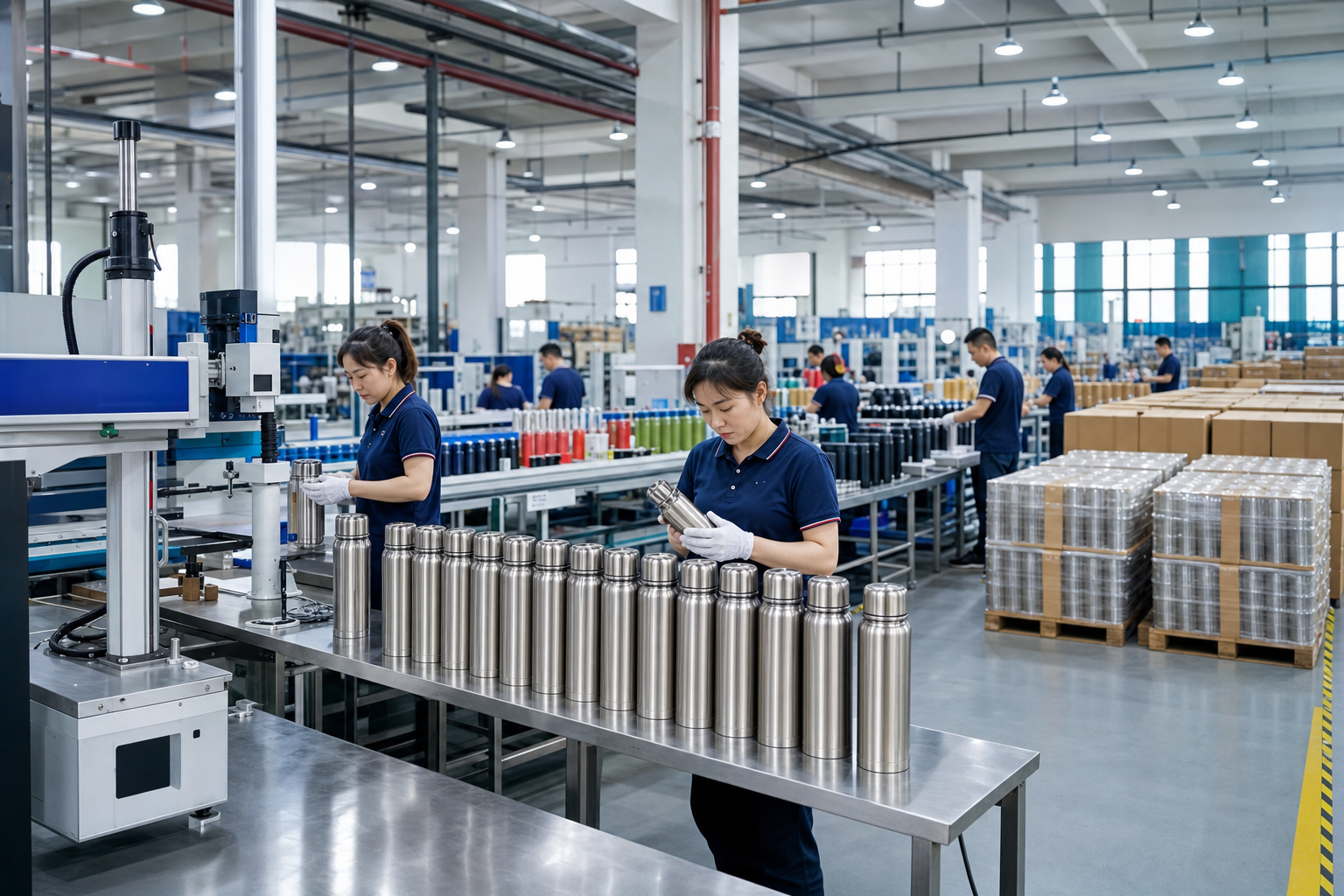
Most first-time buyers underestimate how much changes with the smallest choices: 304 vs 316 stainless steel, 0.4 mm vs 0.5 mm inner wall, powder coat thickness, lid tooling, and how your logo is applied. At our Hangzhou factory in Zhejiang, we run up to 300,000 units per month across stainless drinkware, with standard MOQ starting at 3,000 pcs and normal lead time at 25 to 35 days after sample approval. The line does not forgive loose specs. If the PO says one thing and the artwork file says another, the buyer will flag it and the whole schedule slips, so a private label thermos flask has to be specified like a commercial product, not a gift item.
What Private Label Really Means
People often use private label thermos to mean any bottle with a logo on it. That is too loose. In export sourcing, private label means you control branding, packaging, colorway, and sometimes the lid shape or surface finish, while the base structure comes from an existing factory platform. That is the practical way to launch a private label thermos bottle without spending USD 15,000 to 40,000 on full mold development.
The usual route is simple: choose an existing stainless thermos body, confirm capacity, insulation performance, and decoration method, then apply your brand through silk screen, laser engraving, UV print, or all-over powder coat. We run this on the line every week. If you need a private label thermos flask for outdoor retail, your buyer does not care about the sales pitch; they care whether it survives a 1.2 m drop, stays dry at the cap, and holds up after 50 dishwasher cycles. QC pulled the sample last Thursday, and the gloss on one 500 ml unit was off by 3%. In Zhejiang and across China, the factories that do this well are not the loudest ones. They hold the same color, same gloss, and same vacuum performance for 5,000 units without drift.
For a smart B2B buyer, private label should mean three things: predictable unit cost, controlled lead time, and repeatable quality. If a supplier cannot tell you the lid torque spec, drop-test result, and insulation curve, you are not buying a private label program. You are buying a gamble. We had a buyer flag a PO typo once—“silver” instead of “sliver” looked small, but it changed the artwork file and held the batch for 4 days. That is the wrong question to ask if someone says, “Can you do private label?” Ask what stays fixed, what changes, and how they prove it.
Pick the Right Thermos Structure
The bottle structure sets your margin, freight bill, and complaint rate. For a private label thermos bottle usa or private label thermos bottle uk order, we usually see three builds: single-wall with liner, double-wall vacuum, and vacuum with copper coating. For mainstream retail, double-wall vacuum is the workhorse. It holds heat, ships at a sane weight, and does not punish the carton line. A 500 ml bottle usually lands at 260 to 340 g, depending on 0.4 mm or 0.5 mm wall thickness, lid shape, and whether you add a PP carry handle. The wrong question is which structure sounds premium. The real question is whether your line can keep the vacuum stable after 10,000 units.
For temperature performance, skip vague claims like “keeps hot all day.” Ask for a test report with 95°C fill water, 20°C room temperature, then readings at 6 hours and 12 hours. QC pulled the sample on the bench, and we ship against that sheet, not the brochure line. A solid entry-level bottle can still stay above 60°C after 6 hours and around 45°C after 12 hours. If your channel is premium outdoor, a 316 stainless inner wall and a tighter vacuum spec can earn a higher shelf price in the private label thermos america or private label thermos germany market. We have seen this go sideways when a buyer approved copy first and checked thermal data later.
Capacity and use case matter
- 350 ml: commuter and kids’ use, lower freight cost, easier retail price under USD 20.
- 500 ml: the most flexible size for the private label thermos flask united states market.
- 750 ml: outdoor and sports channel, better for higher perceived value.
- 1,000 ml: campsite and travel, but heavier and more sensitive to lid quality.
If you sell into the private label thermos bottle united kingdom channel, 500 ml and 750 ml usually move better than oversized formats. In Germany and the Netherlands, buyers check carton marks, recycling notes, and label clarity before they care about a flashy body shape. We had one PO where the buyer flagged a simple typo on the outer carton, and the whole booking stalled for 3 days. Keep the engineering honest first, then decorate.
Materials, Steel Grade, and Coating
Stainless steel choice affects both performance and compliance. 304 stainless steel is the standard body material, and it handles water, tea, and coffee without drama. If your buyer wants a premium private label thermos bottle america or private label thermos bottle germany program, 316 stainless steel is the cleaner upsell because it holds up better against salt, sports drinks, and repeated washing. On our line, QC pulled a 304 sample after a 48-hour salt spray run, and the finish still passed. That is the kind of result that matters.
The important detail is not just the steel grade; it is the wall thickness and forming quality. Typical outer wall thickness is 0.4 to 0.6 mm, while the inner liner often sits at 0.35 to 0.5 mm. Go too thin and you get denting, weak vacuum stability, and a cheap feel. Go too thick and cost climbs, shipping weight jumps, and the carton count hurts you. We had a buyer flag a PO calling for 0.3 mm outer wall. The math does not work. This is the wrong question to ask if you want a serious private label thermos bottle us SKU or a private label thermos bottle britain line.
Surface finish is another place where buyers burn margin. Powder coating gives grip and scratch resistance, but if the coating is too thick or the cure is off, it chips around the neck and base. A sensible powder coat is usually 60 to 90 microns. Matte is safer for retail; high gloss looks premium but shows fingerprints fast. We run a cross-hatch test on the line before packing, and the buyer flagged one batch where the neck edge was already flaking after a 1 m drop. For laser engraving, the finish needs enough contrast after marking. For silk screen, ask for adhesion testing and at least 100-cycle rub resistance.
Do not choose material by price alone. A bottle that saves USD 0.18 in steel but fails a drop test costs you far more in returns.
Branding, Logo, and Packaging Decisions
Branding sets how a private label bottle looks on shelf, and it changes unit cost too. A one-color silk screen logo usually adds USD 0.08 to 0.18 per piece at scale. Laser engraving sits around USD 0.12 to 0.25, depending on coverage and cycle time on the rotary fixture. Full-color UV or wrap print costs more, and we only recommend it when the buyer has a clear retail angle.
For a private label thermos flask usa or private label thermos flask us launch, buyers usually want a plain bottle body, one logo position, and a retail carton that can take Amazon handling. That is the right instinct. The wrong question is how much decoration looks premium. On the line, every extra print pass means another jig setup, another QC check, and another chance for dust or a shifted logo at 1.5 mm off-center.
Packaging matters more than many importers expect. If you are selling through retail chains in the private label thermos united states or private label thermos united kingdom market, the carton needs barcode space, care copy, and country-of-origin text. For online channels, a drop-tested mailer cuts damage claims by 15% to 30% versus a thin folding box. We have seen that go sideways when the buyer flagged crushed corners after a 500 kg pallet test. If you need FNSKU labels for Amazon, confirm whether the factory applies them or whether your 3PL handles it after receipt.
Ask for a packaging mockup before mass production. A carton proof with the wrong importer address is a 20-minute fix. A run of 20,000 boxes is not. We once caught a PO typo on the sample stage and saved a reprint, which is exactly why we push for proof approval before the first carton comes off the line.
Compliance for US, UK, and EU
Compliance is where the first cartons get held. We have seen a 3-day delay turn into 18 days because the buyer flagged a missing food-contact file on the PO. For the private label thermos bottle usa and private label thermos bottle united states market, buyers usually ask for FDA-aligned material declarations on the bottle, lid, gasket, and sometimes the silicone base. In the UK, the paper trail is similar, but the route can differ by importer. Germany and the EU are stricter on REACH and LFGB, and a retailer will often ask for test reports before they even approve artwork.
Ask for the files before deposit payment. Material spec sheet. Food-contact declaration. REACH test if the coating or plastic part needs it. LFGB where applicable. Packaging compliance statement. If you are importing into the private label thermos germany or private label thermos deutschland market, recycled-content claims and packaging-waste registration can land on the buyer’s desk too. We had one PO where “thermos” was typed as “thermoes”; silly typo, same headache. Do not accept “it is fine, we ship there all the time.” Ask for dated reports. No dates, no deal.
On production control, put AQL terms in the PO. A common setup is AQL 2.5 for major defects, 4.0 for minor defects, with a pre-shipment inspection at the factory in China or at the forwarder’s warehouse in Zhejiang. QC pulled the sample on one lot and found a lid torque issue at 0.8 N·m instead of 1.2 N·m, which would have turned into leaks in transit. That is not overkill. It is basic export math, and the line only stays honest when the paperwork matches the cartons.
- Food contact declaration for the bottle and lid
- REACH or equivalent chemical compliance for coatings and plastics
- Leak test and thermal retention report
- Carton drop test if you ship DTC or Amazon
Pricing, MOQ, and Margin Math
Buyers ask for the number first, and they should. A solid private label thermos bottle in 500 ml, with a 304 stainless body, basic powder coat, one-color logo, and a standard carton, usually sits at USD 3.20 to 5.80 FOB China at 3,000 pcs. Move to 316 stainless, a better lid insert, or retail-ready packaging, and USD 5.80 to 8.50 FOB is normal. We run this math on the line every week; the price has to cover steel, coating, QC, and export packing, or the quote is dead on arrival.
MOQ changes with the spec, and this is where some buyers push back too hard. Standard private label starts at 3,000 pcs. Add PMS color matching and we usually jump to 5,000 pcs. Ask for a special lid or a new bottle shape, and you are looking at 8,000 to 20,000 pcs plus a tooling charge from USD 2,000 upward. In our Hangzhou plant, the line normally ships in 25 to 35 days after sample sign-off, then we add 7 to 10 days in peak season. QC pulled the sample once and caught a 0.8 mm cap gap; that kind of miss is why we do not promise a faster schedule than the mold and line can hold.
Do the margin math before you approve artwork. If your landed cost into the US is USD 6.20 and you sell wholesale at USD 12.50, you still have room for freight swings, duty, and a few bad cartons. If landed cost is already USD 8.40, the math does not work in a mass channel. That is why the difference between a private label thermos britain entry SKU and a private label thermos bottle america premium SKU should be set by the target margin, not by a PO typo or a rushed logo proof.
Good sourcing is not chasing the lowest quote. It is picking a spec that keeps gross margin stable across 2,000 to 20,000 units. We have seen this go sideways when a buyer saved USD 0.18 per unit and lost it all in rework on the first carton.
How to Vet a China Supplier
Not every factory that says it makes a private label thermos bottle can ship export-grade product. Look at the line, not the sales pitch. Ask how many vacuum lines they run, their monthly output in units, how they check leakage, and whether coating is in-house or handed to a subcontractor. A real Zhejiang factory should show QC checkpoints from incoming steel to final packing, with a 0.02 mm weld check or similar record, not just a brochure.
Request photos or video of the line, but do not stop there. Ask for a sample from the same mold and the same coating batch used on the run. Check lid fit, odor, weld marks, and the bottom seam. We have seen a 1 mm gap on the cap turn into a buyer complaint after 3,000 pieces landed. If you are sourcing a private label thermos bottle uk or private label thermos flask united states range, confirm carton compression strength and pallet pattern too, especially when the cartons get handed off 2 or 3 times.
What a good supplier should answer without hesitation:
- What is your MOQ for standard logo work?
- What is your lead time after sample approval?
- Which parts are made in-house and which are outsourced?
- What is your normal defect rate before AQL sorting?
- Can you provide test reports for 304 or 316 stainless steel?
If the answers are vague, keep looking. This is the wrong question to ask a trading desk and expect a factory answer. In China, the gap between a trading company and a real plant shows up fast when you ask about tolerance, packing, and rework. QC pulled the sample, the buyer flagged it, and the math did not work. That matters more than polished brochures.
Get a factory quote with your exact spec
Send your target capacity, logo method, and market. We will reply with MOQ, FOB price, and lead time for China production.
Frequently asked questions
What is the MOQ for a private label thermos bottle?
For a standard private label thermos bottle, MOQ is usually 3,000 pcs for one logo and one color. If you want PMS color matching, custom packaging, or a special lid, MOQ often rises to 5,000 pcs or more. New tooling can push it to 8,000 to 20,000 pcs. At our Zhejiang factory, standard lead time is 25 to 35 days after sample approval, but peak season adds about 7 to 10 days. If a supplier offers 300 pcs with full customization, ask how they are handling steel, printing, and carton costs, because the economics are usually weak.
Should I choose 304 or 316 stainless steel?
For most private label thermos flask programs, 304 stainless is the sensible default. It gives you good corrosion resistance at a lower cost. Choose 316 if your market is premium, if the bottle may hold acidic drinks, or if you want a stronger selling point in the US, UK, or Germany. In price terms, 316 can add roughly USD 0.25 to 0.80 per unit depending on capacity and market steel costs. The real difference is not marketing language; it is long-term resistance to corrosion and a better premium story at retail.
What compliance documents do I need for the US and EU?
For the US, ask for food-contact material declarations and any supporting migration or safety test reports your retailer requires. For the EU and Germany, REACH is common, and LFGB may be requested by retailers or distributors. For the UK, similar food-contact expectations apply, but the paperwork route may differ. You should also request the coating spec, lid material declaration, and carton labeling proof. For all markets, insist on AQL terms and a pre-shipment inspection. If you sell on Amazon, also confirm FNSKU labeling and carton barcode placement before production starts.
How much does a private label thermos bottle cost FOB China?
A realistic FOB China price for a private label thermos bottle in 500 ml size is about USD 3.20 to 5.80 at 3,000 pcs for standard 304 stainless, basic powder coat, and a one-color logo. If you upgrade to 316 stainless, premium lid hardware, or gift packaging, expect USD 5.80 to 8.50 FOB. Freight, duty, inland trucking, and carton damage can add another USD 0.80 to 2.50 per unit depending on your destination. If a quote looks dramatically lower, check whether the supplier removed the vacuum test, coating thickness, or packaging quality.
How do I reduce defects in my first order?
Start with a signed golden sample and a written spec sheet that covers steel grade, wall thickness, coating thickness, logo position, and carton size. Use AQL 2.5 for major defects and 4.0 for minor defects. Ask for leak tests, drop tests, and thermal retention data from the same production batch. For a first shipment, I recommend a pre-shipment inspection at the factory in Zhejiang or at the export warehouse in China. If you are selling in the private label thermos america or private label thermos germany channel, build one extra week into the schedule so you can correct any packing issue before the container closes.