Key Takeaways
- A 304 stainless inner wall with 0.4-0.5 mm thickness is the usual baseline for a private label vacuum bottle that needs durability and cost control.
- Plan on 3,000 pcs MOQ and 25-35 days lead time from a serious Zhejiang factory, with faster repeats after the first order.
- Laser engraving, screen print, and powder coat each affect abrasion resistance, unit cost, and the final shelf look in different ways.
- For US, UK, and EU sales, ask for REACH, food-contact declarations, ISO 9001 process control, and AQL 2.5 inspection terms.
A private label vacuum bottle can look plain on a shelf. The sourcing work behind it is not plain at all. Wall thickness, lid sealing, coating, and vacuum retention decide how it sells and how often it comes back. We have seen 0.4 mm and 0.5 mm wall specs end up in the same buyer meeting, and the wrong one always shows up in QC. If you are building an outdoor line or a retail private label range, you need a bottle that hits the target cost, survives drop tests, and clears the rules in the market where you sell.
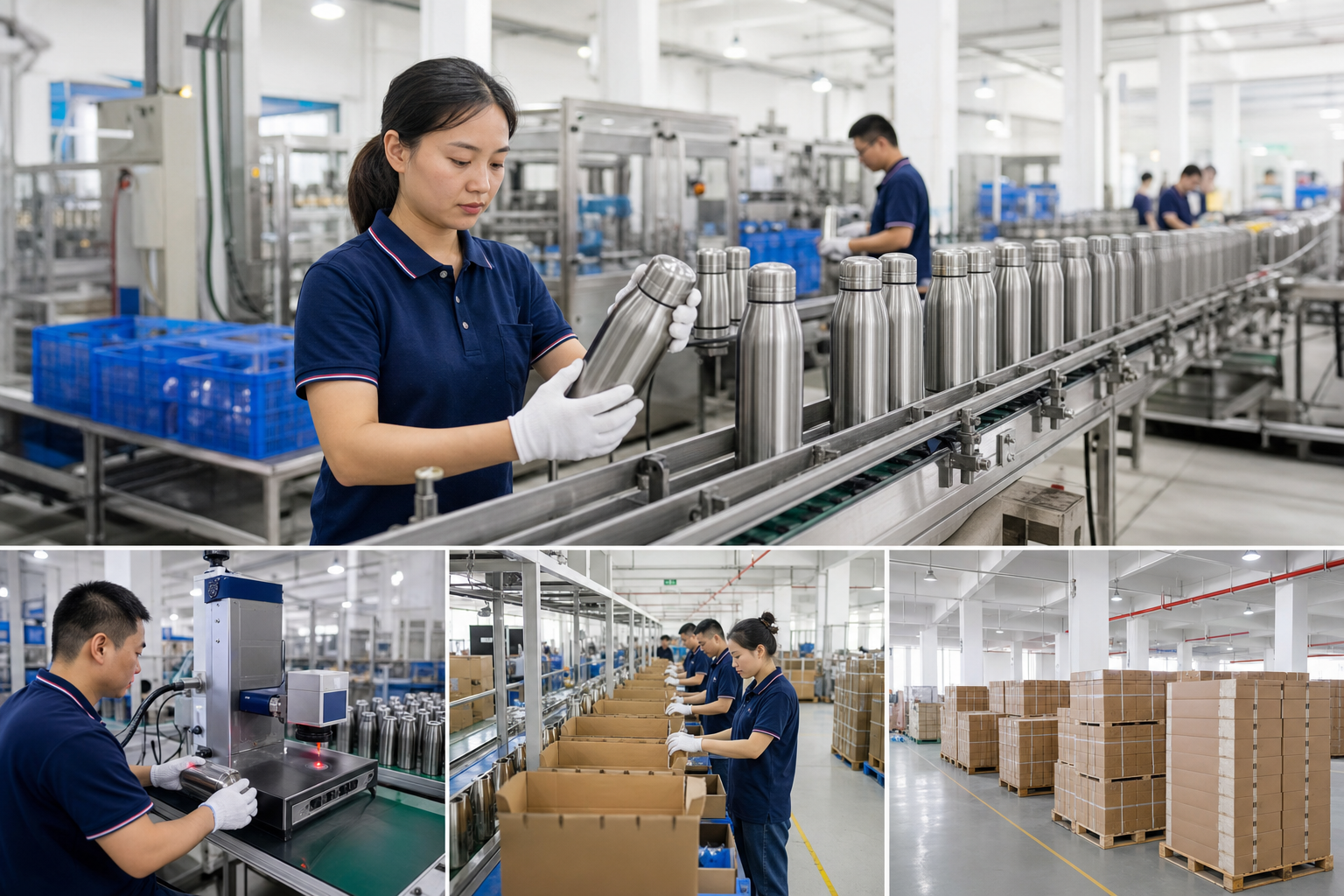
In Zhejiang, a solid thermos factory can run 300,000 units/month, start at 3,000 pcs MOQ, and ship in 25-35 days after sample approval. The hard part is not finding a supplier. It is choosing the right bottle structure, decoration method, and test plan so your private label vacuum flask does not turn into a margin headache later. We once caught a PO typo on a 500ml order where the buyer wrote 50ml, and that sort of thing can waste a week fast.
Start With the Bottle Structure
The first decision is the stainless structure, not the logo. For a private label vacuum bottle, we usually start with a 304 inner wall for general retail, then move to 316 when the buyer wants better corrosion resistance for acidic drinks or a more premium claim. The outer wall is usually 304 too. That keeps forming stable on the line and keeps cost under control. If the wall is too thin, the bottle feels flimsy and dents after a few shipments. If it is too thick, the landed cost rises for no real shelf benefit.
For outdoor and general retail programs, 0.4-0.5 mm is the range we run most often. One buyer pushed for 0.3 mm to hit a target price; the sample came back with a dent after a 1 m drop, so that plan died fast. Ask for measured thermal retention, not brochure copy. We want test data with a defined fill ratio and ambient condition, such as 12 hours hot and 24 hours cold. That matters whether you are buying a private label vacuum insulated bottle usa SKU or a private label vacuum bottle united kingdom line. The search term changes. The bottle spec does not.
- 304 inner: standard choice for value and durability.
- 316 inner: better for acidic drinks and premium positioning.
- 0.4-0.5 mm: a sensible wall-thickness target for retail use.
If the supplier cannot explain weld seam control, vacuum pumping method, and lid gasket material, keep looking. QC pulled the sample on a 2.5 mm seam offset once, and that kind of miss turns into leaks after the first hot-fill run. This is the wrong question to ask if someone only talks about the print on the bottle.
Choose Decoration That Lasts
Decoration is where a lot of private label vacuum flask programs go sideways after the first season. We have seen a logo look sharp on day one, then lose edges after three dishwasher cycles or a week in a commuter bag. The method has to fit the channel. For premium outdoor retail, laser engraving gives the cleanest wear profile. For bold branding and lower unit cost, silkscreen or pad print works only if the ink passes abrasion testing on the line. Powder coating gives stronger shelf impact and a better hand feel, but if the cure is off by even 10 to 15 seconds, the rim and base start chipping.
Finish is not just cosmetic. Matte powder, brushed stainless, and soft-touch paint change grip, fingerprint marks, and the way the bottle reads in hand. On a 650 ml sample, QC pulled the brushed version first because it hid scuffs better under warehouse lights. If you are selling in the private label vacuum bottle usa or private label vacuum bottle germany market, the buyer will compare shelf presence and carton quality in the first three seconds. This is where clean finishing earns margin. The wrong question is "does it look nice?" The real question is "will it still look saleable after 12 days in transit and a few hundred picks?"
Ask for an abrasion test, not just a photo. If the logo drops out after 50 rub cycles on the Martindale tester, it is not retail ready.
For most programs, I run laser on premium SKUs and screen print on volume SKUs, then match the carton art so the line stays coherent across sizes. We shipped one 5,000-piece run where the bottle was right but the box used the wrong silver Pantone; the buyer flagged it before inbound. Small mismatch, big headache. If the MOQ is 3,000 pcs, I would rather standardize the decoration early than fix a mixed batch later.
Test For Compliance Early
Compliance is cheaper before production than after shipment. We learned that on a 5,000-piece run when the buyer flagged a missing food-contact statement on the PO, and the reprint cost more than the cartons. For Europe and North America, your private label vacuum bottle needs food-contact declarations, REACH screening for restricted substances, and an ISO 9001-style trail that follows incoming steel, vacuum sealing, and final packing. If you sell into the private label vacuum insulated bottle united states market, ask for supporting paperwork that matches FDA expectations for food-contact materials. In the UK and Germany, buyers usually want the same base file plus traceability on inks, coatings, and silicone parts.
Use inspection language buyers can read without guessing. AQL 2.5 for major defects and 4.0 for minor defects is a normal commercial standard, but put it in the PO, not in a WeChat message. Same for leak testing, thermal retention, and carton drop tests. If a supplier says they can pass, ask for the fill volume, ambient temperature, and test time. We run this every week on the line with a pressure tester and a 1,000 ml sample, because vague claims turn into disputes after shipment. Good factories in Zhejiang, China, keep this file ready.
- REACH: important for the EU channel and private label programs in Germany and France.
- AQL 2.5 / 4.0: clear inspection terms for production.
- ISO 9001: useful proof of controlled processes.
When a factory is vague here, the risk shows up later as returns. That is the wrong place to discover a silicone smell or a coating issue.
Price the Program Correctly
Unit price only makes sense when you split it into bottle cost, decoration, packaging, and freight. A 500 ml 304 stainless private label vacuum bottle with a single-color print usually sits around USD 2.80-4.20 FOB Ningbo at 3,000 pcs, depending on lid structure and carton spec. If you add laser engraving, a matte powder coat, or an insert card, the price can rise by USD 0.35-1.20 per unit without touching the base bottle. Sounds small. On a 20,000 pcs order, it is not small.
The MOQ talk should be blunt. Buyers often push for a lower number than the line can run cleanly. For a custom SKU in China, 3,000 pcs is normal when the lid, finish, or packaging is not a stock setup. We had one buyer flag a PO that said “3,0000 pcs” by mistake; QC pulled the sample anyway and the math still did not work. Once you repeat the order, pricing usually improves or replenishment gets faster because the tooling is already stable. For private label vacuum bottle america programs, landed cost must include tariff exposure, inland freight, and carton cube, not just ex-works price.
Do not chase the cheapest quote. A bottle that saves USD 0.18 but fails a leak test costs more than the higher quote that ships cleanly. We run the line, and we have seen that go sideways fast.
Build Retail-Ready Packaging
Packaging is part of the product. If you sell into Amazon, clubs, or gift retail, the box has to protect the bottle, carry barcodes cleanly, and survive handling without crushing the lid. For a private label vacuum bottle us program, we ask for the outer carton size first: FNSKU label area, case pack count, and pallet pattern need to be set before artwork goes to print. We once caught a 3 mm carton error on the line, and it cut one full row off the pallet.
Single retail boxes should follow the real bottle height and the foam or pulp insert, not the size the printer wants to run. A 5-ply master carton is the safer base for export; 3-ply gets soft fast in humid warehousing. If the bottle has a painted finish, add a sleeve or bag so the coating does not rub in transit. For the private label vacuum bottle uk channel, buyers often push back on cost, then ask for a cleaner unboxing after the sample lands. That is the wrong question to ask after print approval. We ship more smoothly when the structure is locked early and the color proof matches the PO.
- FNSKU: plan label placement before mass production.
- 5-ply master carton: better for export handling.
- Insert fit: protects the finish and reduces returns.
Good packaging cuts damage claims. That is straight margin.
Qualify the Factory Properly
Factory qualification is where sourcing gets real. In China, a stainless thermos supplier can be a true maker, or just a trader with a glossy sample room. Ask who owns the forming line, the vacuum pumping machine, the powder coating booth, and the final QC bench. We once checked a plant in Zhejiang running 300,000 units/month; the buyer flagged a PO typo on the carton count, and that saved a messy shipment.
If your retailer needs social compliance, ask for BSCI and match it against real records from the line. Wall certificates are cheap. A factory that knows its job will quote 7 days for samples, 25-35 days for production, and tell you straight when a lid change adds 5-7 days or a new coating raises the reject rate. If they dodge that question, the math doesn't work. QC pulled the sample, checked the cap thread at 1.2 mm, and found the difference in five minutes.
For private label vacuum bottle united states, private label vacuum bottle britain, or private label vacuum bottle deutschland searches, the target is the same: a Zhejiang factory or broader China supplier that repeats the same quality batch after batch. A pretty sample does not pay your reorder margin. Repeatability does. We've seen this go sideways when a buyer chose the lowest quote and got three shades of black on the second order.
Build Your Private Label Thermos Line
Send your target size, finish, and market. We will quote the right bottle, test plan, and packaging for China export.
Frequently asked questions
What steel grade should I choose for a private label vacuum bottle?
For most retail and outdoor programs, a 304 stainless inner wall is the standard choice because it balances corrosion resistance, cost, and availability. If you expect acidic beverages, premium positioning, or longer customer use cycles, move to 316 for better resistance. In practice, the wall thickness should sit around 0.4-0.5 mm for a private label vacuum bottle that needs to survive drop tests and daily carry. Ask the factory to show you the material certificate, not just a sample photo. For Europe, keep REACH and food-contact paperwork ready. For the US, ask how the coating, ink, and silicone parts are documented.
What MOQ should I expect for private label vacuum insulated bottles?
A realistic MOQ for a custom private label vacuum insulated bottle is often 3,000 pcs per SKU when you want your own color, logo, or carton. If you only change the print and keep the body and lid stock, some factories may go lower, but the unit price usually rises. In Zhejiang, China, a factory with real production lines can often deliver the first order in 25-35 days after sample approval. For a private label vacuum bottle usa or private label vacuum bottle uk launch, build your forecast around carton quantity, freight cube, and replacement stock, not just the minimum order number.
Which logo method lasts longest on a private label vacuum flask?
Laser engraving is usually the most durable option on a private label vacuum flask because the mark is cut into or through the finish instead of sitting on top of it. If you want stronger color branding, silkscreen can work, but it needs a tested ink system and abrasion checks. Powder coating gives you the best look for many outdoor SKUs, yet it must be cured correctly or it will chip at the base and rim. Ask the supplier for a rub test, a dishwash or wipe test, and a sample that matches the actual production coating. A logo that survives 50-100 abrasion cycles is much more useful than one that only looks good on the first day.
What documents do I need for Europe, the UK, and the US?
At minimum, ask for a food-contact declaration, REACH screening, and an inspection report tied to your PO. If you are buying for the private label vacuum bottle germany or private label vacuum bottle united kingdom market, buyers often want clearer traceability on inks, coatings, and silicone parts. For the US, the buyer or importer may also ask for documentation aligned with FDA expectations for food-contact materials. Use AQL terms in writing, typically AQL 2.5 for major defects and 4.0 for minors. If the factory says it is compliant, ask them to show the exact test standard, the date, and the batch reference.
How do I reduce breakage and returns in retail or Amazon?
Start with carton design and inner protection. A 5-ply master carton, a fitted insert, and a sleeve or bag around the painted body reduce scuffs and dent claims fast. For Amazon FBA, set up the FNSKU label position before mass production so the barcode is not hidden by a seam or curve. Test the bottle in a drop scenario with the actual lid and packaging, not a stripped sample. For a private label vacuum bottle america or private label vacuum bottle us program, the cheapest return prevention is usually a better insert and a better case pack, not a cheaper lid.