Key Takeaways
- A fast drinkware production timeline China often fits into 35 days when artwork, specs, and deposit are approved within 72 hours.
- Sample approval usually takes 5-10 days; delaying it by 3 days can push mass production and booking by a full week.
- For standard stainless steel tumblers, mass production commonly takes 18-22 days after sample sign-off, depending on finish and print complexity.
- Container loading and final inspection should be planned 2-4 days before ETD, with AQL 2.5 for critical defects and 4.0 for minor issues.
If you are buying from China for the first time, price is not the main trap. Timing is. A quote can look tidy on paper, but the order is still dead until the artwork is signed, the sample is approved, the deposit lands, and the line starts cutting steel, printing logos, and packing cartons. We see this every week in Zhejiang. Miss one handoff, and the sales window slips.
For a standard 5,000-10,000 unit drinkware order from a capable Hangzhou factory, 35 days is usually enough to reach shipment prep if the buyer answers fast. One slow reply adds 2-3 days. A messy spec sheet adds more. We ran a 7-day delay last month because the buyer’s PO said “matte red” and the Pantone code was missing; QC pulled the sample, the buyer flagged it, and the schedule moved. I’ll walk you through the drinkware production timeline China buyers actually face, using the milestones we see every week at BottleForge Industrial, where monthly output runs above 500,000 units and normal MOQ starts at 3,000 pcs per SKU.
Day 1-3: Quote and spec lock
The first 3 days decide whether the order moves fast or turns into a back-and-forth mess. A serious Zhejiang factory does not quote off a vague email. We need capacity, material, finish, lid type, carton spec, and target market requirements up front. If you want a 500 ml stainless tumbler with a matte powder coat, laser logo, and retail carton, say that. If you need LFGB, FDA, or REACH-related material support for Europe or North America, put it on the first mail, not after payment. On our side, QC pulled the sample against the PO before we even start pricing, and that catches bad assumptions early.
A usable quote should show unit price by quantity tier, tooling or logo setup fees, packing cost, lead time, and shipping terms such as FOB Ningbo or FOB Shanghai. For a standard 500 ml tumbler, you may see a factory price around USD 2.10-3.40 at 3,000 pcs, depending on wall thickness, lid quality, and print method. The factory should also confirm MOQ, usually 3,000 pcs per design for mainstream stainless drinkware and 500-1,000 pcs for some existing molds or stock bodies. If the buyer pushes for 1,000 pcs with a new lid and custom carton, the math does not work. We see that one a lot.
Do not treat the quote as the end of the process. It is the start of the spec lock. If you change the cap style on day 4, you are not making a small edit; you are resetting part of the timeline. One typo on the PO, like “matte black” when the buyer meant “matte navy,” can stop the line for a day. In Zhejiang, where we run multiple lines, clean instructions save more time than hard bargaining.
Day 4-7: Artwork and sample request
Once you lock the commercial terms, we move the line to sample prep. First-time importers usually lose days here because they send half the details. We need AI or PDF artwork, Pantone codes, logo position, and a proper dimension drawing. If you do not have that, we draft a working spec sheet and send it back for sign-off. That adds one revision cycle, sometimes two if the buyer flagged a typo on the PO.
For logo work, pick the method before the sample is approved. Silkscreen, heat transfer, laser engraving, or embossing each changes the result on the cup. A one-color silkscreen sample can be ready in 2-3 days. Laser engraving needs less setup, but it gives a different finish and does not suit every brand, especially when color matters. We have seen this go sideways when the buyer tried to switch after QC pulled the sample.
By day 7, a solid supplier in China should send pre-production sample photos or a tracking number for the physical sample. On a custom tumbler, sample fees often run USD 30-80, and express shipping to the US or EU usually adds another USD 25-60 depending on the courier. That is cheap insurance next to reworking 5,000 units later. The math does not work any other way.
- Confirm capacity: 350 ml, 500 ml, or 750 ml
- Confirm finish: powder coat, painted gloss, or brushed steel
- Confirm lid: screw lid, flip lid, straw lid
- Confirm carton: 1 pc gift box or bulk pack
Day 8-12: Sample approval window
This step decides the rest of the production plan buyers care about in China. The sample is not a box-ticking exercise. It is the control piece for color, print position, thread fit, sealing, and hand feel. We have seen a buyer sign off on a lid that sat 0.8 mm loose, then ask why the line repeated the same fit in mass production. The answer is simple: QC pulled the sample, the standard was already set.
Most Zhejiang factories can turn a sample in 5-10 days after final artwork and payment lands. Your side needs to move at the same pace. Check logo sharpness, coating uniformity, smell, gasket fit, leak test results, and carton size. If you sell on Amazon, verify the outer carton has a clean FNSKU label area and the unit carton matches your fee model. A 2 mm diameter change can break carton fit and pallet loading. The math does not work.
Use one short approval note: approved as is, approved with one minor text change, or rejected with required corrections. Do not send a wall of comments with 12 small issues and 2 major ones mixed together. We ship faster when the buyer flags the real problem first. Clear approval saves days.
Practical rule: if the sample is still open on day 12, do not count on shipment on day 35. We have seen that go sideways. Unless you pull later steps forward, the schedule slips.
Day 13-18: Deposit, materials, and line booking
After sample approval, the order turns real. Standard orders usually need a 30% deposit; first-time buyers or custom packaging often go to 50%. We’ve had buyers push back on that. The math still doesn’t work without cash in the account. On a busy Zhejiang line, raw material buying, lid part allocation, and print-slot booking all wait for the transfer to clear. A wire sent on Friday afternoon may not show until Monday morning, and that delay can hold the whole job.
In this window, we book stainless steel, plastic lids, silicone rings, cartons, and any special inks or coatings. For a double-wall 18/8 stainless tumbler, body wall thickness usually sits at 0.4-0.5 mm. If the buyer wants a heavier hand feel, we move to 0.6 mm. That adds cost and slows forming a bit. QC pulled the sample once and caught a 0.08 mm drift on the wall gauge; that kind of miss changes dent resistance and insulation, not just appearance.
At BottleForge Industrial, orders above 10,000 units can go onto two production lines, but only if the schedule is fixed early. A late artwork file can push the slot back 3-5 days. We’ve seen this go sideways from a tiny PO typo on the carton mark. This is the wrong question to ask if you wait until the end of week two. The first 13-18 days decide whether we ship on time or spend the rest of the month chasing gaps in the plan.
Day 19-28: Mass production begins
Once materials land and the line is cleared, mass production starts. For a standard stainless drinkware order, the shop floor usually needs 8-12 days. The full production block runs 18-22 days because it covers forming, welding, polishing, coating, logo application, assembly, and in-process inspection. If the cup has 2 colors or mixed lids, add 2-4 days. We run this every week, and the schedule is tight.
QC does not wait for the last carton. That is the wrong question to ask. A factory that knows its job checks leak resistance, temperature retention claims where relevant, print adhesion, and drop test samples during the run. On one 500 ml tumbler order, QC pulled the sample after the third shift and found a 0.3 mm lid misfit. For export orders, we usually work to AQL 2.5 for critical and major defects, with clear limits on scratches, thread defects, and lid misfit. If you ship to North America or Europe, ask for compliance paperwork where applicable, such as REACH declarations or food-contact material support documents.
Here is what a sensible production rhythm looks like:
- Days 19-21: body forming and lid component prep
- Days 22-24: welding, polishing, and coating
- Days 25-26: logo printing or laser marking
- Days 27-28: assembly and first QC check
If the factory reports a defect spike early, ask for photos and a corrective action note. We had a buyer flag a PO typo once, and the spec sheet showed 304 stainless while the carton mark said 316. The math does not work if nobody catches that on day 20. A good supplier in Zhejiang will tell you what changed. A bad one hides it until final inspection, and then you are already burning days.
Day 29-32: Final inspection and packing
By day 29 to 32, the order should be near packed. This is where we see whether the factory’s “done” matches the buyer’s done. Final inspection covers appearance, dimensions, lid fit, leakage, label accuracy, carton strength, and count accuracy. For a first shipment, I’d push for third-party inspection if you are not on site. QC pulled a sample from the packing line at AQL 2.5, and that one carton often tells you enough.
Packing details decide the margin. Bulk-packed drinkware can save USD 0.08-0.20 per unit, while retail-ready gift boxes add USD 0.25-0.60 per set depending on inserts and printing. If you need Amazon-ready packing, the line has to place FNSKU stickers, carton marks, and master carton labels exactly as spec. We had a buyer flag one PO because the SKU had a one-digit typo on the label. That small mistake can hold up warehouse check-in even when the product itself is fine.
We also check carton drop risk, pallet stack height, and how the container loads. A 40HQ container usually takes around 20,000-30,000 standard tumblers, depending on size and packing. If the inner box gap is off by 3 mm, the math stops working fast. We’ve seen this go sideways when a buyer wanted “safer” packing but still expected full container use. Good container planning starts here, not at the port.
Day 33-35: Container loading and handoff
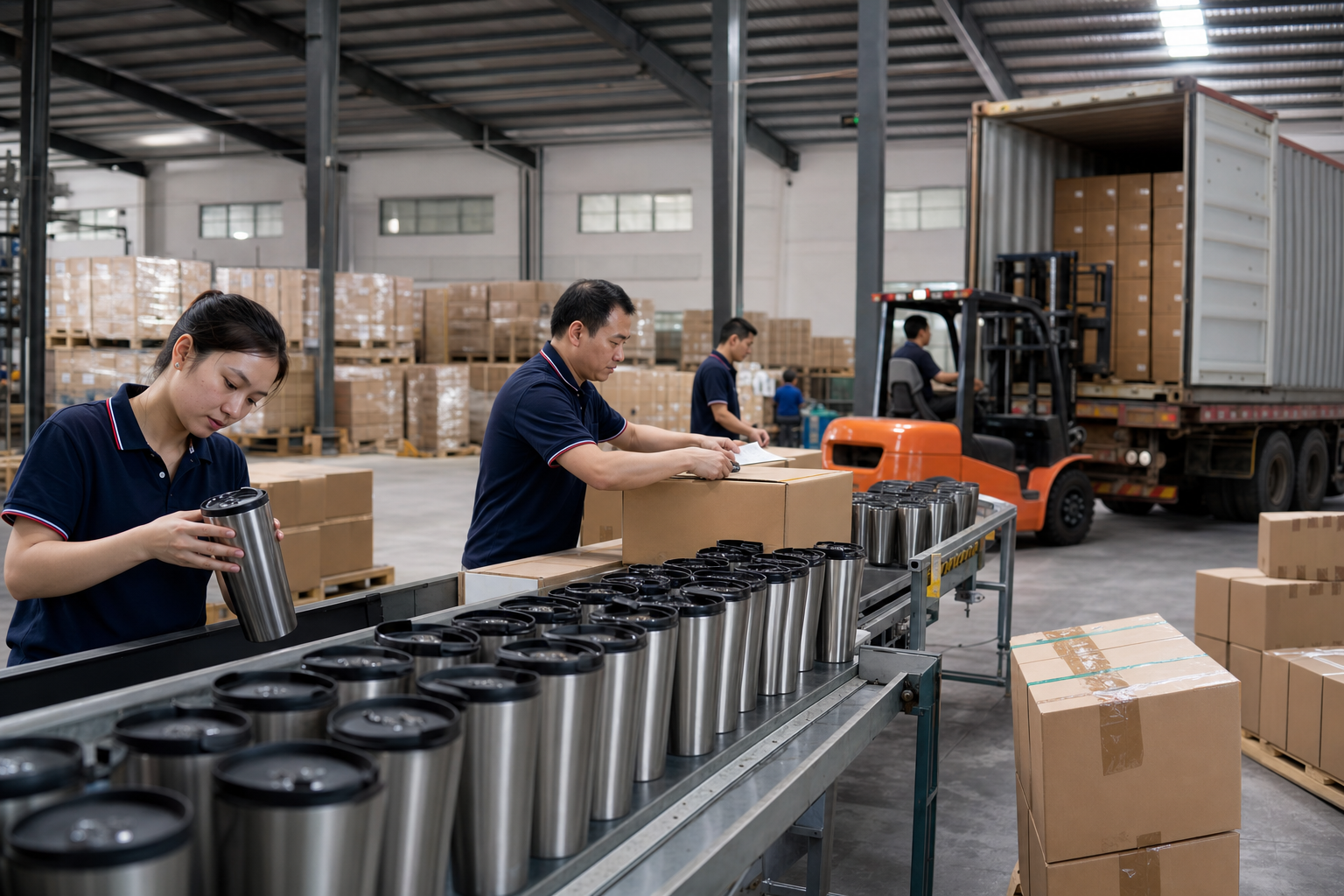
Container loading is the last visible step before the shipment leaves China. For FOB Ningbo or FOB Shanghai, we run the loading, seal the container, and pass the shipping docs to the forwarder. Before the truck arrives, confirm carton count, outer carton condition, pallet plan if there is one, and the seal number. On a clean day, one 40HQ takes 4-8 hours if the warehouse is staged and the forklift is free.
This is where the schedule stops being flexible. If your ETD is day 35, the commercial invoice, packing list, and product photos should already be with your customs broker. One carton mismatch is enough to slow the file. We have seen it go sideways over a PO typo on the carton count, and the math does not work if the documents say 1,200 pcs and the line counts 1,180. For a first order, lock the loading date only after final inspection passes, the balance payment clears, and the freight booking is confirmed.
In Zhejiang, the export team usually sends loading photos, seal photos, and a shipping mark summary before the truck pulls out. If you ask, they should also send stuffing photos that show how the cases were stacked inside the container. QC pulled the sample once and found a crushed outer carton at the rear door, 2 mm dent on the corner, so we reworked the pallet plan before sealing. That is standard practice for export suppliers here, and it cuts down on arguments later.
Get your drinkware order moving on time
Send your specs, target quantity, and market requirements. We’ll map the schedule, confirm MOQ, and keep your China timeline realistic.
Frequently asked questions
How fast can a standard drinkware order ship from China?
For a normal custom tumbler order of 3,000-10,000 pcs, a realistic timeline is 30-40 days from deposit to shipment readiness. If your artwork is final, sample approval happens in 5-10 days, and mass production runs 18-22 days, you can reach container loading around day 33-35. Add 2-5 extra days if you change the logo, packaging, or lid after approval. In Zhejiang, well-run factories may be faster, but only if you answer every approval request within 24 hours.
What slows the drinkware production timeline China factories give me?
The biggest delays are late sample approval, unclear artwork, and slow deposit payment. A 3-day delay in sample approval can push mass production by 5-7 days because line booking and material purchasing stop until you sign off. Another common issue is changing packaging after the sample is approved. For example, switching from bulk pack to printed gift box can add 2-4 days and increase the unit cost by USD 0.25-0.60. Slow freight booking can also create a gap even when production is finished.
What should I check before approving the sample?
Check dimensions, lid fit, leak resistance, logo placement, print sharpness, coating color, odor, and carton fit. If you sell in Europe or North America, ask for food-contact compliance documents such as REACH support, and keep the approved sample as your reference standard. For a 500 ml stainless tumbler, even a 1-2 mm difference in mouth diameter can affect lid sealing and carton fit. Take photos, mark the approval date, and state exactly what is approved so there is no confusion later.
What MOQ should I expect for first-time drinkware sourcing?
For custom stainless drinkware from China, 3,000 pcs per design is a common MOQ, though some factories will accept 1,000-2,000 pcs if the body mold already exists or if you choose stock colors. Printed packaging often has its own MOQ, usually 1,000-3,000 boxes depending on paper stock and print method. If you want mixed colors, expect each color to count separately unless the factory can run a shared production batch. In Zhejiang, larger orders usually get better pricing and more flexible scheduling.
How do I know if the factory is ready for container loading?
Ask for three things: final inspection pass, balance payment confirmation, and loading schedule with seal number. A proper export team will also send carton count, pallet plan if used, and photos of the packed goods before the truck departs. For a 40HQ, standard drinkware loading usually takes 4-8 hours if the cartons are ready and the warehouse is organized. If the factory cannot show you the exact carton count or the finished goods photos, do not assume the shipment is safe to hand over.