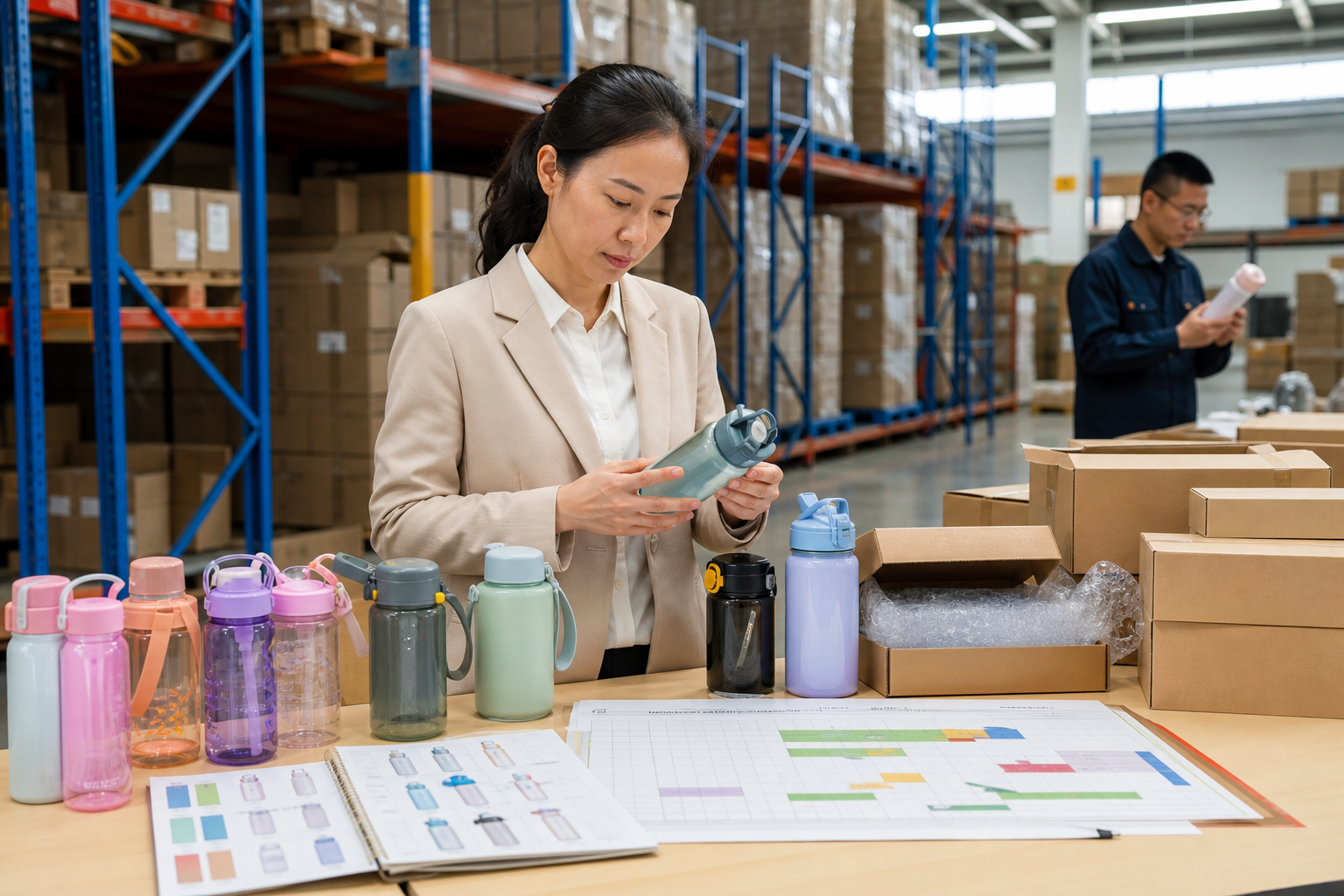
Key Takeaways
- Custom school water bottle orders usually need 45-75 days from approval to delivery.
- Most school-branded kids bottle programs start with MOQ at 1,000-3,000 units per SKU.
- AQL 2.5 inspection is common for export orders; request it before production starts.
- For North America and Europe, allow 10-35 days extra for sea freight, customs, and inland delivery.
If you are buying a school water bottle for a district, timing matters more than most buyers want to admit. The bottle looks simple on paper. Once you add school logos, parent sign-off, compliance checks, and carton marks, a “quick order” turns into a late truck. We run 30,000 to 80,000 units a month in Zhejiang, but the real limit is your calendar, not the line.
Back-to-school sourcing works best when you count back from the first day of class, not from the day you send the RFQ. For a kids bottle program, 45 days works only for plain stock. Custom printing, color matching, and packaging usually push the plan to 60 to 75 days. We’ve had buyers flag a PO typo on the carton spec and lose 3 days before sample approval. If you want bottles on campus before summer break ends, build in sample review, PO sign-off, production, QC, and ocean or air freight from China.
Start With the school year date
The smartest back-to-school sourcing starts with the first delivery deadline, not the purchase order date. If the bottles must land before student orientation, count back from that day and leave room for school board approval, artwork sign-off, and factory loading. For a school water bottle program, we run a 90-day planning window even when the line can finish faster on paper.
Here is the practical calendar:
- 90-75 days out: define quantity, size, material, and branding method.
- 75-60 days out: confirm sample, quote, and compliance documents.
- 60-30 days out: production, in-line inspection, and carton coordination.
- 30-0 days out: freight booking, customs clearance, and delivery appointments.
District procurement teams often miss the approval chain. We had one buyer flag a school logo because the mascot moved 3 mm off center on the mockup, and legal still took 11 days to clear it. That is the wrong question to ask if you are only looking at the PO date. If you are sourcing from China, that delay can cost more than the factory lead time itself, and once QC pulled the sample for a second check, the slot was gone. In Zhejiang, a stable production schedule is normal, but a late artwork approval is not something any supplier can absorb without moving your slot.
Choose the right bottle spec
Not every school water bottle gets the same spec. A kindergarten program needs one setup; a middle school athletics rollout needs another. For younger students, a kids bottle with a 300-500 ml capacity, one-hand flip lid, and soft silicone straw is usually the safer call. For older grades, 650-750 ml works better because students need the volume during PE, club practice, and a full school day. We ran a 500 ml sample through a 1.2 m drop test on the line, and the pushback from the buyer was simple: too small for a 90-minute sports block.
Material choice matters. Tritan-style copolyester is popular for clear bottles because it is light, impact-resistant, and easy to inspect. Stainless steel is the better pick when insulation is part of the brief, but it adds cost and pushes lead time. A basic single-wall stainless bottle with 18/8 material and 0.4 mm thickness may land around USD 2.80-4.20 FOB China at 1,000 units, while a Tritan bottle can come in lower depending on lid complexity. QC pulled the sample on one order because the lid gasket measured 1.8 mm on the drawing but 1.5 mm on the pre-prod piece. If you need BPA-free declarations, REACH alignment, and food-contact documentation, ask before sample approval, not after production starts.
For district procurement, the wrong question is “Which bottle looks best?” Ask for wall thickness, lid gasket material, and drop-test expectations. A decent school bottle should survive basic carton drop handling and daily backpack use. If the bottle is for elementary students, prioritize easy cleaning over fancy insulation. We’ve seen this go sideways when a buyer chose a narrow-mouth design that looked neat in the catalog but failed a 3-second rinse test at the factory sink. You are buying something that gets washed, dropped, and reused hundreds of times, not a display item.
Build the branding schedule early
School branding is where a lot of programs lose time. Silkscreen, laser engraving, pad printing, and full-wrap heat transfer all need different setup work. A one-color logo on a white kids bottle is the fastest path, often 3-5 days for tooling setup after artwork approval. Multi-color logos or curved print positions need one more proof round, especially when the school seal has fine text or a gradient. We have seen a PO land with “blue” typed in the note and no Pantone code; that sort of typo burns a day on the line.
If you need a durable mark, laser engraving on stainless steel is the cleanest option, but it is not a fit for every school logo because color stays limited to the base metal. Silkscreen costs less and usually runs well for large batches, often under USD 0.10-0.25 per print location at volume. Do not approve branding from a PDF mockup alone. Ask for a digital proof with exact Pantone references, imprint size in millimeters, and logo placement measured from the base or handle. QC pulled the sample at 18 mm off-center once; the buyer flagged it immediately.
Good school branding is simple, repeatable, and legible at 1 meter. If the logo looks crowded on the proof, it will look worse on the bottle.
For district-wide programs, lock the branding spec before you request final pricing. A supplier in Zhejiang can quote much faster when the decoration method is fixed. If it is still open, the math does not work. You get one price on day one, then the art team opens the file and finds two inks, a wrap print, or a second-side mark. We run into this every August.
Use a sourcing calendar by month
The cleanest academic-year sourcing calendar looks dull. That is a plus. For a school water bottle program shipping in August or September, we run spec selection in January or February, sample approval in March, PO placement in April, then production and freight booking in May and June. That gives room for a remake if the lid leaks or the logo size is off by 2 mm, and it keeps you out of emergency air freight.
A practical calendar looks like this:
- January-February: set budget, age group, and bottle type; we usually lock capacity and lid style here.
- March: request samples and compliance files; QC pulled the sample on a 500 ml Tritan bottle before artwork even started.
- April: confirm artwork and issue PO; the buyer flagged a typo in the school name before we cut the first screen.
- May-June: production, inspection, and packing; AQL 2.5 checks usually happen on the line before cartons are sealed.
- July-August: ship, clear customs, and distribute to schools; this is where a 12-day delay can turn into 18 days if the port is slow.
For China sourcing, ocean freight to North America or Europe often adds 18-35 days door to door, depending on route and customs speed. If a district drops a late-June PO and still wants August delivery, the math does not work unless you pay for air freight or accept risk. That is fine for 500 units. It is a different story at 8,000. We can move fast in Zhejiang, but the truck to port and the vessel schedule are outside the factory gate.
Check compliance before purchase
District buyers should treat compliance as a gate, not a checkbox. Ask for food-contact declarations, REACH paperwork for Europe, and test reports against ASTM or FDA expectations for the U.S. market. On one school run, the buyer flagged a PO with “18/0” stainless on a spec sheet, but the samples were 304, so the paperwork and the line were out of sync from day one. If the bottle has stainless steel, verify the grade, usually 304 or 18/8, and ask for weld photos plus the internal coating spec if the design uses one. For plastic parts, confirm BPA-free status and repeated-wash performance.
Good suppliers in China should ship a document pack with product spec, commercial invoice details, packing list, and third-party test reports where needed. We run these checks before mass production, not after cartons are sealed. For school procurement, I’d ask for AQL 2.5 for major defects and AQL 4.0 for minor defects on export orders. That gives you a real QC line, not “factory checked.” QC pulled the sample once and found a 1.2 mm cap-thread mismatch; the math for a later claim was ugly.
Ask about carton strength and label format too. A school bottle sold in bulk often ships better at 24 or 36 units per master carton, with barcode, SKU, and destination label on two sides. We’ve seen this go sideways when a buyer wanted 48 units per carton to cut freight, and the drop test failed at 80 cm. If you plan to distribute by campus, carton labeling saves hours at receiving. Compliance and packing instructions are part of the product. Skip them, and you pay later.
Budget for MOQ and freight
MOQ is where district planning meets the line. A custom school water bottle with logo usually starts at 1,000 to 3,000 units per color or design. On our side, one extra mascot means one extra screen, one extra proof, and more setup. We had a buyer ask for 12 campuses, each with a different animal, and the math did not work at the same unit price. If the PO says “same bottle, different print” but the art files are all different, QC will spot the delay before production starts.
Typical FOB China pricing for a decent custom kids bottle can range from USD 1.20 to 3.80 depending on material, lid, print, and packaging. Freight is the next line item, and landed cost can jump 20% to 60% based on ship mode and route. Air freight can make sense for a rush under 1,000 units, but we have seen 18 days by sea versus 4 days by air turn a low unit price into the wrong deal. For bigger district orders, sea freight is the normal move. If your budget is fixed, keep the artwork clean and skip individual gift boxes unless the buyer has already signed off on them.
Procurement teams often compare only unit price. That is the wrong question to ask. We run the carton count, pallet size, customs broker fee, and destination label into the landed cost before we quote. A supplier that looks $0.18 cheaper can end up higher once the pack-out changes or the barcode needs a different size, and we have seen that go sideways on a PO typo with the wrong carton mark.
Inspect samples before mass production
Never approve a school water bottle from photos alone. We’ve had buyers flag a “good-looking” lid, then QC pulled the sample and found a 1.5 mm gap at the seal ring. A physical sample shows the real seal, the logo edge, and whether a 500 ml bottle fits small hands or a backpack side pocket. For school branding, ask for one pre-production sample in the final color, final print, and final packaging. If the order is above 5,000 units, ask for a golden sample signed off by both sides and kept as the QC reference on the line.
Check the sample against the specification list:
- Capacity tolerance within ±5%.
- Leak test after 24 hours upside down.
- Logo alignment within 1-2 mm.
- Cap operation with wet hands and gloves.
- Carton crush resistance for stacking.
Do not skip this step because the calendar feels tight. A 7-day sample review can save a 7,000-unit mistake, and that math works every time we’ve seen it. The buyer once sent a PO with the school name typed two letters off; if we had gone straight to mass production, the reprint alone would have cost more than the sample round. Before the line starts, fixing a cap issue or a print mismatch is still cheap. After production starts, the change hits packaging, print plates, and ship dates. If you are a district buyer, push for early approval and a clean spec sheet. Last-minute urgency is the wrong question to ask.
Plan your school bottle order before summer
Send your quantity, logo, and delivery month. We will map the timeline, confirm MOQ, and quote landed cost from Zhejiang without guesswork.
Frequently asked questions
When should a school district start sourcing water bottles for fall delivery?
For August or September delivery, start 90 days earlier if you need school branding, and 60 days earlier at the absolute minimum for plain stock. If you are ordering from China, add 18-35 days for sea freight and customs. A simple 3,000-unit kids bottle program can still fit inside a 75-day window, but only if artwork is approved fast and you avoid multiple logo revisions. For larger district programs, start in January or February for best pricing and factory slot selection.
What MOQ should I expect for a custom school water bottle?
Most factories in Zhejiang and other parts of China set custom MOQ at 1,000-3,000 units per SKU, color, or print setup. A one-color logo on a standard bottle may stay near the lower end, while multiple colors or special lids push MOQ higher. If you split the order across several campuses, ask whether the supplier can consolidate colors under one mold to reduce cost. At 1,000 units, unit pricing is usually much better than at 300 units, especially for decoration and packaging setup.
Which material is better for a kids bottle in schools?
For younger students, Tritan-style plastic is often the practical choice because it is lighter, easier to carry, and less likely to cause injury if dropped. For older students or staff gifts, stainless steel is more durable and can be insulated, but it usually costs more and weighs more. A basic 304 stainless school water bottle with 0.4 mm wall thickness is a common export spec. If you need clear visibility of the liquid level, plastic is better. If the school wants a premium feel, stainless makes sense.
What compliance documents should I ask for?
For U.S. and European school procurement, ask for food-contact declarations, REACH-related documentation for Europe, and any available ASTM or FDA-aligned test reports depending on the material. If the bottle is stainless steel, confirm the grade, usually 304 or 18/8, and request confirmation on BPA-free plastic components. You should also ask for carton details, HS code support, and a commercial invoice format that matches your import process. A supplier that ships regularly from China should know these requirements and provide them without drama.
How do I reduce risk of late delivery?
Freeze the artwork early, approve a physical sample, and book freight before production ends. For a school water bottle order, production may only take 25-35 days, but late approvals can add 10-14 days immediately. Build a 15% buffer into your schedule for inspection, rework, and port delays. If your delivery date is fixed and the order is under 1,000 units, ask whether air freight is possible. For larger runs, sea freight is cheaper, but you need a longer lead time and a clearer approval process.