Key Takeaways
- A realistic MOQ for stainless steel thermos bulk orders is usually 500 to 1,000 pieces per SKU, with custom lids often starting at 3,000 pieces.
- For most buyers, FOB pricing for a basic 500 ml unit from Zhejiang lands around USD 2.60 to 4.20, while premium private label builds move to USD 4.80 to 7.50.
- Ask for ISO 9001, BSCI, REACH, LFGB, FDA support, and AQL 2.5 inspection standards before you approve a stainless steel thermos factory.
- A disciplined factory in China can run about 80,000 units per month, with sample approval to shipment usually taking 25 to 35 days.
If you are buying a stainless steel thermos wholesale program, the hard part is not finding a catalog. The hard part is separating a real product from a look-alike spec sheet. Two bottles can share the same shape and still differ on steel grade, vacuum quality, lid seal, and coating durability. We have seen a 0.3 mm wall spec on paper turn into 0.25 mm on the line, and that is where your margin disappears, especially for Europe or North America.
From a Zhejiang stainless steel thermos manufacturer, you should expect direct answers on MOQ, lead time, and test data, not vague promises. China has capable factories, but only a few will tell you how they build, inspect, and pack each SKU. QC pulled the sample with a gauge, the buyer flagged a typo on the PO, and the real issue was still the same: the numbers have to match the cup and the carton. If you want a stainless steel thermos custom program that survives retail returns and wholesale reorders, start with the production details, not the artwork.
What Actually Drives Thermos Quality
Buying a stainless steel thermos is not about picking the prettiest bottle in a catalog. The real cost driver is the build stack: SUS304 or SUS316 steel, vacuum quality, lid geometry, and the seal. We tested two 500 ml samples that looked identical on paper; one held 78°C water after 8 hours, the other dropped fast once the line pulled the lid thread 0.3 mm off. For wholesale buyers, that gap turns into returns, complaints, and margin loss.
Ask for the exact material spec, not a generic stainless steel thermos label. A solid B2B spec starts with 18/8 food-grade stainless steel, a double-wall vacuum structure, and a lid that seals with silicone, not hard plastic alone. QC pulled the sample because the buyer flagged a faint oil smell on the first press-fit cap, and that kind of miss comes from sloppy parts, not marketing copy. If you sell into outdoor retail or premium gift channels, a cleaner powder coat and tighter lid thread tolerance matter as much as insulation hours.
- 304 steel is the default choice for most stainless steel thermos bulk programs.
- 316 steel is worth the premium when the bottle will see salty, acidic, or premium-use orders.
- 0.4-0.5 mm wall thickness is a practical range for most factory builds.
- 8-24 hours of heat retention is common, but only if the lid and vacuum are engineered properly.
When a stainless steel thermos manufacturer cannot explain these basics in detail, you are not looking at a strong production partner. You are looking at a catalog reseller. We have seen that go sideways on a 3,000-piece PO where the buyer wrote “304 inside” and the factory quoted mixed grades by mistake.
Wholesale Pricing and MOQ Math
Wholesale pricing in China comes down to steel grade, finish, lid tooling, packaging, and order volume. In Zhejiang, a basic stainless steel thermos bottle wholesale program often starts around USD 2.60 to 4.20 FOB for a simple powder-coated 500 ml unit at 1,000 pieces. Once you move to better insulation, a custom color, and a gift box, the price jumps into the USD 4.80 to 7.50 range fast. The wrong question is “what’s the cheapest price?” The right one is “what exactly is inside the quote?” We had a buyer flag a PO that said “gift box included,” but the box only covered brown export cartons, not retail packaging.
Most factories in China quote MOQ at 500 to 1,000 pieces per SKU for stock molds, and 3,000 pieces or more if you want a unique lid, handle, or special packaging. Our Zhejiang line runs about 80,000 units per month, so lead time usually lands at 25 to 35 days after sample approval. If a supplier promises 7 days on a custom order, the math doesn’t work; you are probably buying from inventory with weak spec control. QC pulled the sample last week and found a 1.2 mm gap on a lid ring, which is the kind of miss that turns into leakage claims later.
Use these pricing checks before you approve a purchase order:
- Confirm the quote is FOB Ningbo or FOB Shanghai, not an ambiguous door price.
- Ask whether the price includes logo setup, cartons, and inner boxes.
- Check if the sample fee is refundable against the bulk order.
- Request tiered pricing at 1,000 / 3,000 / 5,000 pieces so you can model landed cost.
A good stainless steel thermos supplier gives you a cost stack, not one number. We ship this all the time, and the buyer usually changes their mind once they see the carton size, the 304 stainless surcharge, and the MOQ split on the same sheet.
Private Label That Sells
Private label is where a buyer either makes margin or burns a season. We run laser engraving, silk screen, heat transfer, and UV on the line, and the right pick comes down to artwork, target retail price, and the volume you can actually move. Laser engraving stays sharp after a 48-hour dishwasher test. Silk screen is the safer call for a one-color logo on a smooth body. Heat transfer and UV printing carry more color, but they need tighter surface prep and a cleaner body; on one 5,000-piece run, QC pulled the sample because dust specks showed up under UV. If you want a stainless steel thermos bottle private label program to look premium at retail, keep the first run simple.
For a stainless steel thermos flask custom order, the logo is only part of the job. Packaging matters because buyers open the carton before they ever test the insulation, and we've seen a good bottle lose the deal over a sloppy insert. A simple mailer box works for e-commerce. A rigid gift box fits corporate programs and specialty outdoor stores. If you sell on Amazon, lock the carton size early; one 2 mm change can push the packed set into a higher FBA fee tier, and the math does not work in your favor. The buyer flagged it on a PO once, and we had to rerun the inner tray.
Typical custom options from a stainless steel thermos bottle factory include:
- Logo on body, lid, or both
- Matte, gloss, or soft-touch powder coat
- Color-matched lids, carry handles, or silicone bases
- Printed sleeve, barcode, and FNSKU label application
If you are building a stainless steel thermos oem or stainless steel thermos odm program, ask for a pre-production sample with your exact artwork and packaging, not a generic blank sample. We ship better when the sample matches the PO line by line, down to the barcode and sleeve position. On the bench, that means checking lid fit, print registration, and carton marks before mass run. We've seen a 1 mm logo shift turn into a full rework, so this is the wrong question to ask late.
Compliance and Test Requests
Quality control in China should be measured, not assumed. Ask for the factory's quality documents before you talk about color. We ship better when the paperwork is on the table first: ISO 9001, BSCI if Europe is in scope, REACH for EU chemical restrictions, LFGB for Germany, and FDA-related food-contact declarations for North America. This is the wrong question to skip, because a supplier that cannot show the file set will not hold a stable process on the line.
On the production side, use AQL 2.5 for critical and major defects and AQL 4.0 for minor issues if you want a balanced inspection standard. Do not accept vague phrases like good quality. Ask for actual checks: vacuum leak test, thermal retention test, drop test, seal torque test, and surface adhesion test for coated finishes. QC pulled the sample at the packing table, and a 24-hour leak check on 20 random units is not excessive when you are shipping stainless steel thermos bulk orders.
You should also ask how the factory controls odor, welding marks, and lid fit. A polished inside wall is not enough if the cap traps smell after the first use. We check the silicone ring gap with a 0.2 mm feeler gauge, and that catches more trouble than a glossy photo ever will. If a stainless steel thermos supplier says every unit is inspected, ask them to show the line flow and the final inspection checklist. We have seen this go sideways on a PO with one lid code typo, and the buyer flagged it before loading. The difference between a clean shipment and a problem shipment is usually a process sheet, not luck.
How To Vet A Factory
Whether you call the partner a stainless steel thermos manufacturer, stainless steel thermos supplier, or stainless steel thermos bottle factory, the questions stay the same. Who owns the mold? What is the real output? Which parts get outsourced? Can they control the lid, the vacuum shell, and the coating in one site, or are they just stitching parts together from 3 workshops in China? Those answers tell you how much risk you are taking.
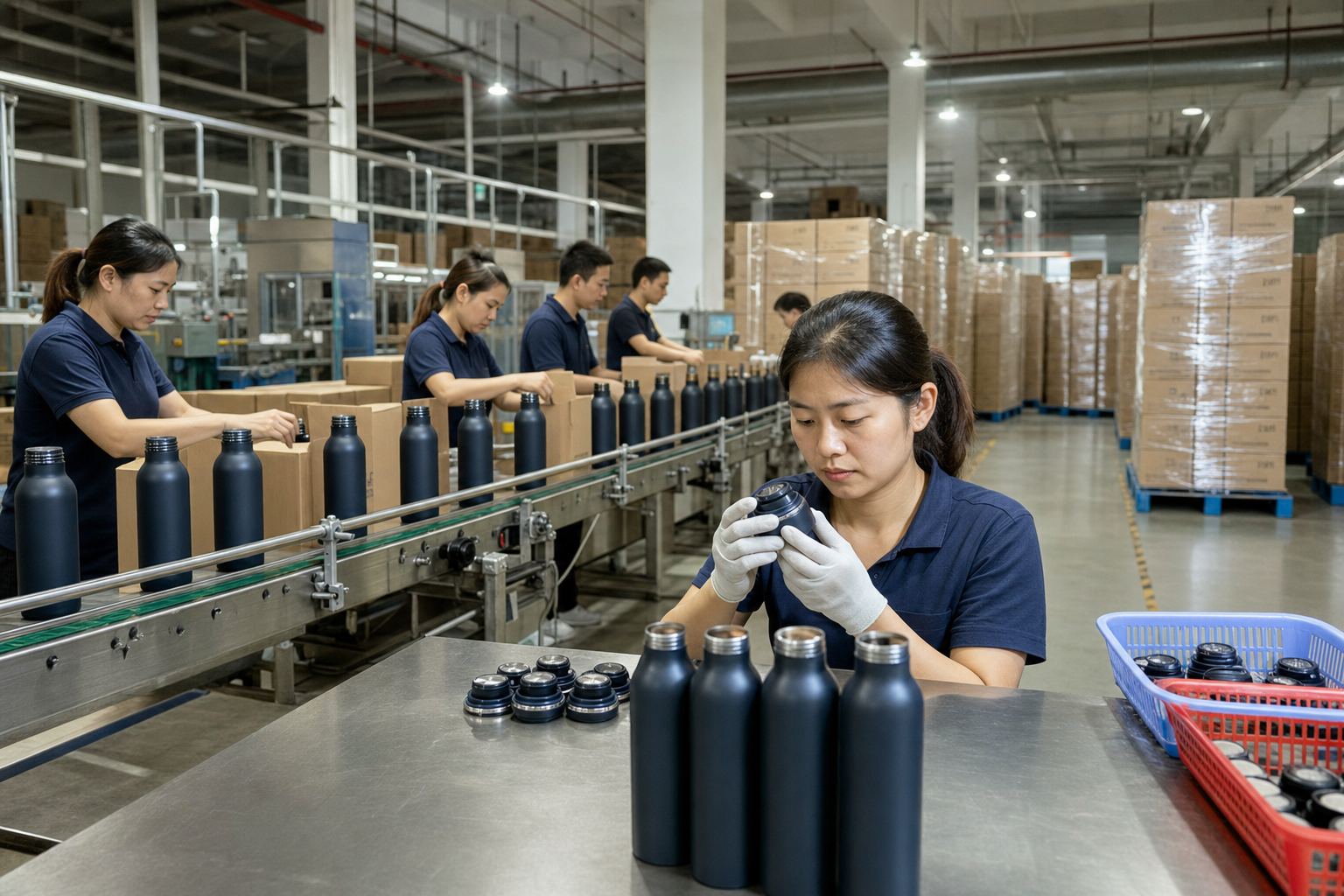
Start with capacity and proof. Ask for machine photos, line videos, and a recent production report. A serious factory should be able to tell you daily output by SKU and show how they handle incoming steel, vacuum welding, coating, and packing. On our line, the vacuum welding machine runs 1,200 pcs per day on one flask size, and that number matters more than a glossy brochure. If you need a stainless steel thermos flask manufacturer for a recurring program, check whether they can keep the same material source for 6 months. We’ve seen steel grade changes slip in mid-season, and the buyer flags it only after the first complaint.
Then verify the commercial side. Ask for MOQ per color, sample lead time, mass production lead time, and whether they support stainless steel thermos flask private label or mixed-SKU orders. If they cannot quote a real timeline, they are probably overpromising. A practical supplier in Zhejiang should be able to discuss tool lead time, artwork proofing, and pre-shipment inspection without hand-waving. One PO typo on color code can burn 2 weeks, and we had a buyer push back on that exact point last month.
What you want is a factory that can explain the process in numbers. If they know their line speed, defect rate, and monthly output, you are dealing with a real producer, not a trading desk.
That is the gap between a stable stainless steel thermos wholesale program and a sourcing headache that keeps coming back. QC pulled the sample, measured the lid gap at 0.8 mm, and that told us more than a full page of sales talk.
Best Specs By Sales Channel
Not every stainless steel thermos fits the same sales channel. For outdoor retail, buyers usually ask for 500 ml to 750 ml, a matte finish, and a lid that survives backpack drops and a cold test. For corporate gifts, 400 ml to 600 ml units with a clean logo and a gift box convert better. For Amazon or DTC, packaging rules matter more than the bottle shape: barcode placement, carton strength, and a box size that does not eat margin. If the bottle weighs 420 g instead of 360 g, or the carton is oversized by 15 mm on each side, freight will bite you before ads ever pay back.
As a stainless steel thermos bottle manufacturer, we match the spec to the channel before decoration is locked. A 350 ml flask works for commuting; a 1,000 ml bottle suits camping and road travel. Last month QC pulled the sample at 24-hour testing because the lid seal dipped after a 1.2 m drop test, and the buyer flagged it. For a stainless steel thermos flask wholesale program tied to winter promotion, a 12-hour hot retention target is enough for the retail pitch; for premium outdoor use, 18 to 24 hours is the number buyers believe. Do not promise a figure the cup cannot hold on the line.
For replenishment planning, watch inventory and lead time together. A 25 to 35 day production cycle from a Zhejiang factory works if repeat orders land before stock gets thin; once you miss the reorder point, the math gets ugly fast. We ship faster on the SKU with a 2-color print, one spare lid part, and the smallest carton we can pass through drop test. That is not glamorous. It is how stainless steel thermos bulk orders stay profitable.
Request a Custom Thermos Quote Today
Send your target capacity, logo file, and market. We will map MOQ, pricing, and compliance for your stainless steel thermos program from Zhejiang.
Frequently asked questions
What MOQ should I expect for stainless steel thermos wholesale orders?
For a standard stainless steel thermos wholesale program, 500 to 1,000 pieces per SKU is common if the factory uses an existing mold and standard lid. If you want a custom lid, unique handle, or special packaging, expect 3,000 pieces or more. Sample orders are usually 1 to 3 pcs, with a sample fee around USD 30 to 80 depending on the decoration. A serious Zhejiang supplier should also give you tiered pricing at 1,000, 3,000, and 5,000 pieces so you can model landed cost before you commit.
304 or 316 stainless steel: which one should I choose?
For most buyers, SUS304 is the right default because it balances cost, corrosion resistance, and availability. It works well for water, tea, and general beverage use. SUS316 costs more, but it is a better fit when your customers use acidic drinks, salty environments, or you want a more premium positioning. In wholesale terms, 316 often adds about 10% to 20% to the material cost depending on the build. If the bottle is for outdoor retail or corporate gifting, 304 is usually enough. If your use case is harsher, pay for 316 and document why.
How long does a custom order take from China?
A normal stainless steel thermos custom order from China usually takes 7 to 10 days for sample development and 25 to 35 days for mass production after sample approval. If you add a new lid mold, custom packaging, or a special coating, the schedule can extend to 45 days or more. Shipping time is separate. From Ningbo or Shanghai to Europe or North America, ocean freight commonly adds another 20 to 35 days depending on the route. If a supplier claims a complex order can ship in a week, they are likely offering stock goods with limited customization.
What private label options are practical for thermos bottles?
The most practical private label methods are laser engraving, silk screen, and simple color coating. Laser engraving is durable and works well for outdoor or premium brands. Silk screen is cost-effective for one-color logos on larger runs. Powder coat color changes are useful when you want the bottle itself to carry the brand. For e-commerce, add barcode and FNSKU labeling at the factory so your warehouse team does less manual work. If you want a stainless steel thermos bottle private label program that stays profitable, keep the first version simple and avoid overcomplicating the lid or carton.
What documents should a factory provide before shipment?
At minimum, ask for the sales specification, pre-production sample approval, inspection report, and packing list. For Europe, REACH and LFGB support are common requests. For North America, ask for food-contact declarations and any applicable testing support. A serious stainless steel thermos factory should also show ISO 9001, and BSCI is a useful social compliance signal if you are working with larger retailers. For quality control, request AQL 2.5 for critical and major defects. If the factory cannot show those documents, you are taking unnecessary risk on a product that will be held, washed, and reviewed by end customers.