Key Takeaways
- MOQ for a typical stainless steel water bottle custom order starts at 1,000 pcs; premium vacuum models usually need 3,000 pcs.
- Factory-direct pricing for a 500 ml 18/8 bottle often lands at USD 2.15-4.80 FOB depending on finish, lid, and packaging.
- For export, ask for REACH, LFGB, and migration test reports; for US buyers, add FDA food-contact compliance and drop-test data.
- A real stainless steel water bottle factory should quote wall thickness in mm, not just capacity, and explain 304 vs 316 steel clearly.
If you are sourcing stainless steel water bottle wholesale for retail, Amazon, promotions, or private label, the hard part is not finding a factory. The hard part is separating a real production line from a polished supplier profile. In Zhejiang and across China, plenty of suppliers can quote a 500 ml bottle. Fewer can keep wall thickness, coating finish, and leak test results stable across a 20,000-unit order.
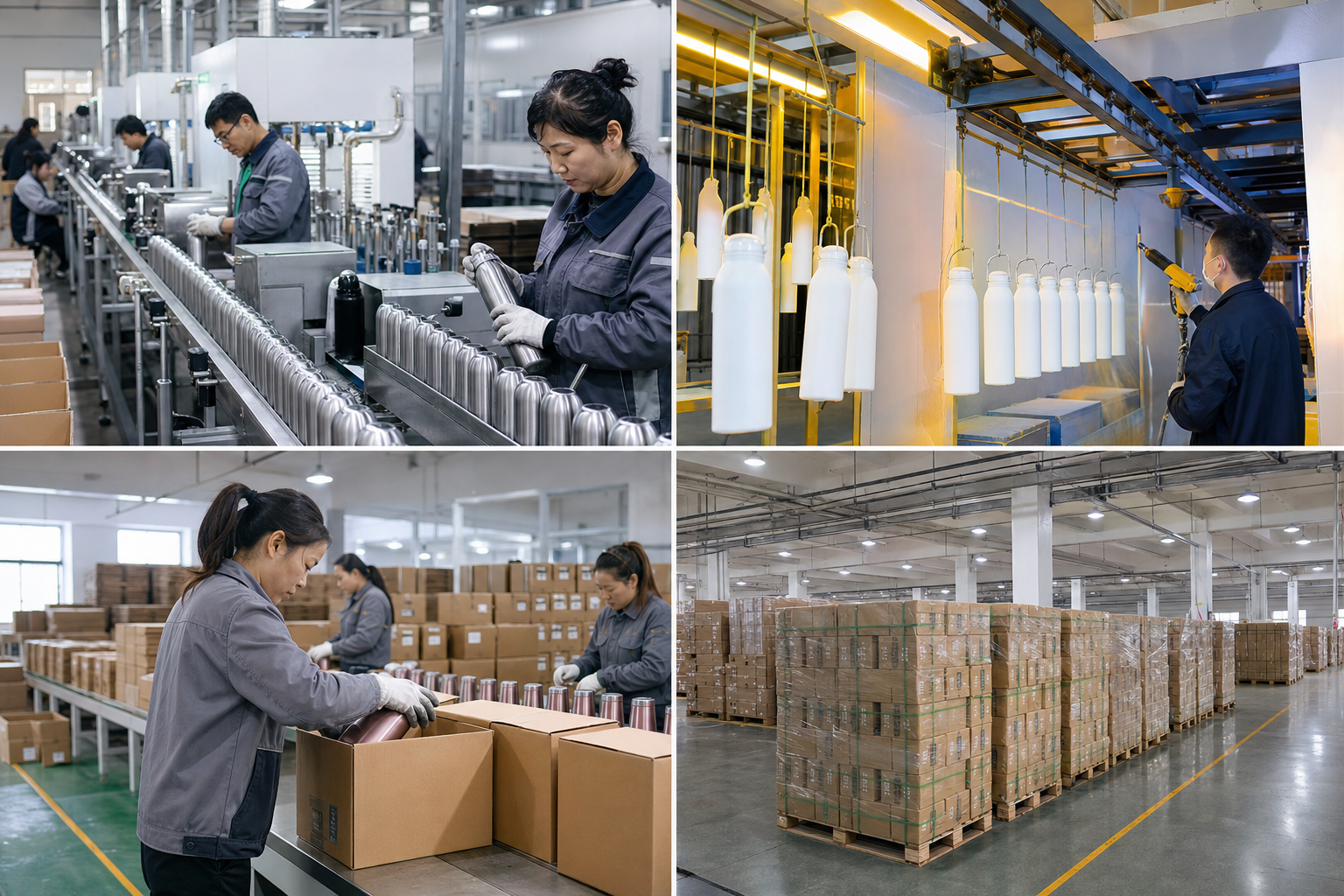
You need to think like a buyer and a production engineer. Check MOQ, lead time, steel grade, lid tooling, and test standards before you send artwork. At BottleForge Industrial in Hangzhou, Zhejiang, we run over 300,000 units a month, with common MOQ starting at 1,000 pcs per design and lead times of 18-25 days after sample approval. QC pulled a bottle at 0.35 mm wall thickness last week, and the buyer flagged a lid typo on the PO. That is the kind of detail that keeps a stainless steel water bottle bulk order profitable instead of a headache.
What wholesale really means
When buyers search stainless steel water bottle wholesale, they usually mean factory pricing, custom branding, and a lead time they can plan around. Wholesale is not just buying 5,000 bottles. It means booking a line, reserving 18/8 steel or 304 stainless, and tying up packaging capacity. If a supplier cannot tell you the steel grade, the inner wall thickness in mm, or whether the lid is PP, Tritan, or 304 stainless inside, you are talking to a trading desk, not a factory.
A solid stainless steel water bottle supplier should quote three numbers without stalling: unit price at 1,000, 3,000, and 10,000 pcs; sample lead time, usually 5-10 days; and mass production lead time, usually 18-30 days depending on coating and print method. We had a buyer flag a PO once because the supplier typed the factory address as “Zhejing” and missed the district name. That typo cost a week. If you are checking a supplier list or supplier directory, ask for the actual factory address in Zhejiang or another industrial base in China. A real factory does not dance around that question.
What to verify before you send artwork:
- MOQ by SKU, not by color only
- Steel grade: 304 or 316, and whether the outer shell is 201, 304, or painted mild steel
- Vacuum performance: 6 hours hot retention, 12 hours, or 24 hours with test data
- Packaging: bulk pack, white box, gift box, or Amazon-ready carton
If you need stainless steel water bottle wholesale bulk pricing, do not ask only for the lowest FOB. Ask what changes at 5,000 pcs: print cost, carton count, and whether the supplier can lock the color batch. We run into this all the time. The math does not work if the line is set for 1,000 pcs and your artwork needs a second screen. That is how you avoid a price bump after sample approval.
304 vs 316 steel choices
For most buyers, 304 stainless steel is the standard pick. It holds up, it is easy to source, and the math works on a 500 ml vacuum bottle. We run 304 inside and outside on a lot of SKUs because it keeps the landed cost under control while still giving a clean retail spec. If your target price is tight, this is the right question to ask.
316 is the upgrade when the bottle needs to earn a premium claim or face salt, sweat, and outdoor abuse. The price jump is real, and we have seen buyers push back hard on that. A lid leak or a weak vacuum seam will kill the product before the steel grade matters. A good stainless steel water bottle manufacturer in China should spell out the structure, not just wave a spec sheet. Ask for inner liner thickness, usually 0.4-0.6 mm on common vacuum bottles, and outer shell thickness, often 0.35-0.5 mm. On a promo run, shaving the wall down saves cents, but QC pulled the sample and the dent test failed after a 1.2 m drop.
Use 316 when:
- You want a premium line with stronger corrosion resistance
- You are selling into outdoor, marine, or fitness channels
- You need a cleaner story for a higher retail price
Use 304 when:
- You need stable wholesale margin
- You are launching a broad private label range
- You want faster sourcing from a stainless steel water bottle factory direct in China
Do not let a supplier sell you “316” without a material certificate or traceable mill source. We have seen PO files with a typo on the steel grade, and that turns into a mess at packing. In Zhejiang, the stronger factories can show batch-level raw material records and inbound inspection logs, not just a口头 promise.
Pricing from factory direct
Factory-direct pricing is where a lot of buyers overread their hand. A stainless steel water bottle factory can quote sharp, but the number moves with more than quantity. Surface finish, lid type, print method, and packaging all change the cost. For a basic 500 ml double-wall bottle with powder coating, FOB Ningbo or FOB Shanghai usually lands at USD 2.15-2.90 at 1,000 pcs. Add laser engraving, a color box, and a custom cap, and the same bottle jumps to USD 3.60-4.80. We’ve had buyers push back on that gap, then QC pulled the sample and found the cap alone added 0.28 USD.
If you want stainless steel water bottle buy in bulk pricing, look at the cost stack:
- Raw steel and cap material: roughly 35-45% of unit cost
- Vacuum forming and welding: 15-20%
- Coating or paint: 8-15%
- Decoration: 5-18%
- Packaging and carton: 6-12%
The cheapest quote is usually the plainest spec. A stainless steel water bottle supplier quoting USD 1.70 for a vacuum bottle is leaving something out, usually testing, packaging, or a heavier cap. We’ve seen that go sideways on the line: the PO says 304 stainless, but the lid drawing is missing gasket thickness, so the math does not work. In Zhejiang, the better factories send a line-item quotation. That is the right way to buy.
If you sell on marketplaces or to distributors, ask for tiered pricing at 1,000 / 3,000 / 5,000 / 10,000 pcs. That is where the real factory efficiency shows up. A good line can drop 8-15% between 1,000 and 5,000 pcs because decoration setup and packing waste shrink with volume. We ship this every week, and the buyer usually sees the break at 3,000 pcs first. One small typo on a PO can erase the savings fast.
Custom logo and private label
Most buyers do not need a brand-new bottle body. They need a solid stainless steel water bottle custom program built on a proven mold, then brand color, logo, lid style, and packaging on top. That runs faster, costs less, and avoids a tooling gamble from scratch. If you only need stainless steel water bottle with custom logo, the decoration choice matters more than the silhouette. We had one buyer push back on a 3,000 pcs mold fee; once we showed him a sample from the same 500 ml line, he switched to logo-only.
Common decoration methods include silk screen, heat transfer, UV print, pad print, and laser engraving. Silk screen works best for a bold single-color mark on one panel, especially at 1,000 pcs or more. Laser engraving is cleaner for premium stainless steel water bottle private label jobs, especially on brushed steel or powder-coated surfaces. QC pulled the sample at 24 hours and the UV mark held up, but the buyer still asked about dishwasher wear, so we compared fade tests instead of guessing. For a useful breakdown, see our guide on silkscreen vs laser engraving.
Typical decoration costs per unit:
- Single-color silk screen: USD 0.08-0.18
- Laser engraving: USD 0.12-0.30
- Full-color UV print: USD 0.20-0.45
If your plan is stainless steel water bottle customized for a chain store or event program, keep the mold and structure stable and customize the branding only. That is how experienced stainless steel water bottle manufacturers protect lead time and keep defect rates lower. The math works; a lid change can add 12 days, while logo and carton changes usually stay inside 5 days if the PO is clean. It also keeps reorders simple for distributors. One typo on a PO, usually the logo size in mm, can stall the line for a full day.
Quality checks that matter
For a drinkware buyer, QC is margin protection. A proper stainless steel water bottle supplier should accept AQL 2.5 for major defects and AQL 4.0 for minor defects as the baseline, unless your retailer wants a tighter level. For export runs, ask for drop testing, thermal retention testing, seal checks, and coating adhesion. If the factory cannot spell out the method, stop there. We’ve seen that go sideways fast.
The failures are plain and costly: lid leaks, seam pinholes, powder coat scratches, off-center logos, and crushed cartons on the truck. A solid stainless steel water bottle factory will check incoming steel coils, vacuum-form samples, and run leak tests on a set percentage of each batch. On our Hangzhou line, we do in-process checks at forming, polishing, coating, and final packing, then QC pulled the sample before shipment. One buyer once flagged a 0.8 mm lid gap on a PO, and that little detail would have come back as a flood of complaints.
Ask for these documents before shipment:
- Material specification for 304 or 316 steel
- REACH or LFGB food-contact test, depending on market
- Carton drop test or transit test for export packaging
- Pre-shipment inspection report with photos and defect counts
For Amazon FBA or distributor orders, push for barcode placement, carton dimensions, and unit weight confirmation. If the carton is off by 2-3 mm, warehouse receiving can reject it. If the bottle varies by 20-30 g, your freight math is wrong. The math does not work on 10,000 pcs. We ship those cases every week, and a typo on the PO for 12.8 kg vs 18 kg is enough to wreck the booking.
Finding the right factory partner
There are plenty of stainless steel water bottle suppliers, vendors, distributors, and manufacturers online. Most are not the same. Some are trading companies with decent service. Some are real factories with welding lines, polishing rooms, and coating booths. If you need stainless steel water bottle oem manufacturer support, start with the second group. Ask for production photos, tooling records, and capacity numbers. We once got a “factory” that sent only a showroom video, and the buyer flagged the PO typo before we even started—wrong model code, wrong cap color.
When you review a stainless steel water bottle supplier list or stainless steel water bottle supplier directory, filter by these points:
- Factory address in China, preferably in a known manufacturing belt such as Zhejiang or nearby coastal provinces
- Monthly capacity, ideally 200,000 pcs or more for stable replenishment
- MOQ by model, not vague “flexible” claims
- Certification scope for BSCI, ISO 9001, REACH, and LFGB where relevant
A distributor works when you need mixed SKUs in small volume. A factory is the better call when you need stable pricing and repeatability. If you plan to scale, choose a stainless steel water bottle manufacturer that can handle custom lids, private labeling, and reorder stability. We run into this all the time: the quote looks low, then the math breaks once the buyer asks for a second logo position or a 0.8 mm wall change. The honest factories talk about fixtures, sampling limits, and production bottlenecks straight away. That beats a cheap number.
For broader sourcing context, our guide on sourcing custom drinkware from China explains how we compare factories, suppliers, and OEM partners without burning weeks on dead-end leads. QC pulled the sample, checked the lid thread, and found a 1.5 mm mismatch on the sealing ring—small issue, big delay if nobody catches it early.
Shipping and reorder planning
Wholesale profit starts before the first carton is sealed. If you are buying stainless steel water bottle in bulk for retail or a promotion, freight and packing can eat the margin fast. A 500 ml double-wall bottle usually runs 260-320 g net, and once we add an inner box, divider, and master carton, the packed weight jumps on the scale. We saw one PO lose margin because the buyer approved a 48-piece carton, then the pallet count pushed the cube from 18.4 CBM to 20.1 CBM.
For an FOB shipment from China, ask for a quote that breaks out product cost, inner packaging, outer carton, and port charges. If you need Amazon prep, get FNSKU labels, polybagging, and carton marks locked before the line starts. QC pulled one sample where the carton print missed the buyer’s SKU by one digit; that typo would have turned into a warehouse headache. A 10,000-unit order with the wrong carton size can waste 1-2 cubic meters of freight space. The math does not work. On repeat orders, a good factory in Zhejiang will keep your artwork plate and packaging spec on file, so you can reorder in 15-20 days instead of starting over.
If you are building a stainless steel water bottle wholesale bulk program for a distributor network, keep the first run tight. One body shape, two lid options, three colors. That is enough. We have seen this go sideways when a buyer asked for four lid styles on a 3,000-piece trial, then sat on slow stock for 90 days. Once sell-through is proven, you can move into promo packs, gift boxes, or a 32 oz version. If the sourcing plan is disciplined, the second PO usually prices better than the first, and you have a SKU that can actually scale.
Source factory-direct stainless bottles today
Send your capacity target, logo file, and market standard. We will quote 304 or 316 options with MOQ, lead time, and FOB pricing within 24 hours.
Frequently asked questions
How long does production usually take?
For a standard stock-mold bottle with custom logo, sample lead time is often 5-10 days and mass production is 18-25 days after sample approval. If you need a new lid, special coating, or custom gift box, add 7-15 days. Ocean freight from China to Europe or North America can add 20-35 days depending on route and season. A capable factory in Zhejiang should tell you the exact bottleneck before you place the PO, not after. That is the difference between a useful supplier and a vendor who only quotes price.