Key Takeaways
- A workable custom growler program usually starts at 500 to 1,000 pcs per SKU, with sample lead time around 7 days.
- For standard retail use, 304 stainless and 0.6 to 0.8 mm wall thickness cover most custom drinkware orders; 316 is for harsher conditions.
- A Zhejiang factory in China with about 180,000 units per month can often ship in 25 to 35 days after sample approval.
- For Europe and the US, ask for LFGB, REACH, FDA food-contact paperwork, and AQL 2.5 major / 4.0 minor inspection terms.
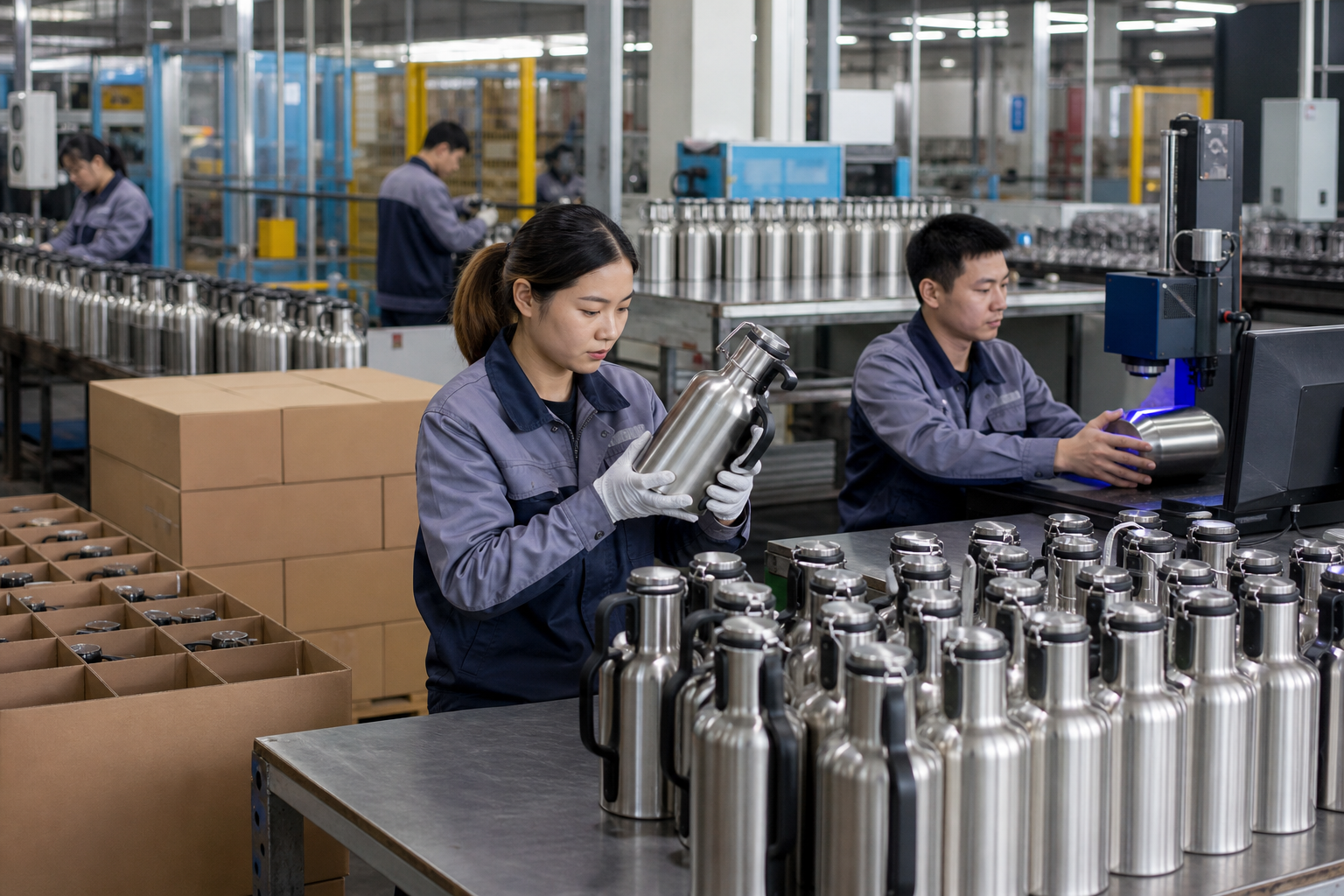
If you are buying from suppliers growler for brewery merch, retail, or a distributor program, the real question is not whether they can make it. It is whether the factory can hold 0.8 mm stainless, leak test every lot with a pressure tester, and ship on the date your retail plan expects. In Zhejiang and other parts of China, the best canteen manufacturer is usually the one already running custom drinkware, custom canteen, and custom growler jobs on the same line. They know how to switch decoration, caps, and cartons without losing control; QC pulled the sample after a PO typo once, and that is the kind of detail that saves a program.
You need more than a low FOB quote. You need a canteen supplier that can document materials, pass REACH or LFGB when required, and keep MOQ, sampling, and lead time predictable. For North America and Europe, that means a practical factory partner, not just a canteen vendor with clean renders. We have seen this go sideways when a buyer accepted a nice spec sheet but skipped the batch records.
What buyers mean by growler sourcing
When buyers search for suppliers growler, they are not chasing a single bottle. They need a repeatable buying route for brewery merchandise, taproom retail, club promos, or a distributor drinkware line that can take reorders without drifting. A custom growler is often 32 oz or 64 oz, with a handle, screw cap, or swing top. The real test is plain: can the supplier keep the same dimensions, coating, and carton spec on batch 1 and batch 8? We have seen a 1.5 mm wall spec slide to 1.2 mm on the line, and the buyer flagged it before shipment.
Factory type is where this gets decided. A canteen vendor can resell stock. A canteen factory runs the tooling, welds, decoration, and carton spec in-house. If you also buy custom canteen, customized canteen, or canteen promotional items, it is usually smarter to work with a canteen manufacturer that already ships across several drinkware lines. In Zhejiang, that setup is common, but only when QC pulls samples at the line, checks cap torque at 12 N·m, and logs the result. We have seen this go sideways when a PO typo changed matte black to black matte; the math does not work if the second order comes back different from the first one.
Materials and build details
Choose the material for the use case, not the brochure. For most custom drinkware and customized growler orders, 304 stainless is the default because it keeps cost, corrosion resistance, and finish in balance. If the bottle will sit in salty air or hold acidic drinks, or the buyer wants a longer service life, 316 is the better spec. For single-wall growlers, we usually run 0.6 to 0.8 mm. For vacuum-insulated models, the outer shell and inner liner need to match cleanly so the neck, welds, and base do not warp during drawing or polishing; we have seen a 0.2 mm mismatch show up as a crooked rim after the polishing wheel.
Check the closure system as hard as the body. A strong bottle with a weak lid still fails. Thin gaskets, shallow thread engagement, and caps that back off after carton vibration are the usual trouble spots. On one 5,000 pcs run, QC pulled the sample and found a 1.5 mm gasket compression gap; the buyer flagged it before shipment. If you are buying a customizable growler or a customized drinkware set, insist on:
- 304 or 316 stainless with a stated material certificate
- Food-grade silicone gasket
- Leak test at 100 percent for sampled cartons or every unit if the order is high-risk
- Powder coating thickness around 60 to 80 microns when you need color
- Drop-tested packaging if the route includes e-commerce or long-haul export
The same logic applies to canteen customizable programs. A good canteen supplier should explain why one lid type, finish, or weld method fits your channel, not just say yes to every sketch. If a PO says “matte black” and leaves out the coating standard, that is how a line stoppage starts. We run into that more than once a month.
Decoration that survives shipping
Decoration is where a lot of canteen suppliers overpromise. A logo that looks clean on a mockup can chip, fade, or rub off after 12 days in transit if the process is wrong. For a custom canteen or custom growler, the decoration method has to match the artwork, the order size, and the sales channel. Silk screen works for one or two solid colors. Laser engraving gives a permanent mark on stainless. UV print can handle full-color graphics, but the buyer should accept a real abrasion limit. Powder coat with laser reveal or underprint is usually the better move for retail-grade customized drinkware. We run that test on the line with a Scotch-Brite rub, and the weak jobs show it fast.
If you sell canteen promotional items, consistency matters more than novelty. Buyers in North America and Europe usually want the same color tolerance, logo placement, and carton presentation on repeat orders, and they will flag a 2 mm logo shift on the second run. That means the artwork file, Pantone target, and approval sample have to be locked before production. If your supplier cannot show a pre-production sample with the actual finish and logo position, this is the wrong question to ask the sales team because the risk is not cosmetic; it turns into returns. QC pulled the sample on one PO last month because the buyer had typed the wrong Pantone code, and we caught it before the press ran. For buyers comparing custom logo options, it is worth reading a process note such as silkscreen vs laser engraving for drinkware and matching the method to the SKU. A canteen custom order that needs shelf appeal is not the same as a distributor canteen order that needs a durable warehouse label.
MOQ, price, and lead time reality
Price changes fast once you change the construction. On the line, a laser engraver or a powder-coat booth can move the cost faster than sales wants to admit. A simple single-wall custom growler with one-color print can land in the $2.80 to $6.50 FOB range, while an insulated version with a powder-coated finish and special lid can move into the $6.80 to $12.00 range or higher. The biggest drivers are steel grade, wall structure, decoration method, lid complexity, and pack-out. If you are comparing canteen distributors or canteen manufacturers, do not compare only unit price. Compare the total landed cost after cartons, inner boxes, inserts, test reports, and export packing are added. We have seen a buyer flag a PO because a 12 mm carton insert changed the count, and the math stopped working.
For a real factory in Zhejiang, China, a useful planning number is about 180,000 units per month across a mixed drinkware line. QC pulled the sample on a lid torque check at 0.6 N·m, and that is the kind of detail that decides whether the schedule holds. That does not mean your SKU gets priority, but it does mean a steady canteen factory can often hold a 25 to 35 day production window after sample approval. Samples usually take 5 to 7 days if no new tooling is required. MOQ is often 500 to 1,000 pcs per color or logo setup, and some canteen vendors will quote lower to win the order, then recover cost in hidden packaging or decoration changes. If you are a canteen distributor or distributor drinkware buyer, ask for a clear break at 3,000 and 5,000 units so you can see where the true price curve starts.
Compliance for Europe and North America
Compliance is not paperwork. It is what keeps a growler stuck at customs or coming back from the port. For Europe, ask for LFGB or, at minimum, a test plan that covers REACH and food-contact migration. For the US, we ship with FDA food-contact statements for the wetted parts, plus a clean bill of materials for lids, coatings, and seals. If the closure uses plastic or silicone, ask for the pigment and additive list, not just a BPA-free line on a spec sheet. QC pulled a silicone cap last month and the lot number on the report did not match the sample tag. That is the wrong question to ignore.
A good China factory knows the file has to match the lot. Not the showroom sample. Ask for ISO 9001 if available, BSCI if your buyer needs social compliance, and a clear AQL standard, usually 2.5 major and 4.0 minor for final inspection. For Amazon FBA or other ecommerce channels, packaging matters just as much as the bottle. FNSKU labels, carton barcodes, and ISTA-style drop testing need to be checked before mass production starts, because we have seen 12 days on the line turn into 18 days when the buyer flagged a carton mark typo on the PO. A canteen manufacturer that cannot show batch records, sample retention, or traceable test numbers is not ready for repeat distributor business.
How to vet a supplier fast
Fast vetting starts with questions a fake supplier cannot dodge. Ask for the exact material spec, monthly output in units, and sample-to-bulk lead time in days. Then ask for production photos from the actual line, not a folder of stock shots. On a real growler line, we expect the welder model, the polishing wheel marks, the 100% leak test setup, and the carton drop test height in mm. If they hesitate, the math does not work. A factory that owns the process answers straight; a trader stays slippery.
Then check repeat orders. The suppliers we keep using hold retained samples, revision history, and a carton spec that does not drift. That is the difference between a reorder that lands in 12 days and one that slips to 18 because the lid torque changed and QC pulled the sample. If you are buying custom growlers for promotion or a distributor range, ask whether they keep spare gaskets and lids on the shelf for after-sales. The buyer flagged one PO because the logo size was written as 38 mm on one page and 3.8 cm on another; that kind of mess burns time. A factory in Zhejiang, or anywhere in China, should answer with numbers, not slogans. If they cannot name their QC gates, do not treat them as a long-term supplier.
Ask for a factory quote with real test data
Send your target size, artwork, MOQs, and destination market. We can check specifications, compliance, and packing before you place the order.
Frequently asked questions
What MOQ should I expect for custom growlers?
For most suppliers growler programs, a realistic MOQ is 500 to 1,000 pcs per SKU or per artwork version. If you need multiple colors, expect the MOQ to rise because each finish needs a separate setup. For a simple single-wall model, some Zhejiang factories in China can accept 300 pcs for a trial order, but the price usually moves up. Samples normally take 5 to 7 days, and mass production is often 25 to 35 days after sample approval. If a canteen manufacturer offers 100 pcs with heavy customization, ask where they recover the mold, decoration, or carton cost.
Should I choose 304 or 316 stainless for a custom growler?
For most custom drinkware and custom canteen orders, 304 stainless is the standard choice because it is cost-effective and performs well in normal retail use. Choose 316 if the product will face salt air, harsh cleaning cycles, or more aggressive beverage exposure. The price difference is real, so do not over-spec the order unless the channel justifies it. In practical terms, 304 at 0.6 to 0.8 mm wall thickness is enough for many distributor drinkware programs, while 316 is better for premium positioning or demanding use. Ask for the material certificate either way.
Can one factory handle canteen custom orders and growlers?
Yes, if the factory has the right tooling and QA discipline. A strong canteen factory in Zhejiang or elsewhere in China can often handle custom growler, customized growler, canteen custom, and customizable drinkware under one roof. That is efficient because you can reuse decoration knowledge, packaging controls, and leak testing systems. The key is not the product label but the process control. Ask whether the same line handles polishing, coating, and final leak testing, and whether the plant can hold separate artwork revisions for your distributor canteen and retail growler SKUs.
What documents do I need for Europe and the US?
For Europe, ask for LFGB or supporting migration tests and REACH-related material declarations. For the US, request FDA food-contact documentation for the wetted parts and a clear statement for silicone or plastic components. If you sell on Amazon, you also need carton labels, FNSKU setup, and packaging that survives fulfillment handling. A serious canteen supplier should also show ISO 9001, BSCI if available, and an inspection plan with AQL 2.5 major and 4.0 minor. If they only send a generic letter, that is not enough for customs, a retailer, or a distributor canteen account.
What decoration method is best for branded growlers?
It depends on the artwork and how hard the bottle will be used. Silk screen is best for one or two colors and controlled repeat orders. Laser engraving is better when you want a permanent mark on stainless. Powder coat with laser reveal gives a more premium retail look and usually holds up better than a simple printed logo. For canteen promotional items, I would avoid decoration that scratches easily unless the channel is very light-duty. If you also sell custom logo drinkware or a custom canteen line, keep the same visual standard across products so the brand does not look fragmented.