Key Takeaways
- A workable promo thermos usually starts at 500 pcs MOQ and 25-35 days lead time from a Zhejiang factory.
- 304 stainless steel, 0.5-0.6 mm body wall, and a 6-12 hour heat-retention target are the baseline, not the premium spec.
- Laser engraving, silk screen, and UV print each suit different thermos bottle for marketing programs and price bands.
- For Europe and North America, REACH, food-contact documentation, and AQL 2.5 inspection matter as much as the unit price.
Buying a thermos bottle for promotional gifts is not about finding a bottle. It is about choosing one that still looks clean after 6 months on a desk, still seals after 200 open-close cycles, and does not create customs or compliance trouble when the cartons land. Low unit price means little if the lid fails the 1-meter leak test, the vacuum drops, or the logo rubs off after the first wash. QC pulled the sample on our line last week, and the print already told the story.
The Zhejiang market is crowded, and online photos hide the real gaps: steel grade, powder coating thickness, leak rate, and how a factory runs its line. We see bottles that look the same but ship with a 0.3 mm gasket mismatch or a sloppy PO typo on the cap color, and the buyer flags it after the first carton. If you are sourcing a thermos bottle for business, thermos bottle for giveaways, or thermos bottle for employees, this is the wrong question to ask: "which model looks best?" The math works only when 2 or 3 spec choices are locked before production starts.
What Makes a Promo Thermos Work
A thermos bottle for promotional gifts does a different job from a retail premium flask. It has to carry your brand, move out of the factory on time, and stay useful after the first week. If it leaks once in a laptop bag, the buyer flags it and the logo turns into a complaint. We’ve seen that go sideways. So we check the bottle as one set: body, lid, seal, coating, and carton all need to match.
The working baseline for a thermos bottle for business is 304 stainless steel inside and out, double-wall vacuum construction, and a lid with a silicone gasket that survives repeated opening. For most campaigns, 500 ml or 750 ml is the safer pick. It fits office desks, commuting, and gym bags without blowing up freight. If you are sourcing thermos bottle for companies at scale, ask for actual test data: hot retention at 95 C initial fill, cold retention at 4 C, and leak testing under inversion. QC pulled the sample at 24 hours, and that tells you more than a sales deck.
Do not pay for decoration that does not move the order. A matte powder coat, one-color logo, and plain gift box usually sell better than a strange bottle shape. A buyer once pushed for a sculpted body, then the carton size jumped 18 mm and the math stopped working. In Zhejiang, the good promo plants keep the process tight. One line making 120,000 units per month can still miss ship dates if the spray booth is full, so check line capacity before you sign off the art proof.
For promo programs, steady output beats shiny specs. A thermos bottle for giveaways should be boring where it counts: stable dimensions, stable coating, stable packaging.
Materials, Insulation, and Build
The biggest mistake buyers make is treating every stainless thermos bottle as the same just because the shell looks close. It is the steel grade and wall build that set the price. For a thermos bottle for promo, 304 stainless is usually the safe default: solid corrosion resistance, food-contact confidence, and a cost that still works for bulk orders. If you are sourcing a thermos bottle for schools, thermos bottle for students, or thermos bottle for kids, check the lid and spout for BPA-free materials and make sure the mouth opening is easy to wash by hand. We had one buyer flag a 38 mm mouth as too narrow after QC pulled the sample.
Wall thickness matters more than a sales sheet wants to admit. On the line, 0.5 mm to 0.6 mm per wall is a common spec. Go thinner, and the bottle dents in transit. Go thicker, and freight climbs for no real benefit. Vacuum quality is the part that gets people into trouble. A decent bottle should hold drinks hot for 6 to 12 hours in normal use, and some builds will stretch past that. We do not quote lab numbers unless we have repeatable test logs, because the math does not work if the factory cannot hold the same result twice.
For a thermos bottle for gym, thermos bottle for fitness, thermos bottle for athletes, and thermos bottle for runners, weight and grip beat a fancy silhouette. For a thermos bottle for hiking or thermos bottle for cyclists, a lockable loop cap and anti-slip coating matter because the bottle gets clipped, carried, or shoved into a side pocket. For thermos bottle for hotels, thermos bottle for restaurants, and thermos bottle for cafes, the bottle needs to clean fast, pack tight in cartons, and take a logo that still looks clean after 200 washes. We once had a PO with “hotel” typed as “hotle”; small typo, big delay.
What to ask the factory
- Steel grade: 304 or 316, with material traceability if you need it.
- Insulation test: retention time and acceptable temperature loss range.
- Lid design: leak-proof structure, gasket material, and replacement availability.
- Surface finish: powder coat, spray paint, or brushed steel, with abrasion resistance data if available.
Logo Methods and Brand Fit
Your decoration choice should follow the use case, not your personal taste. If the order is for thermos bottle for swags at conferences or thermos bottle for events, the logo has to read cleanly from 1 to 2 meters away. Silk screen is the low-cost route for one- or two-color artwork; on our line, a 60 mesh screen is usually enough for that. Laser engraving looks cleaner and holds up better when the bottle gets tossed in and out of bags, which is why it works well for thermos bottle for employees or thermos bottle for business gifts. UV print gives more color range, but it pushes the unit cost up and needs tighter QC on registration.
Brand owners often ask for oversized logos, then the art wraps awkwardly around a curved bottle. That is a design problem, not a printing problem. Keep the mark on the flatter panel if the model has one. We tested this on a 500 ml bottle with a 38 mm print area, and the buyer flagged the wrap immediately. If you want a premium feel, use a restrained logo and put the money into better packaging. A simple sleeve, molded pulp insert, or rigid gift box can make a thermos bottle for companies feel like a controlled corporate gift, not loose merch.
For thermos bottle for ecommerce, the decoration has to survive product photography and parcel handling. That means clean edges, no dust under the coating, and the same print position across the batch. If the bottle will be sold as thermos bottle for sale online, ask for pre-production samples with the exact final logo, not a blank sample. QC pulled one sample after a 3 mm shift on the front mark, and that would have turned into a relabeling headache. This is the wrong question to ask if the buyer only says, “make it bigger.”
When the buyer says “make the logo bigger,” the real question is whether the bottle still looks credible as a corporate gift after the print is enlarged.
MOQ, Price, and Lead Time
Price is where a lot of thermos bottle for promotional gifts orders go sideways. Lowest unit cost is the wrong question to ask. You need a price that fits your margin, freight mode, decoration method, and packaging target. For standard stainless promotional bottles out of Zhejiang or other China supply chains, a realistic MOQ usually starts at 500 pcs for a basic spec, while custom colors or a complex lid can push it to 1,000 pcs or more. If a factory quotes far below that, check whether they are moving stock blanks with only light changes. On the line, we have seen that trick more than once.
For a simple 500 ml model with one-color logo, a common FOB China range can sit around USD 3.20 to USD 5.80 per unit, depending on finish, lid complexity, and carton configuration. Laser engraving may add less than UV print in some cases, but a thicker mailer carton can move the landed cost by more than the decoration itself. If you are buying thermos bottle for gifts at campaign scale, work from the all-in cost per usable unit, not the bare factory price. Carton crush, spare lids, and inspection rejects all belong in the math. QC pulled the sample off the bench, and the buyer flagged a scuffed cap in the first box.
Lead time is usually 25 to 35 days after sample approval and deposit for standard runs. Add more time if you need custom tooling, Pantone matching, or you are booking into a busy season. In China, the queue is often the bottleneck, not the machine speed. Ask for a firm packing schedule, not a verbal promise. A supplier worth working with should tell you how many production lines they run, how many units they finish each month, and what share of orders ship on time. We have seen a 12-day slip turn into 18 days because the buyer approved artwork late.
Practical buying rule
If your campaign date is fixed, do not place a design-heavy thermos bottle for marketing order like it is a stock item. Build at least 10 extra days into the plan for sampling, artwork approval, and carton verification. The math does not work if you leave those steps out. A simple tape measure on the packing bench can save a missed ship date.
Compliance and Quality Control
For Europe and North America, the bottle is only half the job. We also need the paperwork that gets cargo through customs and keeps retail buyers calm. A supplier who ships these orders should know food-contact rules, REACH points, and test methods for coatings and plastic parts. If the order is going to retail or Amazon-style channels, ask for test reports before mass production. We have seen buyers wait until the cartons are on the water, and that always gets expensive.
Quality control needs to be written down, line by line. For a thermos bottle for schools, thermos bottle for children, or thermos bottle for kids, we check lid fit, odor, paint adhesion, and cap safety. For adult use, leak testing, vacuum retention, and drop resistance matter more. AQL 2.5 is standard for general defect inspection, but if the customer is picky, set a tighter major-defect limit and spell out what a critical defect is. If you leave that vague, the buyer will flag it later and the math does not work.
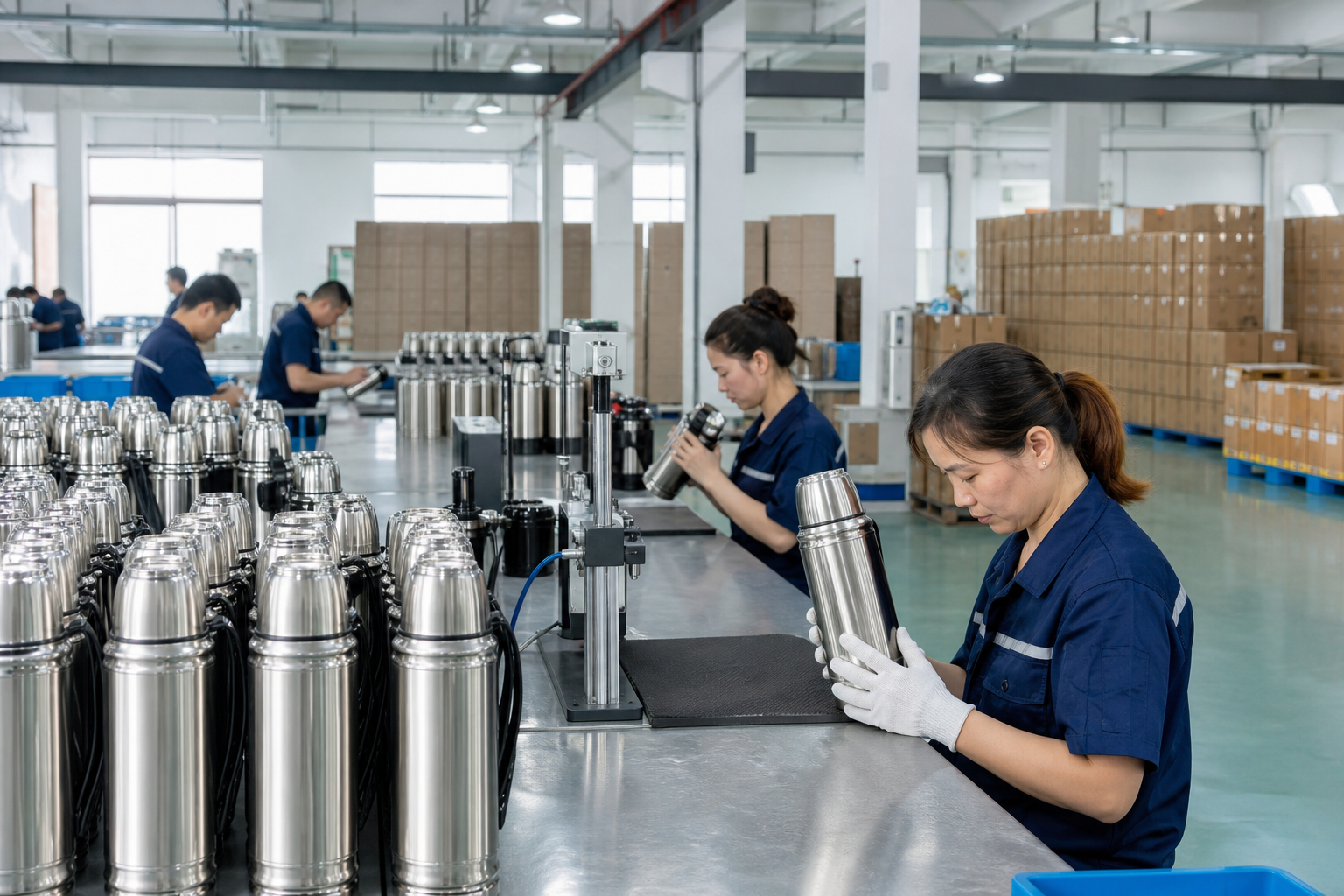
In Zhejiang, a factory with decent discipline runs in-line checks, final inspection, and carton sampling. We run the line with go/no-go gauges, torque testers, and a 1.5 m drop setup. Still, do not assume the internal system covers everything. If the project matters, send a third-party inspector or hire a local QC service for pre-shipment inspection. That matters on hotel, restaurant, cafe, or conference giveaway orders, where 1,000 pieces can move in a week and one bad lid batch becomes a problem fast.
- Request material declarations for stainless steel and silicone, plus the steel grade on the PO.
- Confirm drop test and leak test procedures in the spec sheet, including the test height in mm.
- Insist on carton drop testing if the route includes long-haul freight; 5 layers is not enough if the box corners fail.
- Keep a signed golden sample before mass production starts, and match it against the first 50 pcs off the line.
Matching the Use Case
A thermos bottle for promotional gifts should be chosen by the end user, not by a catalog photo. For thermos bottle for employees, we usually ship a clean 500 ml body, low-key logo print, and a lid that survives 50,000 open-close cycles on our torque tester. For thermos bottle for schools and thermos bottle for students, go with a lighter shell, an easy-open lid, and a color that still looks decent after a month in a backpack. If the buyer is sourcing a thermos bottle for children, the mouth opening should stay simple for small hands, and the rim finish must pass a touch check; we’ve seen a sharp edge turn into a claim.
Outdoor and fitness buyers want a different spec sheet. A thermos bottle for gym or thermos bottle for fitness has to fit cup holders and side pockets, usually with a body around 70 to 75 mm in diameter. For thermos bottle for athletes, the coating needs grip when wet, and the line checks that with a damp-glove test. A thermos bottle for runners or thermos bottle for cyclists should skip extra bulk. A thermos bottle for hiking needs a tight cap, a solid loop, and a finish that does not show scratches after one trail trip. Small details. Big effect.
Hospitality and event buyers care about presentation and carton count. A thermos bottle for hotels, thermos bottle for restaurants, or thermos bottle for cafes needs a polished face and simple replenishment. A thermos bottle for conferences, events, and marketing campaigns should pack tight, print clean, and look worth more than the BOM says. The buyer flagged a PO typo on one campaign order last quarter—500 ml became 550 ml—and the sample had to be remade. This is the wrong question to ask if you only compare unit price. China sourcing works when you give the factory a clear brief; then we can run one base platform across several audience-specific versions without reopening the tooling.
For brands that repeat programs, keep one base model in China and swap seasonal graphics or packaging. We do this with the same 304 stainless body and a fixed MOQ, then change the sleeve or gift box for each run. That is how one thermos bottle for business turns into a sourcing program instead of a one-off buy.
Source Your Promo Thermos With Real Specs
Send the artwork, target price, and ship date. We will match the right thermos bottle for promotional gifts spec, decoration method, and production schedule.
Frequently asked questions
What is a realistic MOQ for a custom promo thermos bottle?
For a standard stainless model, 500 pcs is a normal starting point in China, especially from a Zhejiang factory with existing tooling. If you want custom color, special lid parts, or a fully printed box, the MOQ often moves to 1,000 pcs. Smaller runs are possible, but the unit price usually jumps by 15% to 30% because setup time is spread across fewer pieces. For repeat programs, ask whether the supplier can keep the same mold and just change the logo or finish.
How much should I budget per unit for a promotional thermos?
A practical FOB China budget for a basic 500 ml stainless thermos is often USD 3.20 to USD 5.80 per unit, depending on steel grade, lid type, decoration, and packaging. Laser engraving is usually cleaner and more durable, while UV print can cost more if you need color complexity. Do not ignore freight, duty, inspection, and carton damage. For a real landed-cost plan, add 12% to 28% on top of the FOB figure depending on destination and shipping mode.
Which logo method is best for a thermos bottle for giveaways?
For giveaways, silk screen is the cheapest if your logo is simple and you want a clear color hit. Laser engraving works better when you want a permanent, understated finish that will not rub off. UV print is useful if your artwork has more colors or a gradient, but it needs tighter process control. If the bottle is for executives, employees, or premium clients, laser engraving usually feels more credible. If it is for mass events, silk screen often gives the best cost-to-impact ratio.
What documents should I ask for before paying deposit?
Ask for a quotation with material spec, size, finish, logo method, carton details, and lead time. Then request a pre-production sample photo or physical sample, material declaration for stainless steel and silicone, and any available food-contact or coating test reports. If you are selling into Europe, REACH-related documentation matters. For retail or marketplace projects, ask whether the supplier can support AQL-based inspection and whether they have a standard QC checklist. This reduces surprises after production starts.
How do I avoid quality issues on bulk orders?
Lock a golden sample before mass production, then keep the same build spec, logo file, and packaging reference. Use an AQL 2.5 inspection as a minimum for general orders, and tighten the major-defect limit if the order is customer-facing. Check leak resistance, vacuum performance, print alignment, and carton strength. If the order is large or time-sensitive, use third-party inspection before shipment. In Zhejiang and other China manufacturing hubs, the factories that ship well usually welcome clear QC rules because they reduce rework.