Key Takeaways
- A 1,000-unit trade show bottle order can ship in 7-12 days if you pick stock shapes and one-color decoration.
- Laser engraving usually adds 1-2 days less than full-color wrap printing, especially on stainless steel and tumblers.
- Air freight can cost USD 4.5-8.0 per kg, so the cheapest unit price is not always the cheapest landed cost.
- For event promotional drinkware, ask for AQL 2.5 inspection, REACH-compliant materials, and carton counts before paying the balance.
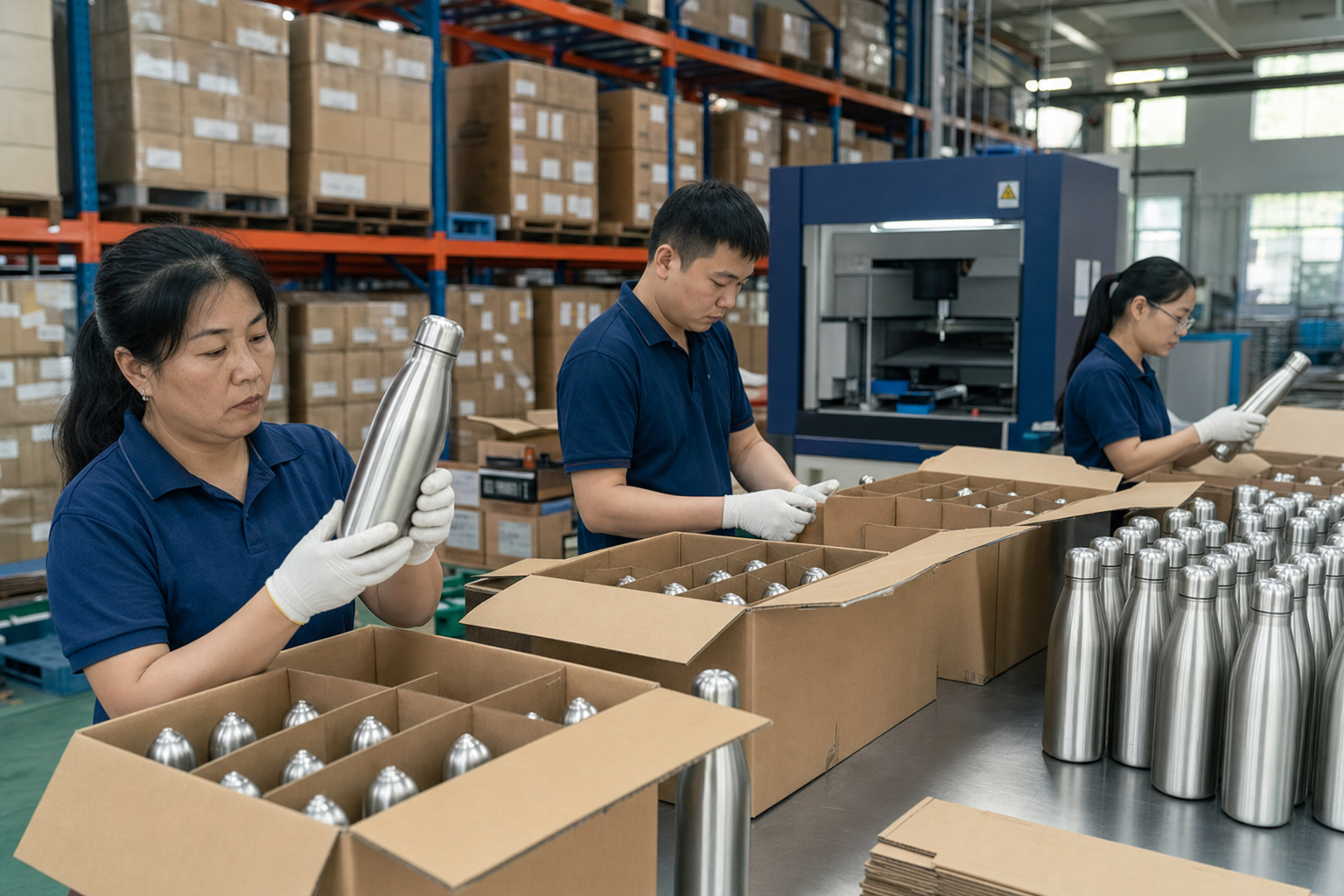
If you are sourcing promotional drinkware for a trade show on a 2-week or 3-week clock, time is the problem. Design is usually the easy part. Printing, stock allocation, inspection, and freight all hit the line at once, and one late artwork approval can wipe out the margin. We ship plenty of conference orders like this, and the buyer usually wants cartons counted, labels right, and pallets ready before the show floor opens.
At BottleForge in Zhejiang, we see the same order pattern every season: 1,000 to 10,000 units, a clean logo, and delivery before the booth build starts. That works if the bottle style is simple, the decoration is realistic, and the factory can move 50,000 units per month without guessing on stock. QC pulled the sample, checked the print at 150 mm from the cap line, and one buyer still flagged a PO typo on the ship-to name. Fair pushback. China can ship fast, but the brief has to be tight, or the math does not work.
Why lead time breaks orders
Lead time breaks in the same few places. The buyer approves artwork on Thursday, then changes from 1 color to 4 colors, asks for individual polybags, custom inserts, and split delivery to three venues. Every one of those changes adds time on the line. For a trade show calendar, 2 extra days can turn a useful giveaway into dead stock in the warehouse.
If you need promotional drinkware trade show inventory fast, build the order around what we can run without a new setup. A stock 500 ml stainless bottle with a single-color screen print is safer than a fully custom mold, and the math does not work the other way. In Zhejiang, a solid export factory can confirm blank stock within 24 hours, send artwork proof in 1 day, and finish production in 5-7 days for a 1,000-3,000 piece run. QC pulled the sample on a 5,000 g weight check and found the lid torque was fine, so that timeline held.
- Fastest route: stock model + one decoration method + standard carton pack
- Slow route: custom shape + mixed PMS colors + retail packaging
- Typical risk point: waiting for logo approval after sampling starts
Buyers often blame the factory. That is the wrong question to ask. Most delays start with the brief, and we see it on PO typos, missing PMS numbers, or a logo file sent as a low-res screenshot. If you want speed, clear the variables before the order goes in.
Pick stock shapes first
For event promotional orders, shape matters less than stock. A stock bottle with a 73 mm diameter, 260 mm height, and 500-650 ml capacity fits most conference bags and standard print setups. We ship faster when the shape is already on the shelf. Do not push a weird silhouette unless the brand team is paying for it.
The fastest picks are usually stainless steel single-wall bottles, vacuum tumblers, BPA-free PET sport bottles, and plain glass bottles with silicone sleeves. A trade show bottle needs to pack cleanly in cartons of 24 or 50, count fast on the line, and print without drama. QC pulled the sample last week and found one bottle body with a 1.5 mm neck mismatch; that kind of issue eats time. If the product already sits in the factory warehouse, you save 3-7 days right away.
What works best for urgent events
- Stainless steel bottle: 0.4-0.5 mm wall thickness, durable, premium look
- Travel tumbler: 304 inner, 201 outer on budget builds, MOQ often 500-1,000 pcs
- Sports bottle: light, low freight cost, suitable for 1-2 color printing
- Glass bottle: better for boutique events, but more breakage risk in transit
For a conference giveaway, a clean stock body with a good logo beats a custom shape that lands after the event. We have seen that go sideways more than once.
Many China factories keep core promotional drinkware models in semi-finished inventory. That helps only if you ask the right question: “Do you have this shape in blank stock now?” not “Can you make it fast?” The buyer once sent a PO with the wrong lid code, and we had to stop packing for half a day. This is the wrong question to ask, because speed starts with stock on hand, not promises.
Decoration choice changes timing
Decoration is where urgent orders lose a week. Screen printing stays economical, but every extra color means another screen, another pass, and more drying time on the line. Laser engraving is faster on 304 stainless steel because there is no ink curing, and it holds up better on an executive conference giveaway or a badge-style tumbler.
If the logo is simple, laser is the cleanest call. If the buyer wants a full-color brand panel, UV printing can work, but only when the machine slot is open and the curing rack is not stacked. We ship laser jobs in 2-4 days after proof approval in our Zhejiang factory; multi-color UV usually takes 4-6 days. The buyer flagged this on one PO because freight cutoff was fixed, and the math did not work any other way. QC pulled the sample with a 0.2 mm pinhole once, so we do not guess on timing.
For a promotional drinkware trade show order, keep the decoration spec tight:
- One logo location only
- One PMS color if possible
- Artwork in vector format, not JPG
- Line thickness above 0.25 mm so it prints cleanly
If the buyer wants names, add them only when the run is over 500 pieces and the data file is final. Variable engraving still works, but it is not a same-week job. We have seen it go sideways when the PO listed "John Smiths" for 80 pieces and the file had 79 names. Print complexity is a schedule line item, not a design choice.
MOQ and sample strategy
Fast sourcing is not just production speed. MOQ decides whether the job stays on schedule. For a standard trade show bottle, we usually run 500 to 1,000 pieces for stock colors, and 3,000 pieces if you want a custom body color or special packaging. Go below that and the unit price climbs fast, or the line gets held up because the factory has to merge your order with another batch. That math does not work.
Samples are where a lot of event managers overthink it. For urgent conference giveaway jobs, you do not need a full pre-production sample unless the decoration is complex. A blank sample or digital mockup covers 80% of fast-turn orders. QC pulled the sample last Friday, and the decorated one still needed 3-5 days. That is fine only if your event calendar gives you room.
Here is the practical rule: if delivery has to land in under 20 days, lock the product first, then confirm decoration. Do not reopen product selection after sampling starts. We have seen a 10-day order turn into 30 days because the buyer flagged one color, then changed the lid style, then asked for a new print file. Bad move.
A good export factory in Zhejiang should give you three things fast: stock confirmation, packing spec, and a real lead time. If they cannot tell you carton size, gross weight, and units per carton on the same day, they are not ready for urgent sourcing. One PO typo on carton marks can waste a full day in the packing room.
Shipping options under pressure
When the event date is fixed, freight decides the job. For a late conference giveaway, air is usually the safe move. Sea freight is cheaper on paper, but if the booth closes on Friday and the cartons land on Monday, the math is dead. For 1,000 stainless bottles at about 0.42 kg each packed, air freight can add roughly USD 2.0-4.0 per unit, depending on route and season. We had one buyer flag a PO typo on the ship date, and that single line would have pushed the cargo past the show.
If you have 25-35 days, expedited sea freight can still work from China to North America or Europe, as long as we ship early and leave room for customs clearance. We run this a lot on the line when the buyer wants the first drop at the venue and a second drop later. For true lead-time-tight sourcing, send the first lot by air or express, then refill by sea if the program repeats. That is the cleaner way to keep freight from eating the margin.
Ask for these before you confirm shipment:
- Gross weight and carton count
- HS code suggestion
- Commercial invoice and packing list draft
- Whether the goods are packed 24 pcs or 50 pcs per carton
Do not assume the lowest FOB quote wins. A USD 0.35 gap in unit price can disappear with one extra freight day or a poor carton layout. We saw this go sideways on a 600-unit order when QC pulled the sample and the carton test failed at 12 kg. On tight timelines, landed cost is the number that matters.
Quality checks you can still demand
Fast does not mean sloppy. If the ship date is tight, we still run a basic QC plan. For trade show drinkware, ask the supplier to work to AQL 2.5 for major defects and AQL 4.0 for minor defects. That setup catches leaks, dents, print shift, and loose lids without stopping the line. We checked one rush run last quarter: 18,000 cups, and QC still pulled a bad cap fit before packing.
Ask for REACH-compliant materials if you are shipping to Europe, and make sure any stainless steel contact surface is 304 or equivalent when that is part of your brand claim. For North America, a lot of buyers want FDA-style material declarations or a supplier statement, even when the item does not need full certification. We had a buyer flag a PO typo on the steel grade once, and that small mismatch turned into a week of back-and-forth. Keep the paper trail short. Keep it accurate.
In our Hangzhou export workflow, the fastest quality plan is one inspection before packing, then photo confirmation of 10 random cartons. That gives enough eyes on the goods without burning a day on over-inspection. You should also request:
- Leak test on 3-5 pieces per batch
- Drop test for outer cartons if the route includes air freight
- Print rub test after 24 hours curing
If the supplier cannot explain how they control defects, the order is not fast. It is rushed. We ship 500-unit samples through this process all the time, and the math does not work any other way.
Build a repeatable sourcing playbook
The best event managers do not start from zero each season. We see the same mistake every year: buyers rebuild the order from scratch, then the show date is already 18 days away. Build one playbook and keep it on file: approved product list, approved logo file, packing spec, backup supplier details. That is how you move from panic buying to repeat buying. On our line, the bottle shape, print position, and carton spec have to match the last run, or QC pulls the sample and the buyer flags it.
For a trade show bottle program, set up a master file with:
- Product code and capacity, such as 500 ml or 750 ml
- Decoration method and artwork format
- MOQ, unit price, and lead time by season
- Packaging spec and pallet count
- Contact person for rapid reorders
Once you have that, repeat orders get much easier. A decent Zhejiang factory can often reorder blank stock within 3 days and finish a small branded batch in under 10 days if the artwork stays unchanged. The math does not work if you keep changing the logo by 2 mm or send a new PO with a typo in the carton count. We run a lot of these rush jobs, and the ones that stay on schedule all have the same thing: one file, one spec, one backup contact. That is the kind of consistency you want when the next conference date gets announced late. Keep the file tight, keep the specs unchanged, and your next promotional drinkware trade show order will be less stressful than this one.
Need fast trade show drinkware now?
Send your quantity, event date, and logo file. We will confirm stock, MOQ, and a realistic lead time from Zhejiang today.
Frequently asked questions
What is the fastest realistic lead time for promotional drinkware trade show orders?
For stock shapes and one-color decoration, 7-12 days is realistic if artwork is final on day one. A 1,000-piece order can often be produced in 5-7 days in Zhejiang, then 2-5 days for air freight or express handling. If you add custom colors, special packaging, or name personalization, expect 15-25 days. The real limiter is not the factory press line; it is artwork approval, material allocation, and shipping cutoff. If you need the goods for a fixed conference date, build the schedule backward and leave 3-4 days of buffer.
Should I choose screen print or laser engraving for a conference giveaway?
If your logo is simple and you want a premium finish on stainless steel, laser engraving is usually faster and more durable. It also avoids ink curing delays. For a colorful brand mark, screen print works well, but one extra color can add 1-2 days and increase setup risk. For urgent orders under 2,000 pieces, many buyers choose laser on 304 stainless or matte-coated bottles because the schedule is more predictable. If you need a full-color event promotional look, ask for UV print only when the supplier can confirm line capacity immediately.
What MOQ should I expect for a fast-turn trade show bottle?
A stock trade show bottle often starts at 500-1,000 pieces for standard colors and one simple logo. If you want custom body color, custom cap, or retail box packaging, MOQ can rise to 3,000 pieces or more. Some Zhejiang factories can split stock inventory for smaller runs, but the unit price usually rises by USD 0.20-0.80. For event managers, the better tactic is to keep MOQ aligned with giveaway count plus 5-10% overrun, not to chase the lowest possible order size.
Can I ship promotional drinkware by air without blowing the budget?
Yes, but you need to accept that air freight can add roughly USD 4.5-8.0 per kg depending on route and season. On a 0.42 kg packed bottle, that can mean USD 2.0-4.0 per unit before local charges. For urgent conferences, air is often justified because a missed event is more expensive than freight. If you have 25-35 days, a faster sea service may be more economical. Ask for packed weight, carton count, and commercial invoice data before deciding, because freight cost depends heavily on packaging efficiency.
What quality documents should I ask for from a China supplier?
For Europe, ask for REACH-compliant material declarations and confirm the product contact materials. For North America, many buyers request supplier statements and material specs even when formal certification is not mandatory. Also ask for AQL 2.5 inspection results, leak test records, carton photos, and a packing list. If the drinkware is stainless steel, confirm grade such as 304 for the inner surface when that matters to your brand. A serious China factory should provide these documents quickly, usually within 24-48 hours after inspection.