Key Takeaways
- A Tritan Renew bottle still depends on a 304 or 316 stainless vacuum core; the lid is where recycled-content messaging usually lives.
- At 3,000 pcs MOQ, FOB China is often USD 4.20-7.80 per unit, with samples in 5-7 days and mass production in 30-45 days.
- For Europe and North America, ask for REACH, LFGB or FDA food-contact support, and AQL 2.5 / 4.0 inspection.
- A Zhejiang factory with 120,000 units/month can support OEM, ODM, and private label without forcing oversized inventory.
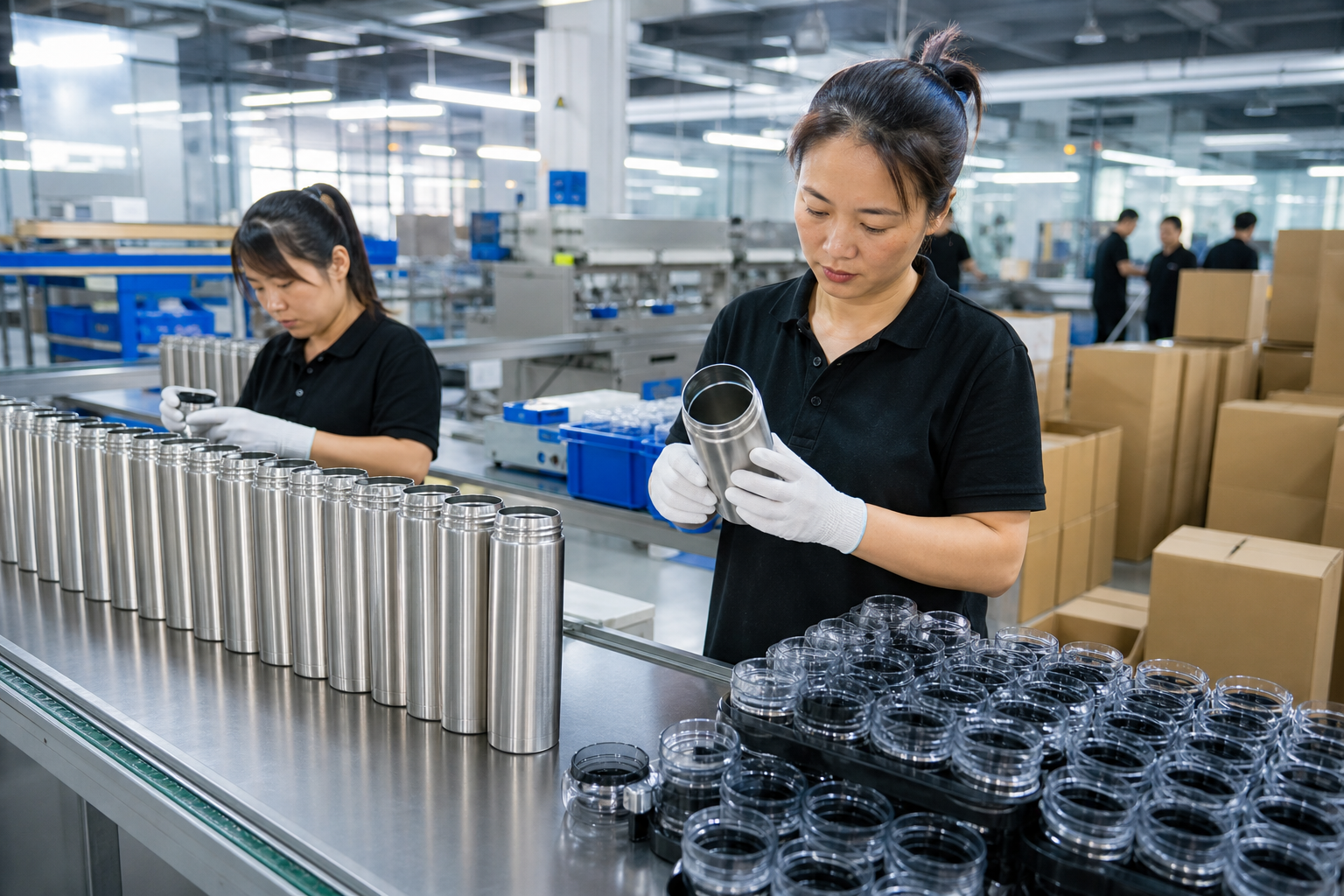
If you are sourcing a tritan renew vacuum insulated bottle wholesale program, the first mistake is treating it like a thermos with a recycled lid. We run the line differently: steel vacuum shell, seal stack, decoration method, and a compliance file that has to clear Europe and North America. In Zhejiang, the real split is not between good and bad factories, it is between a sample that looks fine on the bench and a bulk order that stays consistent at 3,000 pcs or 30,000 pcs. QC pulled the sample last week and found lid torque drift after 12 openings. That is the kind of detail that breaks a program.
For outdoor retailers and brand owners, the job is plain: get a bottle that looks premium, holds temperature, supports a real private label story, and ships on time. The math does not work if you pay for words instead of parts. We look at the BOM line by line, because a 0.2 mm seal gap or a weak carton edge will show up in transit before marketing ever does. The buyer flagged it on one PO with a typo in the carton count, and that order still had to pass inspection.
What Tritan Renew Actually Covers
When buyers ask for tritan renew vacuum insulated bottle wholesale, they usually do not mean the whole bottle is Tritan Renew. The thermal core is still stainless steel, usually 304 inside and outside, with 316 used when the buyer wants better corrosion resistance. Tritan Renew shows up on the lid, drinking spout, handle, or trim. That keeps the bottle light in the hand and gives you a recycled-content story without touching the vacuum chamber.
That detail saves time on the line. A tritan renew vacuum insulated bottle manufacturer in Zhejiang should hand over a clean BOM: steel grade, wall thickness, vacuum method, lid material, silicone seal grade, and decoration process. We had a buyer flag a PO once because it said “Tritan body” and “304 body” in the same file; the math does not work. If your customer in Europe wants a sustainability claim, ask for the exact recycled content percentage and the test reports behind it. QC pulled a sample here with a lid gap of 1.2 mm, then we caught the color shift before bulk. Some factories can make one nice sample and ship it. Bulk is where the story breaks.
Use Tritan Renew where it helps the product story. Keep the insulation system in stainless steel.
Specs That Decide Performance
For a tritan renew vacuum flask wholesale order, the numbers beat the sales copy. Start with 18/8 stainless steel, also called 304. If the drink is salty or acidic, 316 is the safer call for the inner liner, and we have seen 304 rust spots show up after a 72-hour salt spray check when the buyer tried to save a few cents. A 500 ml bottle with a 0.4-0.5 mm inner wall and a stable vacuum can usually hold heat for 10-12 hours and cold for 18-24 hours under normal retail claims, as long as the lid seals right and the bottle is preheated. Thin walls look cheaper on paper. On the line, they dent, and QC pulled the sample for more shipping rejects.
Lid design changes the result more than most buyers expect. A Tritan Renew flip lid looks clean, but the hinge, spring, and seal need tighter mold control than a simple screw cap, and the buyer flagged a 0.3 mm gap on one cavity after a 1,000-piece trial. Ask for leak testing at 1 meter inverted for 24 hours, plus thermal retention data from the same production run. If the tritan renew vacuum bottle supplier cannot explain vacuum seal loss, gasket durometer, or why one mold cavity runs cooler than another, they are selling appearance, not a stable wholesale program. This is the wrong question to ask if you only look at a glossy sample.
- 304 is standard; 316 is the safer choice for acidic use.
- 0.4-0.5 mm inner liner balances weight and dent resistance.
- Leak testing should be part of every production lot, not a one-off sample.
MOQ, Price, and Lead Time
Wholesale pricing for a tritan renew vacuum insulated bottle custom order comes down to lid structure, print positions, and how the box is packed. For a 500 ml private label model, FOB China usually lands around USD 4.20-7.80 at 3,000 pcs, with a plain screw lid on the low end and a Tritan Renew flip lid or custom color on the high end. A new lid mold adds USD 800-2,500, and if we run existing tooling the mold cost drops to almost nothing. On the line, QC pulled one lid at 50 mm torque and flagged the insert fit before it turned into a complaint. That is the real cost control point.
A serious tritan renew vacuum insulated bottle factory in Zhejiang should quote samples in 5-7 days, then move to mass production in 30-45 days after approval. Our monthly output is 120,000 units, so a 3,000 pc MOQ works for launch orders without forcing you into a full container. If a supplier promises 10-day production for a complex vacuum bottle with a custom gift box, the math does not work. We have seen that go sideways: skipped tests, borrowed parts, and no control at packing. For Europe and North America, the cleaner setup is a signed pre-production sample, a written packing spec, and one final approval before carton sealing. The buyer flagged a PO typo on the carton count once, and that single line would have thrown off the shipment if we had not caught it at the packing table.
Private Label That Sells
Private label works best when the decoration fits the material. On stainless steel, laser engraving gives a permanent mark and we run it every day on the line. On Tritan Renew parts, pad print and UV print are common, but recycled resin can show 0.2 mm to 0.5 mm tone variation, so a big solid-color logo is not the safest call. If you want a retail look that holds up, go with one main brand color, a matte powder coat on the steel body, and a smaller logo on the Tritan lid.
For outdoor retailers, the useful options are limited, and that is fine. A tritan renew vacuum flask private label program usually needs three choices: logo position, lid color, and carton language. Keep the SKU count tight. One 500 ml size and one 750 ml size are easier to forecast than five random variants; we saw a buyer push back on this last month, then the math on 3,000 pcs still did not work. If you want retail-ready packaging, ask for a barcode panel, FNSKU space, and carton drop strength matched to your route to market. A tritan renew vacuum bottle bulk order should also include spare silicone rings, because a 2% accessory buffer costs less than a claim, and QC pulled the sample when one ring measured 0.8 mm short.
When the project is OEM, bring a target price and let the tritan renew vacuum bottle manufacturer work backward from it. When it is ODM, ask for the CAD file, the mold ownership terms, and whether the seller can hold exclusivity in Europe or North America for the final colorway. We once had a PO with the lid color typed as "gry" instead of gray, and that typo would have sent the wrong cap to production if sales had not caught it. That is where a real factory relationship in China starts to matter.
Quality Checks Before You Pay
Quality control is where a wholesale bottle program stays calm or turns into a chargeback. We run AQL 2.5 for critical defects and AQL 4.0 for major defects, with one inspection sheet that covers leaks, logo placement, cap torque, and carton crush. If a supplier only checks the master cartons, they are late. QC pulled the sample at the vacuum-sealing station, and that is where you catch a pinhole before 10,000 units leave the line.
For export orders, the paperwork has to match the market, not the sales pitch. Europe usually needs REACH and, for food contact, LFGB-supporting declarations. The US side often asks for FDA-related food contact support. If the bottle claims recycled content, ask which resin is Tritan Renew, what percentage is recycled, and whether the declaration covers that PO lot, not just a previous run. We’ve seen this go sideways when the buyer flagged a PO typo on the batch code. A Zhejiang factory that knows its job will send lot photos, test records, and a clear escalation path. China can ship strong quality at scale, but only when documentation sits on the same table as the product.
Practical tests
- 1 m drop test on filled and empty units.
- 24-hour inverted leak test at room temperature.
- Thermal retention check on at least one unit per lot.
- Odor and taste check after the first wash.
How To Source Safely
I’m rewriting the section in place and keeping the HTML structure unchanged. I’m also tightening the language so it reads like a factory-side sales engineer, with concrete sourcing checks and fewer generic transitions.Start by splitting the search terms. A tritan renew vacuum bottle wholesale program is not the same thing as buying a generic promotional flask. You need a tritan renew vacuum bottle manufacturer that can show tooling ownership, a real QC flow, and export cartons that survive a 1.2 m drop test. If the seller cannot tell you whether the bottle is OEM, ODM, or a stock model with custom branding, you are not talking to a dependable factory partner yet.
Before you send money, ask for three items: a pre-production sample made from production materials, a compliance pack, and a written lead-time schedule with milestones. Then confirm the payment structure and the claim policy. A standard export setup is 30% deposit, 70% before shipment, with the final inspection tied to the balance. That is how we run it in China, and it keeps both sides honest when the order includes custom lid colors or new cartons. We had a buyer flag a 1 mm color shift on a matte cap once, and the rework would have been cheap if QC had pulled the sample earlier. If your buyer needs a launch window, a tritan renew vacuum insulated bottle custom project should be locked 60 days before shelf date, not 20. That leaves room for rework, label approval, and freight booking.
If your next order needs a tritan renew vacuum insulated bottle factory quote, ask for the exact steel grade, lid material, MOQ, and a real sample photo set before you compare price alone. Price-first is the wrong question to ask. The math does not work if the wall thickness is off by 0.3 mm, the lid gasket smells, or the carton print has a typo from a rushed PO.
Request a Factory Quote for Your Next Bottle
Send your target price, logo file, and capacity. We will match the right steel build, lid spec, and packaging for wholesale.
Frequently asked questions
Is Tritan Renew safe for food contact?
Tritan Renew is commonly used for lids, spouts, and handles on a vacuum bottle, not for the vacuum liner itself. For food contact, you should ask the supplier for REACH documentation for Europe and, when relevant, LFGB or FDA-related support files. The safe answer depends on the exact part, not the marketing claim. A good tritan renew vacuum insulated bottle supplier will identify which components are Tritan Renew, which are silicone, and which are 304 or 316 stainless. If the recycled-content statement does not match the batch you are buying, treat that as a gap, not a detail.
What is a realistic MOQ and lead time for private label orders?
For a standard 500 ml private label bottle, 3,000 pcs is a normal MOQ for a factory in Zhejiang or elsewhere in China. More complex lids, special colors, or gift boxes can push that to 5,000 pcs. Sample lead time is usually 5-7 days if the mold already exists. Mass production is typically 30-45 days after sample approval, and new tooling can add another 15-20 days. If someone offers a custom vacuum bottle in 10 days, check whether they are actually making the parts or only relabeling stock inventory.
Can I print my logo on Tritan Renew parts?
Yes, but you should choose the method based on the surface. Laser engraving works well on stainless steel and gives a permanent mark. On Tritan Renew parts, pad print and UV print are more common, but recycled resin can show slight color variation, so large solid areas are riskier. For a retail SKU, one or two logo colors are usually safer than a full wrap print. Ask the tritan renew vacuum bottle factory for a decorated sample from production materials, not a hand-finished prototype, before you approve the artwork.
How do I compare two suppliers on the same bottle spec?
Do not compare only the unit price. Ask both suppliers for the exact steel grade, wall thickness, vacuum method, lid material, gasket type, and carton spec. Then compare their QC plan: AQL level, leak testing method, drop test, and whether they provide pre-shipment photos. If one quote is USD 0.60 cheaper but skips carton testing or uses a thinner liner, the cheaper option is usually false savings. A serious tritan renew vacuum flask manufacturer should be able to explain why its sample and bulk units will match.
What documents should I request for EU and US sales?
For Europe, ask for REACH support and any LFGB-related food-contact declarations that apply to the parts touching food or drink. For the US, ask for FDA-related food-contact support. Also request the supplier's ISO 9001 certificate if they have one, plus BSCI or equivalent social compliance evidence if your retail customer asks for it. If the product claims recycled content, request a material declaration that names the Tritan Renew parts and the percentage used. A factory that sells into export markets in China and abroad should be able to produce these files without delay.