Key Takeaways
- A standard vacuum bottle for promotional gifts usually starts at 500 ml, MOQ 1,000 pcs, with FOB China prices around USD 2.80-6.50 depending on finish and lid
- 304 stainless steel is the usual commercial choice; 316 costs about 12-20% more and makes sense only for higher-value outdoor or premium programs
- Typical production lead time in Zhejiang is 25-35 days after sample approval, with sample turnaround in 5-7 days
- For Europe and North America, ask for REACH or LFGB-friendly materials, AQL 2.5 inspection, and carton/drop test details before you place the order
If you are sourcing a vacuum bottle for promotional gifts, the first question is not “what looks nice?” It is whether the bottle can survive a 1.2 m drop test, pass transit, and still fit the target cost. We have seen a shiny sample lose the order because the cap cracked in carton packing. A cheap thermos hurts the campaign fast.
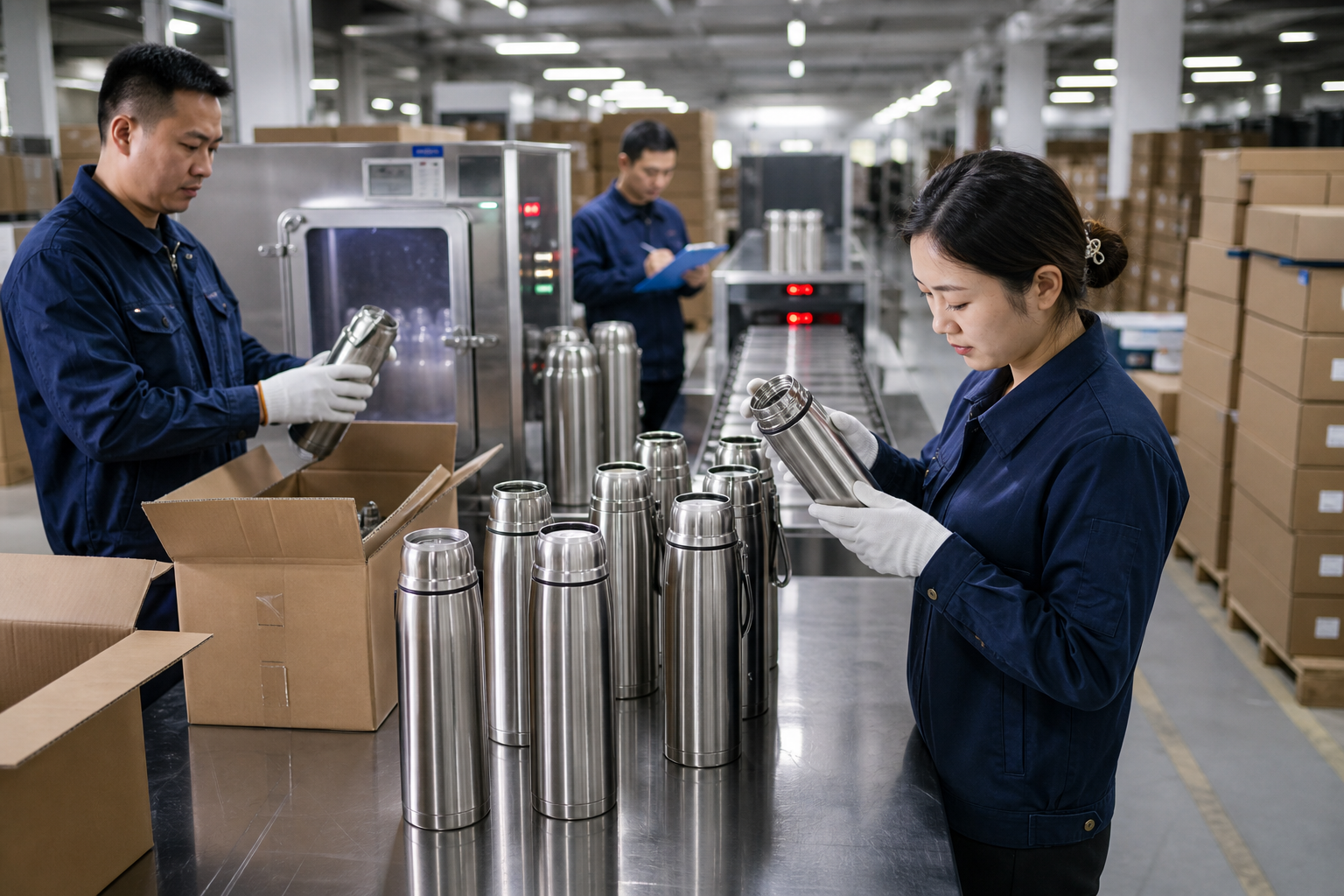
From our factory in Hangzhou, Zhejiang, we run stainless thermos production for brands, distributors, and corporate buyers in Europe and North America. The starting specs are plain: 304 or 316 stainless steel, 0.4-0.5 mm inner wall thickness, 500 ml or 750 ml capacity, and a decoration method that matches the budget. QC pulled the sample on the line and checked the weld seam at 0.3 mm, because that detail shows up in use and in claims. If the buyer wants a bottle for staff gifts or giveaways, the math has to work before the artwork does.
What buyers really pay for
People search vacuum bottle for sale online and see the outside first: matte coating, logo, maybe a price under USD 4. That is not the product. We run the line for 5,000-unit promo orders and the bill is driven by steel grade, vacuum retention, lid fit, coating wear, and whether the factory can keep tolerances tight. A 0.3 mm gap on the lid thread will show up fast. On a gift project, that gap turns into leaks, bad reviews, and reorders that never come back.
For a serious vacuum bottle for promo program, the cost drivers are straightforward:
- Material: 304 stainless steel is the baseline; 201 is cheaper, but export gift buyers usually regret it after the first QC pull.
- Construction: single-wall is the wrong spec for thermal use; double-wall vacuum construction is standard, and the vacuum chamber is where the money goes.
- Finish: powder coating, spray paint, or brushed steel change the feel in hand and the scratch rate on the packing line.
- Lid: PP, AS, stainless, or a tea-infuser top all change cost, seal life, and the leak test result.
- Decoration: silkscreen, laser engraving, UV print, or 360° wrap printing each fit a different budget and a different MOQ.
In Zhejiang, good factories quote structure first and decoration second. That is the right way. The buyer flagged a fancy outer carton on one PO, but the math did not work because the lid seal and insulation held the real value. If you want a vacuum bottle for business that gets used at work, ask for the gasket spec, the drop-test result, and the heat-retention data before you talk about the box.
Choose the right steel and wall
For most vacuum bottle for promotional gifts orders, 304 stainless steel is the right default. It runs well on the line, the price stays workable, and export buyers know what they are getting. If the brief is a premium outdoor bottle for athletes, runners, cyclists, or a hiking campaign, 316 inner steel is a cleaner upgrade. We have seen the buyer flag the cost on a 5,000 pcs PO, and that pushback is normal. 316 resists corrosion better, but it is not magic; you pay more, and you get a stronger premium story.
The wall structure matters just as much. A common spec is 0.4 mm inner wall and 0.5 mm outer wall for a 500 ml bottle. That balance keeps the bottle solid without adding dead weight. If a supplier quotes 0.25 mm walls, ask for the tube gauge and the draw process. Thin steel dents fast. It also feels cheap in hand. For a vacuum bottle for employees or a vacuum bottle for companies, that hand feel is part of the gift value, and the math does not work if the shell is too thin.
We see buyers chase capacity and miss thermal data. A properly made 500 ml bottle should usually keep hot water above 60°C after 6 hours and still be usable after 12 hours, depending on lid type and room temperature. Ask for test data, not sales copy. QC pulled the sample, checked the lid seal, and found a 1 mm gap on one lot because the stopper thread was off by a hair. If you source from China or Zhejiang, ask for insulation reports, salt-spray results for coated parts, and REACH or LFGB declarations when your market calls for them.
Decoration that survives real use
Promotion buyers always want the logo big. The problem is wear. A vacuum bottle for swag at conferences can use silkscreen printing when the budget is tight and the artwork stays in 1 or 2 colors. For a vacuum bottle for marketing that needs a cleaner premium look, laser engraving wins because it does not peel, and we ship a lot of 304 stainless cups this way. Powder-coated bottles also hide light scratches better than glossy painted finishes; we saw a 0.3 mm scratch on a gloss sample get flagged by QC after one day in a tote bag.
Here is the practical rule: choose the method based on handling, not just appearance. The buyer once sent a PO with the logo size written as “30cm” instead of “30mm”; the math did not work.
- Silkscreen: best for simple 1-2 color logos, usually the lowest cost.
- Laser engraving: sharp, permanent, good for stainless or powder-coated surfaces.
- UV print: useful for complex colors, but you need good adhesion testing.
- Heat transfer or wrap print: suitable for bold promotional graphics, especially for events or ecommerce bundles.
If the bottle will be used as a vacuum bottle for giveaways, you want a finish that still looks clean after 3 months of car cup holders and desk abuse. For a vacuum bottle for schools or students, a bright coating plus engraved or printed name space can make the product feel more personal and cut mix-ups. Factories that export regularly should show abrasion test photos or a rub test standard before mass production; we run a 100-cycle rub check on the line and reject the sample if the print starts to haze.
MOQ, pricing, and lead times
Let’s talk numbers, because procurement lives on them. For a vacuum bottle for promotional gifts, our normal MOQ is 1,000 pcs per color or per SKU. We have seen 500 pcs work in Zhejiang, but the unit price jumps enough that the math stops working. For a standard 500 ml model, FOB Ningbo or Shanghai usually lands at USD 2.80-4.20 for basic 304 steel with one-color print, and USD 4.50-6.50 for powder coat plus laser engraving or a better lid. Once you add 316 steel, tea-infuser lids, or gift packaging, USD 7.50+ is normal. QC pulled a sample last week with a lid cap typo on the carton, and that kind of slip is why we check pack-out before price is signed off.
Lead time is where buyers lose days by staying vague. Sample production usually takes 5-7 days. Mass production for 5,000-20,000 pcs is usually 25-35 days after sample approval and deposit. Ocean freight adds another 15-30 days depending on destination and season. If the project is tied to a seasonal event, 60 days from artwork approval to warehouse arrival is the safe plan. We had a buyer push back on a 28-day ship date once, then asked for a 2,000 pcs rush after the PO was already confirmed. The line can move, but not on wishful dates.
Our Hangzhou plant runs 300,000 units a month across stainless thermos lines, so split shipments and staggered delivery dates are normal for us. That matters when one carton goes to a launch and the next carton goes to replenishment. Ask for carton quantity, gross weight, and pallet dimensions early. If the project is for vacuum bottle for ecommerce or retail distribution, we also check whether the outer carton fits a 1.2 m pallet without overhang. The buyer flagged this on a 40HQ once, and we had to rework the carton count before booking. That saved a headache at loading.
Match the bottle to the end user
A good sourcing brief starts with the user, not the logo. A vacuum bottle for employees is a different spec from a vacuum bottle for athletes or a vacuum bottle for children. Office gifting usually runs to clean lines, 500 ml to 750 ml, and neutral colors like black, silver, or white. Outdoor retail wants a stronger lid, better grip, and often 750 ml or 1,000 ml sizes. Schools and children’s programs need lighter bottles, safer lids, and sometimes a smaller 350 ml or 450 ml body that fits small hands and backpacks.
For a vacuum bottle for restaurants, cafes, hotels, or conference venues, presentation matters more than extreme thermal performance. A lot of hospitality buyers ask for a matte finish, subtle branding, and cartons that stack cleanly on the pallet; one chain buyer once flagged a 3 mm taller box because it blew up the loading plan. For a vacuum bottle for gym or fitness promotions, a wide-mouth opening and easy-clean lid beat flashy graphics. If your customers are cyclists or hikers, a carry loop, anti-slip base, and a secure one-handed cap are worth paying for.
Do not order one generic bottle and try to force it into every channel. A vacuum bottle for schools and a vacuum bottle for runners are not the same product, even if the logo is identical.
That is why distributors often buy 2 or 3 variants under one brand system. Same logo, different lid, different pack-out. QC pulled the sample on one order because the PO said 450 ml and the buyer meant 550 ml; the math does not work if you ignore that detail.
Quality checks before you buy
You do not need to become a QA engineer, but you do need a simple inspection plan. For a vacuum bottle for promotional gifts, we run leak tests, insulation checks, coating adhesion, and carton drop testing before shipment. Ask the factory to test samples at 0°, 45°, and upside down for at least 30 minutes with hot water. Then ask for a thermal sheet with initial water temperature, ambient temperature, and readings at 6 hours and 12 hours. QC pulled the sample on a Friday, and the lid still wept at 45°—that is the kind of miss you want to catch before the PO is locked.
For production control, AQL 2.5 is a normal commercial standard for major defects, with a tighter check on leakage and lid fit. If the buyer flagged a leaky cap on the pre-shipment sample, we do not argue about theory; we rerun the test. For printed graphics, ask for rub resistance after 50-100 abrasion cycles. If the bottle has powder coating, request cross-hatch adhesion data or a documented tape test. For export to Europe and North America, make sure your supplier can provide material declarations and, when needed, compliance support for food-contact requirements. A missing 304 stainless declaration or an LFGB file will slow the booking down fast.
Packaging counts too. A bottle can pass function testing and still arrive damaged if the inner tray is weak. For a vacuum bottle for companies or a large campaign for events, insist on carton compression details, drop test results from 80 cm, and clear master carton labeling. We once saw a PO with the carton mark typed as “12pcs/ctn” on one line and “120pcs/ctn” on the next. The math does not work. In Zhejiang, experienced exporters know the line can pass, then the freight can ruin the job if the tray is only 3 mm too thin.
Send your spec and get a real quote
Tell us capacity, logo method, target price, and delivery country. We will quote a vacuum bottle for promotional gifts with factory numbers, not guesswork.
Frequently asked questions
What is the usual MOQ for a vacuum bottle for promotional gifts?
The most common MOQ is 1,000 pcs per color or per design. Some factories in China will accept 500 pcs for a custom run, but the unit price usually climbs 15-30%, which weakens the savings. For a standard 500 ml bottle, 1,000-3,000 pcs is the sweet spot for brands, distributors, and event buyers. If you need mixed colors, confirm whether the factory treats each color as a separate MOQ. That detail matters more than people expect.
How much should I budget per unit FOB China?
For a basic 304 stainless 500 ml bottle with one-color print, budget roughly USD 2.80-4.20 FOB China. Add powder coating and laser engraving, and you are usually in the USD 4.50-6.50 range. If you upgrade to 316 steel, a premium lid, or gift packaging, the cost can move above USD 7.50. Freight, duties, and local fulfillment are separate. If you are buying for ecommerce or retail, include 8-15% for extra packaging and damage allowance.
What lead time should I expect from a Zhejiang factory?
Sample lead time is usually 5-7 days after artwork and specs are confirmed. Mass production for a typical 5,000-20,000 pc order is often 25-35 days after sample approval and deposit. Ocean freight to Europe or North America adds about 15-30 days depending on the route and season. If your campaign is tied to a conference, school term, or holiday launch, build in at least 60 days total. Tight schedules are possible, but only if the artwork is final and the packaging is simple.
Which decoration method is best for a vacuum bottle for business?
For business gifting, laser engraving is usually the safest choice because it is permanent and looks clean on stainless steel or powder-coated surfaces. If your logo is simple and the budget is tight, silkscreen printing works well. For colorful marketing campaigns, UV print can be effective, but you should ask for adhesion testing. The best method depends on use, not just appearance. A bottle for employees, hotels, or conferences needs different durability than a bottle for giveaways or swag.
Can you support compliance for Europe and North America?
Yes, but you should ask for it early. For Europe, buyers commonly request REACH-related documentation and, where applicable, food-contact support. For North America, many brands want material declarations and testing aligned with their internal compliance program. If the bottle uses coatings, inks, or plastic lids, those components should be documented too. A good factory in China should provide traceable BOM details, sample retention, and batch records. If the supplier hesitates on documents, treat that as a warning sign.