Key Takeaways
- A 500 ml vacuum flask for promotional gifts usually lands at USD 2.20-3.80 FOB at 1,000-3,000 pcs.
- MOQ for custom logo thermos bottles is often 500-1,000 pcs, with 20-35 day lead times from Zhejiang, China.
- 304 inner steel and a 0.4-0.5 mm wall give better insulation and fewer warranty issues.
- For brand campaigns, laser engraving lasts longer than silkscreen on high-touch promotional drinkware.
If you are buying a vacuum flask for promotional gifts, the first mistake is treating it like a generic tumbler. A good stainless thermos for branding has to survive pad printing, carton drop tests, and daily use without leaking, denting, or turning into a return problem. On our line in Zhejiang, QC pulled a sample with a 0.35 mm wall on the outer shell and the buyer flagged the lid gap on the first round, which is exactly where cheap orders go sideways. We see buyers lose margin when they chase the lowest unit price and ignore wall thickness, lid seal quality, and the packaging cost per carton.
The right buy is a balance: 304 stainless inside, 201 or 304 outside depending on budget, double-wall vacuum construction, and a decoration method that fits your artwork and timeline. For a standard 500 ml promotional flask, factory pricing can start around USD 2.20-3.80 FOB at 1,000-3,000 pcs, with lead times of 20-35 days. A 500 ml cup looks simple, but the math changes fast once you add a color box, inner tray, and one extra logo color. If you are sourcing for a campaign, employee program, or retail launch, you need something that looks good on day one and still holds up after 6 months of use.
What buyers actually need
When you source a vacuum flask for promotional gifts, you are buying a marketing item that has to earn desk space. It needs to carry well, stay light, and keep liquid hot enough that people use it twice, not once. For vacuum flask for business programs, a leak or weak insulation hurts more than the unit price. We saw a 500 ml sample come back after 12 days with a lid seep at the thread, and the buyer flagged it fast.
For most vacuum flask for companies orders, the usual spec is a 450-750 ml stainless steel double-wall flask with a screw lid or push-button lid. If the audience sits in an office, 500 ml is the safe pick. For vacuum flask for employees and vacuum flask for giveaways, broad use beats a fancy shape. For vacuum flask for schools, vacuum flask for students, and vacuum flask for kids, ask for a tighter lid seal, rounded mouth edges, and a powder-coated finish that can take backpack rub. QC pulled the sample on a 3 mm lid gap once, and the math did not work.
- 500 ml: the best all-around promotional size
- 18/8 inner liner: preferred for food-contact durability
- 6-12 hour heat retention: acceptable for corporate gifting
- Gift box with insert: often adds USD 0.30-0.90 per set
Materials and insulation specs
Do not accept vague material descriptions. In our shop, “stainless steel thermos” can mean three different builds on the same line. If you need a vacuum flask for sale online or a retail-ready vacuum flask for ecommerce, spell out the inner and outer steel grades, vacuum level, and coating on the PO. The common build we ship is 304 stainless inside, 201 or 304 outside, with wall thickness at 0.4-0.5 mm. Once you go below 0.35 mm, dents show up in transit and after a week in a bag.
Insulation has to be measured with a thermometer, not a slogan. For a 500 ml flask, 60°C after 6-8 hours is a fair target under normal test conditions, and the better runs on our line hold heat for 12 hours or more. For vacuum flask for hiking, vacuum flask for gym, vacuum flask for fitness, vacuum flask for athletes, vacuum flask for runners, or vacuum flask for cyclists, a sweat-free shell and a carry loop that does not crack at the rivet matter more than a fancy silhouette. For vacuum flask for restaurants, vacuum flask for cafes, and vacuum flask for hotels, we push a neutral finish and threads that clean fast. The buyer flagged a glossy body once; fingerprints killed the deal.
Ask for test data, not slogans: vacuum retention, thermal retention, salt spray, and dishwasher risk notes if your market expects them.
If you are selling into Europe, ask for REACH compliance and a materials declaration. For North America, some buyers ask for LFGB-style food-contact paperwork and carton drop-test confirmation for ecommerce fulfillment. We had a PO last month with “LFGB” typed as “LFGF”; QC pulled the sample, and the paperwork stopped the shipment for two days. The math does not work if the documents are sloppy.
Decoration methods that survive use
I’ve got the structure and constraints. I’m rewriting the prose in place, keeping the HTML tags and the existing pricing numbers intact, while adding the kind of factory-level detail that reads like someone who runs the line.The decoration choice decides whether your promo flask comes back with a clean logo or a scratched complaint. For sharp logos and small artwork, laser engraving is the durable call; it does not peel, and it holds up on brushed or powder-coated steel. Silkscreen is cheaper for larger flat-color graphics, but the ink sits on the surface and takes abuse fast. On the line, we have seen a sample pass QC in the morning and come back marked up after 3 days in a gym bag. If the bottle will move through conferences, offices, or backpacks, I would take durability over saving a few cents.
For a marketing run, match the decoration to the buyer and the use case. A minimalist laser mark fits executives and premium retail. A 1-color silkscreen fits vacuum flask for swag, vacuum flask for events, and high-volume giveaways. The wrong question is whether one method looks good on a render; the real issue is registration on a curved body, where 1-2 mm drift makes small text look rough. One PO came in with "1mm" typed as "1m", and QC pulled the sample before it reached packing. If the art has gradients or tiny text, change the art or change the decoration method.
Typical decoration cost at factory level:
- Laser engraving: USD 0.15-0.40 per unit
- 1-color silkscreen: USD 0.08-0.25 per unit
- Full-color UV print: USD 0.30-0.80 per unit
For volume orders in Zhejiang, China, we run one decoration method per SKU. Mixing finishes lifts setup cost, slows the line, and gives QC more points to check. A 5,000 pcs order with two print styles can add a full day at setup, and that is before the first carton gets labeled. One clean method ships easier.
MOQ, pricing, and lead times
Pricing for a vacuum flask for promotional gifts comes down to body size, steel grade, lid structure, and how you pack it. A plain 500 ml single-wall mug is one thing. A double-wall vacuum flask with a screw lid and gift box is another. On the line, those are not the same job. For a standard promo build, MOQ is usually 500-1,000 pcs per color and 1,000 pcs per logo version. If the buyer wants 3 Pantone colors, the MOQ goes up, or we add a color surcharge.
For export planning, use these numbers: basic promotional flask, USD 2.20-2.80 FOB; mid-range branded flask, USD 2.80-3.80 FOB; premium powder-coated or copper-lined option, USD 3.80-6.50 FOB. Lead time is usually 20-35 days after sample approval and deposit. If you need custom printing, outer carton labels, and retail insert cards, add 3-5 days. We had one PO where the buyer wrote the logo code wrong by one letter, and QC pulled the sample back before printing. Saved a mess.
Our Hangzhou, Zhejiang factory runs about 300,000 units a month across stainless thermos lines, so repeat orders move fast once artwork is fixed. The real hold-up is not machine time. It is sample sign-off, packaging choices, and the buyer changing the logo after production starts. We've seen that go sideways more than once. A 2 mm logo shift sounds small, but it can stop the whole batch.
For vacuum flask for businesses and vacuum flask for companies campaigns, ask your supplier to quote separately for:
- Flask body
- Lid or cap
- Gift box
- Outer carton packing
- Testing and compliance documents
How to qualify a supplier
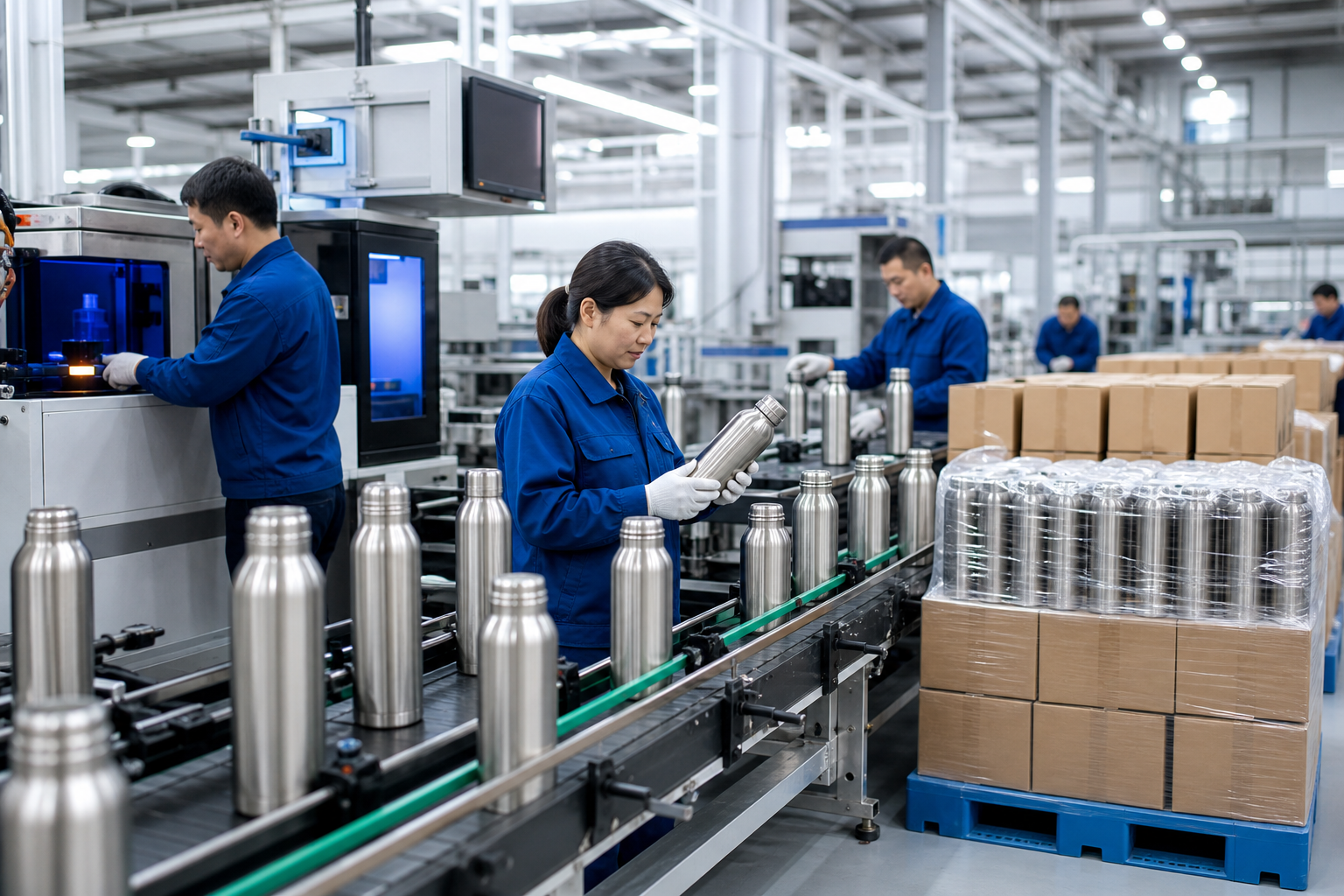
If you are sourcing a vacuum flask for promotional gifts from China, supplier qualification matters more than the sample photo. You want a factory, not a trading-only middleman with loose control. Ask where the vacuum sealing is done, whether the plant has pressure leak testing, and what the defect rate is at final inspection. We run AQL 2.5 for major defects and AQL 4.0 for minor defects on this type of drinkware, but that only works if the line actually follows it. One missed seal and the buyer flags it fast.
When you review a factory in Zhejiang, China, check for BSCI or similar social compliance if your end customer asks for it. Ask for ISO 9001 if you want process discipline, and ask for recent test reports for coating adhesion, thermal performance, and food-contact safety. A good factory should show vacuum sealing, polishing, and packing line photos or video without a long back-and-forth. If they stall, move on. We saw a 304 stainless lot pass on paper and fail a random magnet check at 2.5 mm wall stock, so this is the wrong question to ask if you only trust a brochure.
Practical sourcing questions:
- Can you hold the same color across a 3,000 pc repeat order?
- What is the actual leakage rate after 24-hour upside-down testing?
- How many cartons per master carton, and what is the gross weight?
- Can you print FNSKU or retailer barcodes directly on the box?
For ecommerce and Amazon-style programs, carton strength and labeling matter as much as the flask itself. One crushed box can sink a bulk shipment. We ship cartons at 5-layer kraft board, and QC pulled the sample from a 1.8 m drop test after the buyer flagged a PO typo on the carton mark. The math does not work if packing is treated like an afterthought.
Use cases by market segment
The phrase vacuum flask for can mean different things by channel. For schools and students, buyers watch price, color count, and a lid that survives a drop on tile. For kids, 350-400 ml usually sells better because it fits a backpack pocket, and the mouth ring has to feel smooth. We had one buyer flag a sharp rim on a 12 oz sample, and QC pulled it off the line that same day. For athletes and runners, a light body and one-hand cap open faster. For cyclists and hiking customers, a carry handle or a carabiner hook moves the order.
For hotels, restaurants, and cafes, you are not selling a hero SKU. You are buying a service item or a branded resale gift, so repeatability and easy reordering matter more than a new shape. For one chain order, the PO typo said 500 pcs in one line and 5,000 in the notes, and that kind of mess slows the line. For conferences and events, the flask has to fit in a tote bag and still look clean with low-cost packaging. For vacuum flask for swag programs, one logo placement usually beats full-wrap artwork because people keep and use it.
When you build a long-tail cluster around vacuum flask for promotional gifts, vacuum flask for business, vacuum flask for employees, and vacuum flask for ecommerce, the same rule applies: match the product to the use, not just the logo. A buyer in North America may want a matte black bottle with a laser mark and a 0.3 mm etch depth. A distributor in Europe may ask for neutral colors, recyclable packaging, and REACH paperwork. We've seen this go sideways when someone picks the wrong finish first. The product changes less than the market does.
Request your custom thermos quote today
Send your logo, target quantity, and market. We will quote a vacuum flask for promotional gifts with MOQ, FOB price, and sample timing.
Frequently asked questions
What is the usual MOQ for a custom vacuum flask?
For a standard stainless vacuum flask for promotional gifts, MOQ is commonly 500-1,000 pcs per design. If you need multiple body colors, special lids, or full-color printing, many factories in Zhejiang, China will ask for 3,000 pcs to keep the price competitive. For repeat orders, the MOQ can sometimes drop to 300-500 pcs if tooling and packaging are already set. A sample normally takes 5-10 days, and mass production is usually 20-35 days after approval.
How much should I budget per unit FOB?
For a 500 ml promotional flask, a realistic FOB budget is USD 2.20-3.80 per unit for standard builds. Entry-level promo models with simple packaging may come in under USD 2.50, while powder-coated or better-insulated versions can land at USD 4.00-6.50. Add USD 0.08-0.40 for logo decoration, and another USD 0.30-0.90 for a gift box. If your order is under 1,000 pcs, expect a higher unit cost because setup and packaging overhead are spread across fewer bottles.
Which logo method lasts longest on a stainless thermos?
Laser engraving is usually the most durable option for a stainless thermos because it removes surface coating rather than sitting on top of it. It is ideal for vacuum flask for businesses, conference gifts, and employee programs where the bottle will be used often. Silkscreen is cheaper for large simple logos, but it can wear if the bottle rubs against bags or desk surfaces every day. UV print looks good for color artwork, but you should treat it as less abrasion-resistant than laser.
What compliance documents should I request?
For Europe, ask for REACH-related material declarations and food-contact documentation. For North America, request food-safe material statements, coating test data, and carton drop-test results if the product is shipping through ecommerce channels. If your customer requires social responsibility checks, ask for BSCI or a similar audit report. You should also confirm factory QC controls, ideally with AQL inspection terms in the purchase order. A serious supplier in China will not hesitate to provide these documents.
Can these flasks work for retail or Amazon listings?
Yes, but only if you treat packaging and labeling seriously. For vacuum flask for sale online and vacuum flask for ecommerce programs, the box must survive parcel handling, and the product data should match the actual size, volume, and insulation claims. Many buyers request FNSKU labels, barcode stickers, and carton marks before shipment. A 500 ml flask with a clean matte finish, retail box, and good photos can work well in both gift and online channels, especially if you keep the SKU count manageable.