Key Takeaways
- For retail under $10, stainless steel and Tritan usually beat glass on damage rate by 20-35% in shipping.
- A typical custom MOQ in Zhejiang is 1,000-3,000 pcs, with 25-35 days lead time after sample approval.
- Double-wall vacuum bottles usually add $1.20-$3.50 to factory cost versus single-wall options.
- For EU and North America, REACH, LFGB, FDA, and BPA-free claims matter more than the headline capacity.
If you are trying to answer what is the best water bottle for your catalog, the straight answer is simple: it depends on the buyer, the channel, and the margin you need to protect. A $2.40 plastic bottle and a $9.80 vacuum insulated bottle can both be the right pick if they match the account. On the floor, the wrong call usually shows up later as returns, compliance trouble, or a bottle that looks fine in photos and leaks after a week.
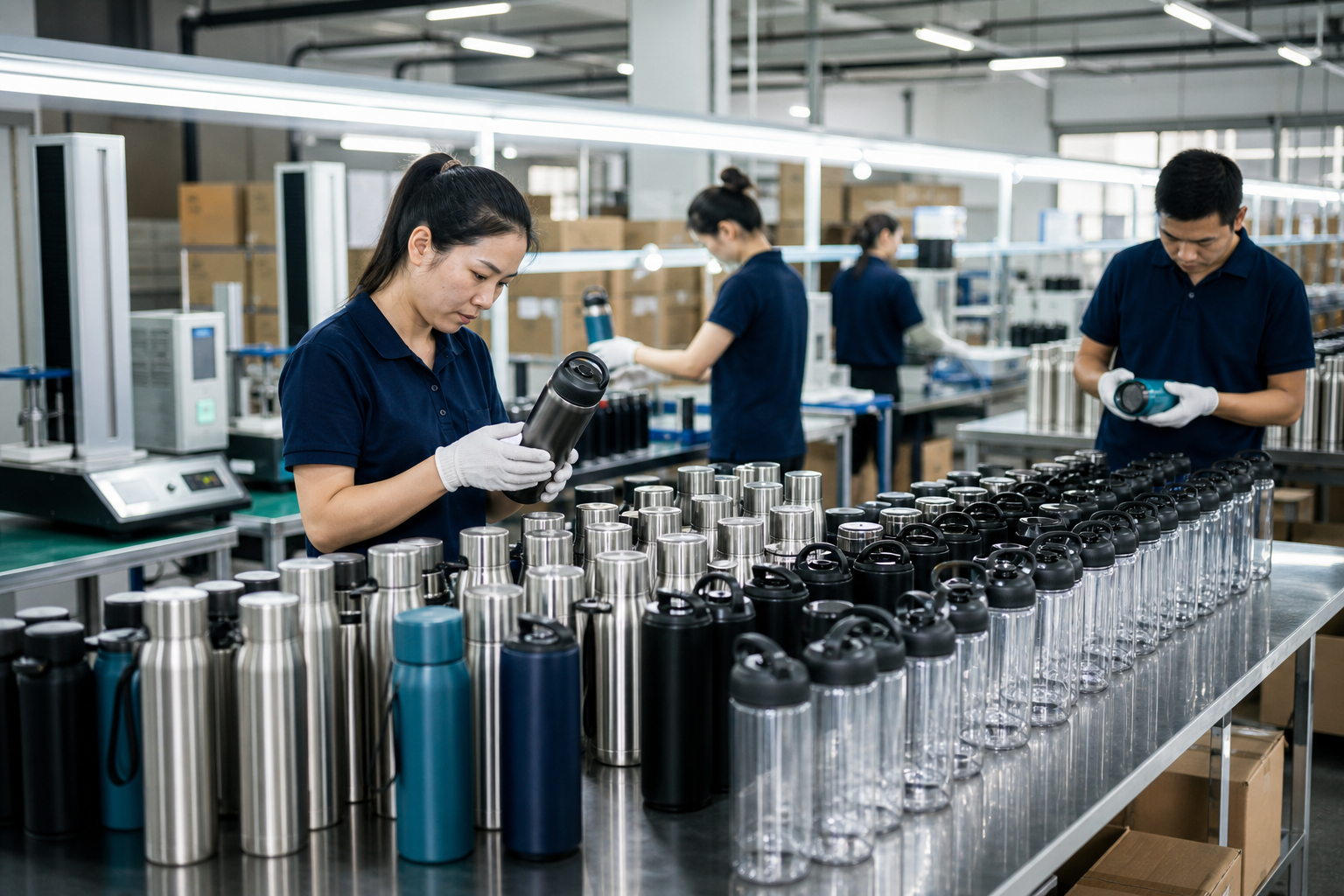
From our Hangzhou, Zhejiang factory, we see the same pattern every season. Buyers ask for the best reusable water bottle, then the sample room shows them why “best” changes with material, lid, insulation, print method, and target price. We run up to 180,000 units a month, and our standard MOQ is 1,000 pcs for stocked structures and 3,000 pcs for custom molds. QC pulled a sample last week with a 0.8 mm lid gap, and the buyer flagged it before shipment. If you want a clean answer, start with the use case, then material, then cost, then certification.
Start with the buyer, not the bottle
When buyers ask what is the best drink bottle, they usually mean one of four jobs: commute, sports, corporate gifting, or Amazon and retail. Those are four different briefs. A commuter bottle may need 500 ml, one-hand opening, and a lid that stays dry in a backpack. A gym bottle wants a wide mouth and a fast sip cap. A gift bottle needs clean packaging and laser engraving. A retail bottle has to hit a price point that still leaves distributor margin.
If you sell into Europe or North America, start with channel math. A retail SKU that lands at $15.99 often needs a factory cost around $3.20-$4.80 FOB China, depending on packaging and decoration. For a premium item, that can rise to $7.00-$11.00 FOB. We run this calculation on the line before sampling because one buyer flagged a 0.8 mm wall as “too flimsy” after the first carton landed. Factories in Zhejiang can quote fast, but if you do not define the use case, you get the wrong bottle with a clean sample and a dead sell-through rate.
Practical buyer filter:
- Daily commute: 350-600 ml, leakproof lid, cupholder fit
- Outdoor and sports: 600-1000 ml, carry handle, quick-drink cap
- Premium gift: 450-750 ml, powder coat or UV print, gift box
- Child use: lightweight body, safety-tested lid, narrow mouth or straw
Stainless steel wins most retail programs
If you need the answer to what is the best stainless steel bottle or what is the best stainless steel water bottle, the short version is this: 304 stainless steel is the safest default for mainstream retail, while 316 stainless steel fits buyers who want stronger corrosion resistance and a cleaner premium story. For hot-and-cold performance, a properly made vacuum insulated bottle is usually the best-selling format in North America. It feels like an upgrade, not a commodity bottle. We run this on the line every week, and the buyer usually stops arguing once they see the sample beside a thin single-wall cup.
A good double-wall structure is usually 0.4-0.5 mm inner and outer wall thickness, with vacuum sealing that keeps beverages hot for 6-12 hours and cold for 12-24 hours, depending on fill temperature and lid design. If a supplier claims more, ask for the test setup. QC pulled the sample last month and the lid was the weak point, not the steel. In our Zhejiang production, a 500 ml powder-coated bottle with a basic screw lid may FOB at $3.60-$5.20, while a branded flip-lid model with a copper-plated inner wall and gift box can reach $6.80-$9.40. The math does not work if the lid leaks or the coating chips after 50 dishwasher cycles.
For most importers, stainless steel is the safer revenue choice because it balances perceived value, low breakage, and broad market acceptance.
Tritan and plastic still have a place
For buyers asking what is the best tritan bottle, what is the best tritan water bottle, or even what is the best plastic water bottle, the straight answer is simple: these bottles win on weight, clarity, and price, not on heat retention. Tritan copolyester is the better pick when you want a glass-like look without the breakage. We ship a lot of 650 ml and 750 ml units for fruit infusions and front-panel logos; QC pulled a sample last week and the wall thickness held at 2.8 mm, which matters more than marketing copy.
If your customer needs the best BPA free water bottle, Tritan and certain polypropylene builds are the first materials we run. A polypropylene bottle usually comes in as the lowest-cost option, often 15-30% below Tritan depending on lid complexity. It works for giveaways, kids’ programs, and high-volume promotions where the target is low unit cost and basic compliance. A custom 750 ml Tritan bottle might FOB at $1.80-$3.10, while a PP bottle of similar size can be $0.90-$1.80. The buyer flagged it once when a PO typo turned “750 ml” into “7500 ml” on the draft; that’s the kind of mistake that blows up a quote. The math does not work if you expect plastic to look like stainless steel, so use stronger graphics, better packaging, or a cap upgrade if you want the shelf price to hold.
For North America and Europe, confirm food-contact documents, migration testing, and if needed, REACH and FDA-related declarations. We had one shipment held because the file missed a declaration for the lid resin, and the line stopped for half a day while we rechecked the batch code. The bottle can be cheap; the compliance problem never is.
Glass is clean, but not always practical
When a buyer asks what is the best glass water bottle or what is the best borosilicate glass bottle, the target is usually premium wellness, office sets, or an infuser bottle. Borosilicate glass handles thermal shock better than ordinary soda-lime glass, so if the bottle will take hot water, tea, or a quick ice-water rinse, that is the material we run. It also gives a clean, high-end look, and that matters in gift boxes and boutique shelves. On one 500 ml sample, QC pulled the bottle after a 1.2 mm lip check and the buyer flagged the finish, not the glass itself.
Still, glass is not the default winner. It breaks in transit, pushes packaging cost up, and turns into claim emails fast on e-commerce orders. We have seen freight damage move by 8-15% when the carton only uses thin dividers. That is why buyers searching for what is the best refillable water bottle often keep glass for local retail or tightly controlled distribution, not mass online fulfillment. If you insist on glass, use a tight-fit silicone sleeve, drop-test the pack, and specify carton inserts that survive a 1-meter fall; the math does not work if the outer box is soft.
For a polished shelf display, glass can be the best drinkware. For a distributor who does not want breakage reports, it usually is not. One PO even came in with a typo on the carton mark, and we had to stop the line for 20 minutes before the first 2,000 pcs shipped.
Lids and seals decide the real winner
The bottle body gets the shelf photo. The lid decides whether the buyer gets a reorder or a pile of complaints. If you are asking what is the best vacuum bottle, what is the best vacuum flask, or what is the best thermos bottle, start with the closure. A cheap cap makes a solid body look flimsy. We have seen a 316 stainless bottle lose the deal because the PP lid felt loose in hand.
For leakproof performance, ask for torque specs, gasket material, and cycle count. A silicone seal should hold shape after 3,000 open-close cycles, not flatten after a week on the line. For flip lids and straw lids, we check whether the parts go together at line speed without burrs or gaps. QC pulled the sample on a 2.5 mm gasket once, and the buyer flagged it before packing. If the choice is between formats, the best thermos flask for a broad retail program is usually a plain screw-top vacuum model with a wide mouth. Boring sells. It also cuts returns.
- Leak test: 30-60 minutes inverted, then shake test
- Drop test: 1.0 m to 1.2 m, packaged and unpackaged
- Insulation check: hot/cold retention under controlled conditions
- Thread fit: no cross-threading after repeated use
Branding changes the economics
Once you know what is the best insulated water bottle for your market, branding becomes the next cost lever. A plain bottle and a branded bottle are not just different on the shelf; they change line speed, reject rate, and rework. Silkscreen is still the cheapest choice for one or two colors on a flat panel. Laser engraving on stainless steel gives a clean mark that holds up in transit. UV print gives strong color, but the setup needs tighter control. We run a sample table check before mass print. If the artwork is complex, expect extra setup cost and a 3-7 day delay for print testing.
For custom projects, we quote by MOQ tier because the math changes fast. 1,000 pcs can work for a basic laser logo on a stock 500 ml tumbler, but a new cap or handle mold usually starts at 3,000 pcs and needs 30-45 days for tooling and sampling. This is standard in China, and Zhejiang factories are built for fast sampling, not for carrying a weak mold investment. The buyer flagged a PO typo once—500 ml written as 550 ml—and that one line changed the whole packing plan. If your team is comparing what is the best double wall bottle versus a single-wall promo bottle, do not ignore decoration cost. A high-value decoration can wipe out the price gap on the base bottle.
For brand owners, the better question is which bottle keeps margin after packaging, freight, and damages. We have seen that go sideways on a 2% breakage claim after carton drop testing. The line still has to ship.
Choose by channel, not by trend
The phrase what is the best water bottles sounds awkward, but that is how a lot of buyers type it when they want a fast answer. The channel decides the winner. Amazon and DTC want strong photos, bundle value, and clear feature claims. Wholesale distributors watch reorder stability, carton efficiency, and claim rates. Corporate buyers care about logo placement, lead time, and whether the gift feels cheap. Grocery and sporting goods live on price ladder and shelf competition.
If you want the best thermos or the best thermal bottle for North America, a 500-750 ml powder-coated stainless model with a screw lid and gift box is usually the safe pick. We run that spec a lot. For Europe, a cleaner, less bulky profile sells better, especially if you want recyclable packaging and a tighter carton count. A 48 pcs master carton often beats a loose 36 pcs setup on freight. If your target is a private-label launch, start with one hero SKU, one lid, one color family. Three versions is already enough to create trouble. We saw a buyer try six bottle shapes at once, and the math did not work. QC pulled the sample, checked the lid torque on the bench, and the line still had to stop for a carton-size mismatch.
That is the practical way to identify what is the best drinkware: not by what looks good on a sample table, but by what survives the channel you actually sell into. A typo on the PO for the print position can wipe out a week. We’ve seen that go sideways.
Request the right bottle spec today
Send your target price, capacity, and market, and we will match the bottle structure, logo method, and MOQ before you waste time on the wrong sample.
Frequently asked questions
What is the best water bottle for retail buyers?
For most retail programs, a 304 stainless steel double-wall bottle is the safest answer. A 500 ml model usually sells well between $14.99 and $24.99 retail, depending on branding and packaging. Factory FOB often lands around $3.60-$5.50 for standard powder coat and laser logo. If you need lower damage rates and stronger perceived value, stainless steel beats glass and most plastics. If your market is fitness or office use, add a leakproof screw lid and test for 1-meter drop performance before approval.
What is the best reusable water bottle material?
If you want the best reusable water bottle for broad commercial use, stainless steel is the most versatile. Tritan is a good second choice when weight and transparency matter more than insulation. Glass looks premium but breaks more easily in transport. Polypropylene is the cheapest, but it is usually reserved for giveaways or kids’ promotions. In practice, the best material depends on channel: stainless for premium retail, Tritan for lightweight clarity, PP for price-driven volume.
What is the best vacuum insulated bottle for Europe and North America?
A 500-750 ml 304 stainless vacuum insulated bottle with a simple screw lid is usually the best vacuum insulated bottle for those markets. Ask for 6-12 hours hot retention and 12-24 hours cold retention, measured under defined test conditions. If the factory cannot state wall thickness, gasket material, and lid type, you are not comparing the same product. For compliance, confirm FDA, LFGB, and REACH-related documentation where needed.
What is the best BPA free water bottle for large orders?
For high-volume orders, Tritan and polypropylene are the common BPA-free options. Tritan gives better clarity and a more premium look, with FOB typically around $1.80-$3.10 for a custom 750 ml bottle. Polypropylene is cheaper, often $0.90-$1.80, and works well for promo campaigns. The best choice depends on whether you need shelf appeal or lowest landed cost. Always request material declarations and migration test reports before shipment.
What is the best thermos bottle if I need low return rates?
The best thermos bottle for low return rates is usually a simple stainless steel vacuum model with a proven lid design and fewer moving parts. Avoid overly complex straw lids if your audience is broad consumer retail, because they add cleaning issues and seal failures. A good program starts with 1,000 pcs MOQ for stock bodies and 25-35 days lead time after sample approval. In Zhejiang, that is a normal production window for a stable export order.