Key Takeaways
- A proper wholesale growler program usually starts at 1,000 pcs MOQ and 25-35 days lead time from Zhejiang factories.
- 304 stainless steel with 0.5-0.8 mm wall thickness is the safer default for beer growler bulk orders.
- For export, ask for REACH, food-contact compliance, AQL 2.5/4.0 inspection terms, and drop-test packaging.
- Laser engraving, silkscreen, and powder coating each change cost, scratch resistance, and MOQ in very different ways.
If you are sourcing a wholesale growler program, you are balancing three things at once: price, compliance, and a product that does not come back with leaks, dents, or weak branding. Simple on paper. Then the spec sheet shows glass, stainless steel, aluminum, handle styles, logo method, MOQ, and export paperwork all at once. We see this every week on the line. The factories that keep repeat orders are not the cheapest on paper; they hold tolerances, ship on time, and answer the technical questions before the buyer flags them.
For procurement managers and brand owners, the job is not finding any growler. It is finding the right bulk growler spec for your market, whether that is beer growler wholesale, canteen wholesale, or drinkware wholesale for a retail chain or distributor. At BottleForge Industrial in Hangzhou, Zhejiang, our output reaches 300,000 units per month, with typical MOQ from 1,000 to 3,000 pieces and lead times around 25 to 35 days depending on decoration and packaging. We once caught a 3 mm artwork shift on a PO before sampling started; the buyer had copied the wrong cap code. That is the baseline you should expect from a China supplier.
What a wholesale growler buyer should define
Before you ask for a quote, define the product like a shop-floor engineer, not like a shopper. A wholesale growler can mean a 32 oz beer growler for taprooms, a 64 oz stainless jug for retail, or a branded alcohol flask wholesale bulk run for promo channels. If you leave the spec loose, factories in China will quote 0.5 mm, 0.6 mm, and 0.8 mm wall options, three lid builds, and different polish grades, then you spend 10 days clearing up what should have been on the first PO.
Start with capacity, body material, finish, and use case. A cold-beer program needs a different cap seal than a canteen bulk order for outdoor hydration. If your channel is retail, the item has to look good on shelf and survive a 1.2 m carton drop test. If your channel is hospitality, stackability and refill speed matter more. We had one buyer flag a typo on the RFQ—32oz written as 23oz—and QC pulled the sample before the line ran. Put these points in the RFQ:
- Capacity: 16 oz, 32 oz, 64 oz, or custom
- Material: 304 stainless steel, 201 stainless steel, glass, or aluminum
- Wall thickness: 0.5 mm, 0.6 mm, or 0.8 mm
- Finish: brushed, matte powder coat, mirror polish, or printed
- Seal: screw lid, flip lid, gasket type, leak test requirement
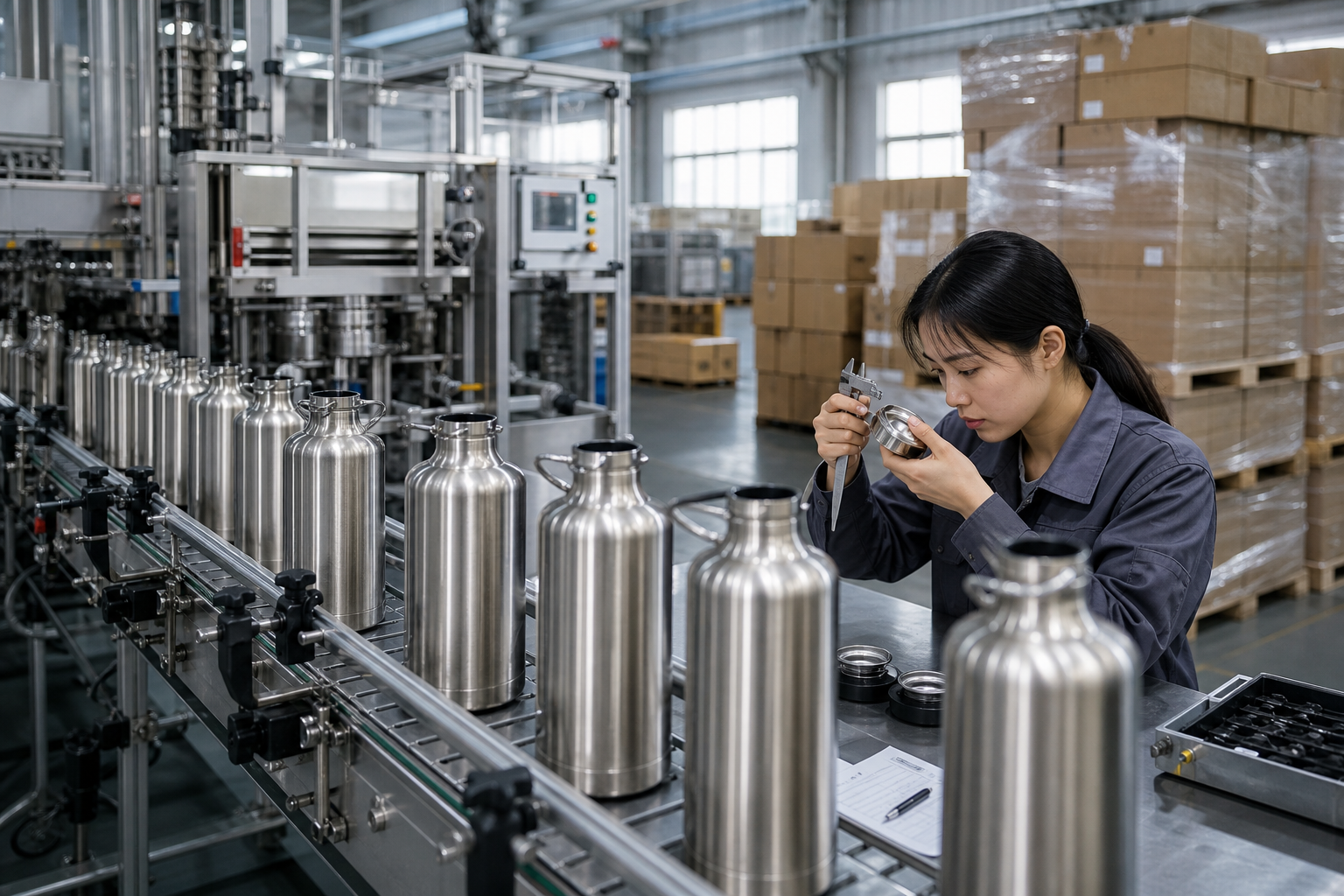
In Zhejiang, the factories that quote fast are the ones that know your limit on cosmetic defects, carton drop performance, and logo position. We run these checks on the bench with a caliper and a leak tester, not guesswork. This is the wrong question to ask if you only compare unit price. A real wholesale drinkware supplier gives you production discipline; a trading quote gives you noise.
Material choices that actually matter
For wholesale growler orders, material drives unit cost, tare weight, dent rate, print quality, and compliance. Stainless steel is still the safest commercial choice for beer growler wholesale bulk because it takes repeated use, accepts laser engraving, and does not crack the way glass does. For a premium retail program, 304 stainless with 0.6 mm or 0.7 mm wall thickness is the sweet spot. We ship that spec a lot. It stays light enough for freight and strong enough for normal handling. Go thinner than 0.5 mm and QC will start flagging dents at the packing line. Go much thicker and the freight bill climbs fast.
Glass still sells when the buyer wants visibility and a classic beer growler look, but the math does not work if the route is rough or the cartons are weak. We had one buyer flag a PO typo on the inner pack count, and the trial pallet came back with 3 cracked units out of 48. Aluminum is lighter, but lining and coating quality become the real issue. For alcohol flask bulk or alcohol flask in bulk orders, most buyers still pick stainless because it reads as better value and gives cleaner branding. If you are also buying canteen wholesale or wholesale canteen, it is common to consolidate SKUs through one factory in China and keep the MOQ at 1,000 pcs instead of splitting freight across three vendors.
Here is the rule we run by: match the material to the channel, not the catalog photo. A retail gift set can justify powder coating and laser logos. A distributor pushing drinkware bulk into outdoor stores may need a brushed body and a lower landed cost. Ask for material certificates, and if your market requires it, request food-contact compliance under REACH and relevant FDA expectations for coated or printed parts. A decent Zhejiang factory will have those files ready, and if they do not, that is the wrong supplier to chase.
Pricing, MOQ, and lead time
Buyers usually ask for the best wholesale drink bottle price, then the quote shifts once decoration, packaging, and carton count are added. We see that all the time. The clean way to compare wholesale drinkware is landed cost, not just EXW or FOB. For a standard 32 oz stainless growler bulk order, a China FOB range often starts around USD 2.80 to USD 5.50 per piece, depending on wall thickness, lid style, and print setup. A powder-coated version can jump above that fast. On the line, a 0.8 mm body costs one number; a heavier 1.0 mm body and laser logo cost another. Same bottle, different math.
MOQ depends on the setup the factory has to absorb. Plain brushed body with one-color silkscreen can start at 1,000 pcs. Multi-color printing, custom caps, and gift packaging usually push the MOQ to 3,000 pcs or more. Lead time is often 25 to 35 days after sample approval and deposit. We once had a buyer flag a PO typo on lid color, and QC pulled the sample before the line ran the wrong part. If you need a rush order, 5 to 7 days can come off the schedule, but only when the base body is already in stock and the logo file is clean.
Ask for three numbers every time: unit price, MOQ, and production lead time. If a supplier cannot put all three in one sentence, you are not talking to a production-ready factory.
In Zhejiang, the better suppliers quote with a straight tradeoff table: what changes cost, what changes lead time, and what changes the minimum order. We run that way because the buyer always asks the same thing after the first quote. The wrong question is, “What is your cheapest price?” Ask what it takes to hold the price at 1,000 pcs, then 3,000 pcs, then 5,000 pcs. That is how bulk drinkware sourcing should work.
Logo methods and shelf appeal
Logo decoration is where a lot of wholesale growler jobs go sideways. The bottle can pass spec, but the mark looks thin, chips in transit, or shifts under retail LEDs. For beer tumbler bulk and beer tumbler wholesale bulk programs, the logo often sells the piece before the buyer touches the body. Same story with beer growler wholesale accounts that move through taprooms, bottle shops, and gift channels.
Silkscreen is the low-cost choice for flat or lightly curved panels. It fits a 1-color or 2-color mark, and the trade-off is simple: less abrasion resistance than laser. We had a buyer flag a PO because the artwork called for 3 colors on a 72 mm panel, and the math did not work. Laser engraving gives a cleaner line and holds up better on stainless steel, especially for wholesale canteen and drinkware wholesale programs that get washed every day. Powder coating gives strong shelf impact, but it can push MOQ up and add 3 to 5 days to production because cure time is fixed by the line. Debossing or embossing can work on some metal forms, but it needs a custom tool and a higher setup fee.
Ask for a pre-production sample with the actual logo method. A PDF mockup is not enough. QC pulled the sample on our bench, checked the weld ring, the seam, and the lid threads, and that is where weak decoration shows up first. If the brand needs a premium look, spend the extra few cents on laser or a controlled wrap print. Cheap decoration stands out fast, and buyers in Europe and North America spot it without a second look.
Compliance and testing you should demand
If your wholesale growler ships to the EU, UK, US, or Canada, compliance is part of the buying decision, not a box to tick later. We ask for food-contact declarations, REACH paperwork for coatings and inks where used, and test reports for the exact material batch. If the body is 304 stainless, name the grade on the paperwork and back it with a material declaration. If the finish is coated, ask which restricted substances were checked out. For a silicone gasket, we want the resin type, hardness, and the food-contact standard it passed. The buyer flagged one PO here because the gasket code was typed as “silicon” instead of silicone, and that small typo caused a two-day hold at our QC desk.
Put testing into the purchase order. “Factory standard” is too loose; we have seen that phrase mean three different things on the same line. For bulk orders, we usually run AQL 2.5 for major defects and AQL 4.0 for minor defects, unless the channel needs tighter limits. For shipper cartons, ask for a drop test or a carton compression spec if the goods sit on a vessel for 30 to 40 days. If the order goes to Amazon FBA, the outer carton, barcode position, and case pack must be locked before production. We had one buyer push back on a 24-pack case because their warehouse wanted 12-pack only. The math did not work, so we changed the packout before the first 500 pcs hit the line.
A Zhejiang factory should never promise zero defects. That is the wrong question to ask. What you want is a real QC flow: incoming inspection, in-process checks, final inspection, and photo reports before balance payment. On our floor, QC pulled the sample with a caliper reading at 0.2 mm over spec, and we stopped the batch at once. That is the gap between a supplier and a headache.
Packaging, freight, and channel fit
Packaging decides whether a wholesale growler program makes money. A unit that looks cheap FOB can turn expensive once you add inserts, retail boxes, shrink wrap, and carton limits. We run the math on unit cost, 12 bottles per master carton, and pallet counts before we quote freight. That is where the margin lives.
For glass or premium stainless products, use molded pulp, EVA, or thick dividers where the drop test shows a weak spot. On one 750 ml growler run, QC pulled the sample after a 1.2 m corner drop because the neck rubbed the carton wall. For canteen wholesale and bulk canteen programs, a simple polybag works for factory-direct channels, but retail and gift buyers usually want a printed box. If you are selling beer growler wholesale bulk, ask for carton burst strength and cap protection against abrasion. A weak box will eat the margin faster than a $0.18 unit price increase.
Channel fit matters too. Taproom and hospitality buyers often want plain packaging. Retail buyers want shelf-ready presentation. Distributors want a carton they can pick, store, and reship without repacking. If you are building a mixed SKU program, one standard outer carton across several wholesale canteen and growler wholesale SKUs keeps the line cleaner, with only the inner pack and label changed. We have seen this go sideways when a buyer changed the carton spec three times after PO issue; the typo on the PO added a week.
At BottleForge Industrial in Hangzhou, Zhejiang, we usually start with the distribution channel, then decoration. A buyer once pushed for a heavy gift box on a taproom order, and the math did not work. This order saves money and keeps you from overbuilding the wrong box.
Send your growler spec for a fast quote
We can quote your wholesale growler program with MOQ, FOB pricing, compliance, and packing details in 24 hours from Hangzhou, Zhejiang.
Frequently asked questions
What is a realistic MOQ for wholesale growler orders from China?
For a standard wholesale growler, realistic MOQ is usually 1,000 pcs for a simple stainless model and 3,000 pcs for custom color, custom lid, or retail packaging. If you want laser engraving, MOQ may stay at 1,000 pcs because tooling is minimal. If you want full-surface print, special cartons, or mixed SKU packing, many Zhejiang factories will ask for 3,000 to 5,000 pcs to cover setup and material waste. Always confirm whether MOQ is per color or per order, because that changes your budget fast.
Which material is best for beer growler wholesale bulk?
For most beer growler wholesale bulk programs, 304 stainless steel is the safest choice. It handles repeated use, supports laser engraving, and resists breakage in transit. A practical wall thickness is 0.6 mm to 0.8 mm. If you need a lower-cost option, 201 stainless can reduce price, but you should confirm corrosion resistance for your market. Glass works for premium shelf appeal, but shipping damage rises unless packaging is upgraded. Aluminum is lighter, but lining and coating quality need closer inspection.
How much should I budget per piece for a bulk growler?
For a standard 32 oz stainless bulk growler, a common FOB China range is USD 2.80 to USD 5.50 per piece, depending on thickness, lid type, logo method, and packaging. A brushed body with one-color print sits at the lower end. Powder coating, laser engraving, or gift boxing pushes the price up. Freight, duties, and inland transport can add another 15% to 35% to your landed cost depending on destination and carton density. Always compare total landed cost, not just factory price.
What QC terms should I request from a Zhejiang factory?
Ask for AQL 2.5 for major defects and AQL 4.0 for minor defects as a starting point. Then specify leak testing, cap torque check, logo alignment tolerance, and carton drop checks if the product is shipping internationally. A good China supplier should provide pre-production samples, in-line inspection photos, and final inspection reports before balance payment. If the order is for drinkware wholesale or wholesale drinkware retail channels, also confirm barcode placement, carton marks, and case pack accuracy.
Can I combine canteen wholesale and wholesale growler SKUs in one order?
Yes, and that is often smarter for distributors. Many factories in China can consolidate canteen wholesale, wholesale canteen, and wholesale growler SKUs in one shipment if the body material and decoration process are similar. This helps reduce freight fragmentation and simplifies warehouse receiving. The caveat is tooling and packing differences. A 32 oz growler and a 750 ml canteen may share a production line, but they may not share the same cartons, closures, or print fixtures. Confirm each SKU’s MOQ and packing spec separately.