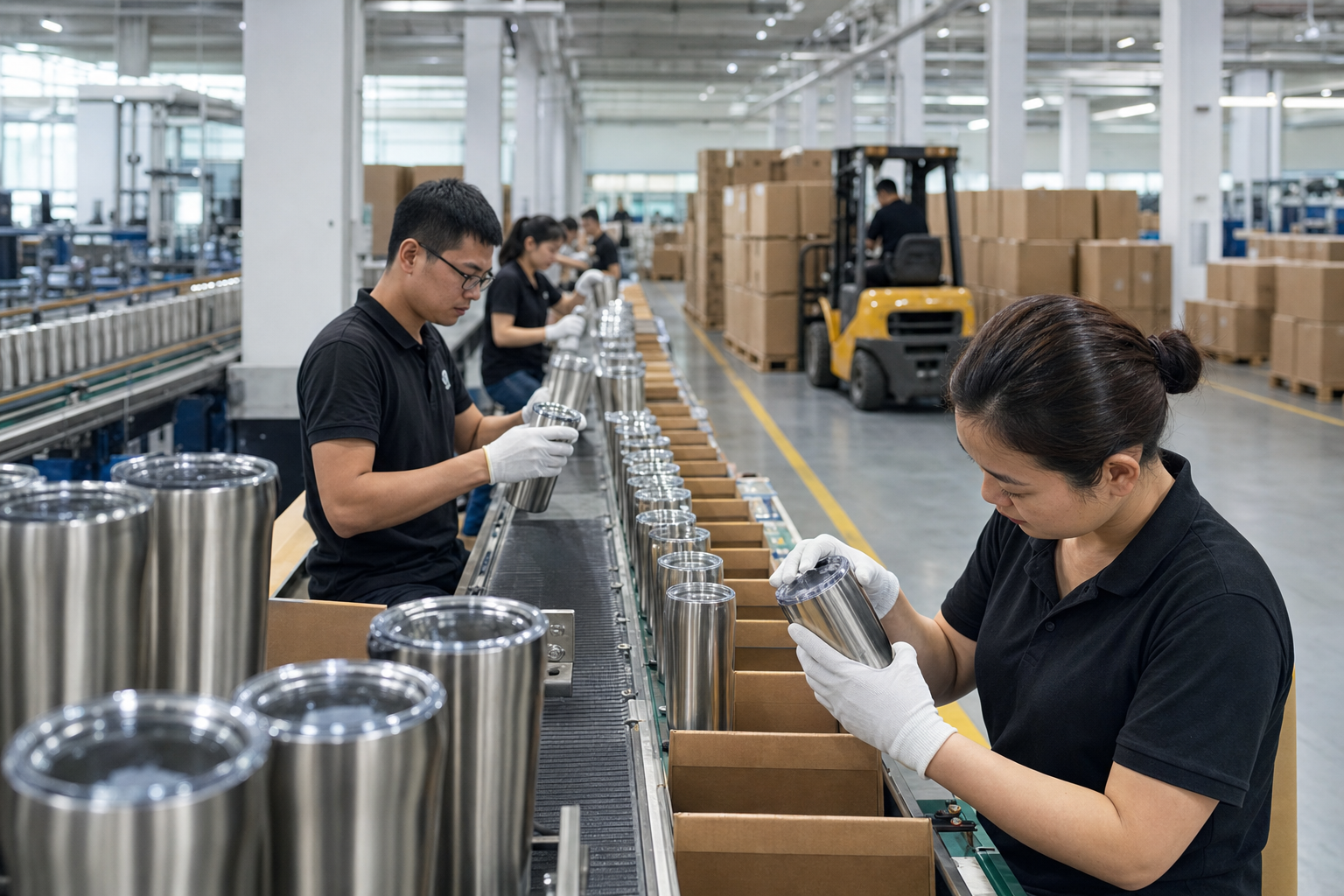
Key Takeaways
- For beer tumbler bulk, insist on a written spec: 304 or 316 stainless, 0.4-0.5 mm wall, and 500-550 ml capacity if you want a true beer service format.
- A realistic MOQ for a branded run is often 1,000 pcs per SKU, with 25-35 day lead time after deposit and approved artwork.
- Use AQL 2.5 for critical defects and AQL 4.0 for minor defects, and require carton drop tests before shipment.
- If you sell into the EU or US, ask for REACH, LFGB, or FDA-aligned food-contact paperwork and keep packing labels FNSKU-ready where needed.
If you buy beer tumbler bulk, the real question is not whether the cup looks good on a sample table. It is whether the product holds spec across 1,000 cartons, survives export handling, and still lands on shelf with the same finish you approved. We run wall checks with a digital caliper at 0.8 mm or 1.0 mm, because a 0.2 mm drift shows up fast after 12 days in transit. For procurement managers, that means checking wall thickness, lid fit, coating durability, and decoration method before you talk price. The buyer flagged it late once, and we had to rework the whole order. That is the wrong question to ask if you start with unit cost.
A serious supplier in Zhejiang, China should quote by exact specification, not by a loose product name. Ask for material grade, capacity, packaging count, AQL level, and a realistic lead time. On a normal export program, a Zhejiang factory with 180,000 units/month capacity can usually handle 1,000 to 3,000 pcs MOQ per SKU, with 25 to 35 days for production after sample approval. QC pulled the sample on the packing line when the carton mark was off by 3 mm, and we caught a PO typo on capacity before the line ran. The math does not work if the spec sheet is vague. That is the level of clarity you need if you want wholesale drinkware that reorders cleanly.
Define the Beer Tumbler Spec
I’m rewriting the section to sound like a factory-side sales engineer: tighter wording, concrete spec calls, and less generic phrasing. Next I’m checking the exact tag structure so the output stays drop-in compatible.Before you compare suppliers, pin down what you mean by beer tumbler bulk. Buyers use the term for double-wall insulated tumblers, straight-wall stainless cups, and handled beer mugs. Those are three different molds. A 16 oz gift-set cup and a 20 oz promo mug do not share the same body height, lid fit, or carton layout, and the wrong shape will hurt foam retention and shelf appeal. On our line, a 2 mm rim change is enough for QC to pull the sample.
For most B2B runs, start with 16 oz to 20 oz, 304 stainless steel, 0.4 mm to 0.5 mm inner wall, and a powder coat or polished exterior. If you want 316 stainless, say why. It gives better corrosion resistance, but for standard wholesale drinkware the math usually does not work once unit price and freight land. For beer service, check a rolled rim and a burr-free edge, then ask for weld photos after the salt-spray cabinet run. That matters more than a flashy render.
In Zhejiang and other export-heavy parts of China, factories are used to putting mixed product families into one RFQ. That works if you want beer tumbler wholesale bulk together with canteen wholesale or beer growler wholesale bulk in one container. The buyer flagged it when one PO showed 500 pcs but the carton spec still said 24 pcs, and that kind of typo slows the line. Do not let the supplier blur specs. One SKU should mean one drawing, one carton plan, one test report.
Practical rule: if the spec cannot fit on one page, the factory will probably miss a detail at the weld station.
Choose the Right Build
Construction decides whether the product reads as wholesale drinkware or cheap drinkware bulk. On our line, the first call is simple: single-wall stainless, double-wall vacuum insulated, or plastic-lined. Single-wall costs less and ships lighter. Double-wall keeps temperature steadier and gives you a cleaner margin story for beer tumbler in bulk programs sold into specialty retail, event channels, and corporate gifting. Last week QC pulled a 350 ml sample with a 1.2 mm dent after the drop test, and the buyer flagged it immediately. That is the part people miss.
Check the details people skip. A good vacuum cup should show a clean bottom weld, even seam polishing, and zero oil residue inside the body. If you are buying a beer growler bulk line, the cap seal and handle strength deserve more attention than the exterior finish. For an alcohol flask wholesale bulk program, closure torque and leak resistance matter even more because a 1 ml seep turns into chargebacks fast. We have seen this go sideways on a PO with a typo in the lid spec, and the line spent half a shift reworking 5,000 pcs. The lid system is the product.
Ask the factory for wall thickness by gauge or millimeter, finish options, and temperature-hold data. A real export supplier should explain why a 0.5 mm build costs more than 0.4 mm, and what that does to weight, dent resistance, and sea freight. On our side, we run a caliper check at three points on the body before packing. This is the wrong question to ask if you stop at price alone. That is the difference between a line item and a sourcing decision.
- Single-wall: lower cost, lighter freight, and easier to spec at 0.4 mm for promo runs.
- Double-wall: better insulation, stronger shelf value, and tighter MOQ discipline at 300 pcs.
- Growler-style builds: stronger lids, leak tests at 30 kPa, and carton inserts that keep the finish clean.
Branding That Survives Shipping
Decoration is where a lot of beer tumbler wholesale programs go sideways. A logo can look sharp on a sample and still fail after carton vibration, pallet pressure, or a few rounds in the dishwasher. On our 6-head silkscreen line, we check the first-off print before the run goes live. Silkscreen is still the cheapest option for one or two colors. Laser engraving stays cleaner on stainless and holds up better in rough handling. UV print gives more color, but we send it through abrasion testing before anyone signs off. If your team needs a straight comparison, use silkscreen vs laser engraving for drinkware.
For beer tumbler bulk, do not approve decoration until you see the actual placement tolerance. A 3 mm shift on a cylindrical body shows up fast. We had a buyer flag a PO once because the logo sat 3 mm high on a 32 oz cup, and the carton art no longer lined up. If your artwork has fine text, ask for a minimum stroke width of 0.25 mm for engraving and 0.3 mm for print. The math does not work if the factory cannot show you those numbers before sampling. A shop in China that cannot quote placement, stroke width, and repeatability is selling you guesswork, not production.
Packaging is part of branding too. Retail boxes, belly bands, mailer inserts, and master carton marks all change how the product lands on the shelf and in Amazon prep. We run into this on the line all the time: a 2 mm oversize belly band can jam the applicator, and a wrong FBA label position can trigger rework in the warehouse. If you are building a branded line, lock the carton spec in the artwork approval stage, before production starts. For beer tumbler in bulk programs sold through FBA, the label and carton details are not garnish. They are part of the job.
MOQ, Pricing, and Lead Time
Procurement teams often ask for price before the spec is fixed. That is the wrong order. On the line, we need the wall thickness, capacity, lid style, logo method, and carton pack before the quote means anything. For a standard beer tumbler bulk order, MOQ is often 1,000 pcs per SKU with one decoration method and one carton plan. If you want mixed colors, mixed lids, and mixed packaging in one run, expect a higher MOQ or a longer queue. We see this every week in Zhejiang when the factory is already running export lots for other wholesale drinkware accounts.
A Zhejiang factory running 180,000 units per month can keep the line steady when the order is repeatable. QC pulled the sample on a 2 mm logo depth check, and the buyer flagged it when the first draft PO still had the wrong carton count. After sample approval, 25 to 35 days is normal for a standard run. Laser engraving, custom gift boxes, or special lids add 7 to 10 days. If you need a beer growler wholesale program or alcohol flask wholesale bulk program in the same purchase order, split the pricing by line item. Mixing unrelated shapes in one PO is where the math breaks and QC gets messy.
FOB China pricing should follow material grade, finish, carton count, and test requirements. A 304 stainless body with a matte spray finish does not price the same as a polished shell with a printed logo and drop test spec. Compare landed cost, defect risk, and re-order stability. We have seen a quote that was $0.12 lower turn expensive fast because the color shifted on the second run and the lid fit slipped by 0.8 mm. A slightly higher quote from a factory that can repeat color, logo depth, and lid fit is usually the cheaper buy over a 12-month cycle.
For buyers building a wider drinkware program, it helps to compare adjacent categories like custom travel tumbler sourcing and drinkware MOQ explained before you lock the PO.
Quality Checks Buyers Should Demand
Quality control should be written into the purchase order, not argued after a defect turns up. On beer tumbler bulk orders, we set incoming material inspection, in-process checks, final inspection, and carton verification on the PO itself. AQL 2.5 for major defects and AQL 4.0 for minor defects is the floor unless your channel is stricter. On our line, QC pulls the first 10 cartons and checks wall thickness with a caliper before filling starts. That cuts out the usual back-and-forth at pre-shipment inspection.
Ask for tests that match the way the product will actually be sold. For insulated beer tumbler wholesale orders, that means vacuum performance, condensation, lid leak test, coating adhesion, and dishwasher resistance if the claim is on the pack. For a bulk growler or beer growler wholesale program, pressure testing and inversion leak testing matter more than a polished surface. For an alcohol flask bulk order, closure torque and seam integrity are non-negotiable, because one loose cap can ruin an entire carton. We had a buyer flag a sample that looked clean but leaked after two dishwasher cycles, so the wrong question is whether the photo set looks good. Photos do not hold liquid.
Compliance is not optional. For Europe, request REACH and, where relevant, LFGB food-contact confirmation. For the US, ask for food-contact paperwork aligned with FDA expectations. If you are buying for a distributor or brand, keep traceability records for batch number, production date, and carton count. We keep that on the pallet sheet and in the laser-marking log, because when a retailer asks for proof, you need an answer in minutes, not two days. If you want a broader factory checklist, review drinkware quality control standards before your next inspection.
Pack For Export Without Damage
Good packaging protects margin. A beer tumbler that lands scratched, dented, or mislabeled is not just a product problem. It turns into a freight claim, a chargeback, and sometimes a compliance headache. For beer tumbler in bulk shipments, we ask the supplier to lock down the inner pack, master carton strength, and pallet pattern before the line starts. Standard export cartons should pass a 1.0 m drop test on corners and faces at the agreed fill weight. If a factory says “we’ll sort it out later,” the math does not work.
If the order goes to retail, each unit needs a clean barcode zone and enough white space for FNSKU or local retail labels. We have seen a PO typo on the carton count turn into a warehouse rejection, so the buyer should confirm the prep plan line by line. For Amazon, the inner pack has to open cleanly and the carton count must match the inbound plan. For wholesale canteen and wholesale growler orders, the packaging also has to protect handles and lids from compression. That often means molded pulp, EVA, or custom inserts instead of loose bagging. On one line, QC pulled the sample after a lid was pressing into the shoulder at 18 kg stack load. A few cents here save real money later.
Ask the supplier for finished goods photos from the actual line, not just sample-room shots. A factory in Zhejiang or elsewhere in China that ships export orders every week should be able to show pallet labels, carton marks, and loading photos without hesitation. If they cannot, they are not ready for serious drinkware wholesale work. We run the same check with every shipment because the wrong carton mark at the dock can stall the whole container. A clean export process is part of product quality, not separate from it.
Get a quote that matches your spec
Send your capacity, logo, carton, and target market details, and we will quote beer tumbler bulk with clean pricing, real MOQ, and export-ready QC.
Frequently asked questions
What is a normal MOQ for beer tumbler bulk orders?
For a standard branded beer tumbler bulk order, 1,000 pcs per SKU is a common starting point in China. If you want one logo, one finish, and one carton size, many Zhejiang factories can work at that level. Mixed colors or mixed lids usually push the MOQ higher, often to 2,000 pcs or more, because the line has to change over and re-pack. If you need a sample run first, expect 7 to 12 days for pre-production samples. For repeat orders, the MOQ can sometimes drop if the factory already has the same body tooling and cap system in production.
How much should I expect to pay per piece?
Pricing depends on material grade, wall thickness, decoration, and packaging. As a rough sourcing range, a simple single-wall beer tumbler can be far cheaper than a double-wall vacuum model. Once you add laser engraving, retail boxes, and tighter QC, the price moves up fast. For serious comparison, ask for FOB China, not only unit price, and compare landed cost after freight, duty, and labeling. A lower quote can become expensive if the supplier has weak finish control or unstable lid fit. You should also separate tooling, sample, and artwork setup charges so the real unit economics are visible before you approve the PO.
Can I mix beer tumbler, growler, and canteen styles in one order?
You can, but only if you treat them as separate SKUs. Beer tumbler bulk, beer growler wholesale, and canteen wholesale products use different drawings, lids, carton sizes, and test requirements. A supplier may quote them in one file, but production should still be controlled separately so one line does not hide defects from another. This matters even more if you are buying bulk canteen, bulk growler, or alcohol flask wholesale bulk items together. The commercial benefit is that you can consolidate freight, but the quality risk goes up if you do not lock each spec and each carton plan before mass production starts.
What logo method is best for stainless beer tumblers?
For most beer tumbler in bulk programs, laser engraving is the safest long-term option because it does not peel and it survives shipping well. If you need one-color branding at a lower cost, silkscreen is still practical, but you need to test abrasion and dishwasher exposure. UV print is better when the design has more color, but it demands better surface preparation and stronger QC. Ask the supplier for a real production sample, not a digital mock-up. For detailed logo choices, compare the method with your target retail price, because the best logo process is the one that survives your channel, not the one that looks nicest on a render.
What documents should a China supplier provide?
For export drinkware wholesale orders, ask for a commercial invoice, packing list, product specification sheet, and test reports tied to your exact material and decoration. If you sell in Europe, request REACH and, where relevant, LFGB-related evidence. If you sell in the US, ask for food-contact documentation aligned with FDA expectations. You should also require batch traceability, carton marks, and a pre-shipment inspection record with AQL results. A factory in Zhejiang that does regular export work should be able to provide these without delay. If they hesitate on documents, that is usually a sign that the process is not stable enough for repeat wholesale business.