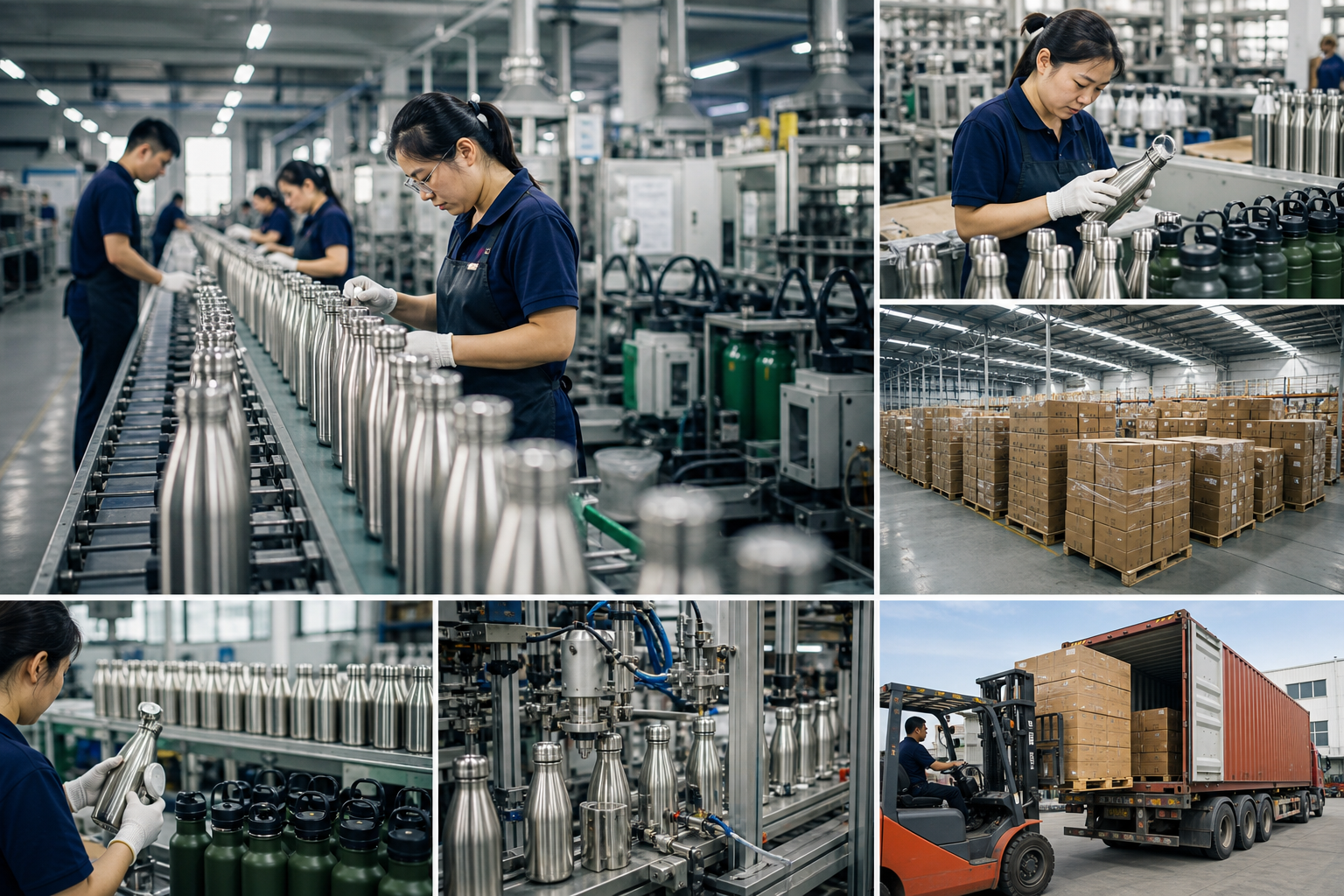
Key Takeaways
- A workable promotional bottle usually starts at 500-1,000 pcs MOQ and lands at USD 1.20-4.80 depending on material and print.
- For Europe and North America, REACH, LFGB, FDA expectations, and AQL 2.5 inspection should be built into the plan before you approve artwork.
- Double-wall stainless steel around 0.5 mm inner/outer shells gives better margin than cheap thin-wall options that dent in transit.
- If you need distributor drinkware for repeat orders, choose one lid platform and one decoration method to avoid retooling costs.
If you are buying the best promotional drinkware for a brand campaign, distributor program, or retail promotion, the first trap is choosing on looks alone. A bottle that photographs well but fails a 1.5 m drop test, leaks after 3 months, or misses your margin target is a return liability, not a promo item. We look at unit cost, print durability, carton weight, and the real MOQ the line can hold.
From Zhejiang and across China, we see the same thing every season: buyers ask for a custom canteen, custom growler, or other customizable drinkware, then find out the lid spec and compliance papers matter more than the shape. A good canteen manufacturer will ask how you sell, where you ship, and whether you need FOB Ningbo or delivered-to-warehouse pricing. That is the right question. BottleForge runs 180,000 units per month, with standard MOQs from 500 to 3,000 pieces and normal lead times of 20 to 35 days; QC pulled the sample last week because the buyer flagged a 2 mm print shift, and that is the kind of detail that saves a PO from trouble.
What “best” really means
The best promotional drinkware is not the cheapest line on the quote sheet. It is the item that fits the sales channel, survives transit, and still looks on-brand after 6 to 12 months on a desk or in a car cup holder. For a distributor canteen program, best can mean low MOQ, fast replenishment, and one-color logo printing. For a premium corporate gift, it can mean a 500 ml insulated custom drinkware piece with laser engraving and gift box packaging. Different jobs, different winners. We have seen a PO typo turn "500 ml" into "50 ml" before production, so the buyer had to ask for a clean recheck at the sampling stage.
Start by ranking the product on four points: unit economics, decoration area, material compliance, and logistics weight. A 500 ml stainless steel bottle can ship at roughly 280-360 g net weight; a glass bottle may be heavier, but it can carry a cleaner premium story. If you are sourcing from a canteen factory in Zhejiang, ask for actual sample data: leak test results, insulation performance, carton dimensions, and decoration durability. QC pulled the sample, and the torque meter told us more than the brochure ever did. A serious canteen supplier will give those numbers without drama.
- Low-cost giveaways: PP or single-wall aluminum, usually USD 0.80-1.80.
- Mid-tier promo: 304 stainless or Tritan, usually USD 1.80-4.20.
- Premium gift: double-wall vacuum, usually USD 3.80-8.50.
Pick the right bottle material
Material choice changes your cost, print result, and claim risk. For a canteen customized for mass promotion, aluminum is light and cheap, but we still check the inner lining batch by batch; one 0.3 mm coating slip and the buyer flags it fast. For a customized drinkware order going to North America, 304 stainless steel is the safer middle ground because it handles hot and cold drinks, supports powder coating, and gives you better shelf value. If you want a sports-oriented canteen customizable for gyms or outdoor campaigns, Tritan and BPA-free polypropylene are common, but the lid torque and chemical compliance both need to pass before we run the line.
Glass looks premium and photographs well, especially for a custom growler or customized growler, but it is not forgiving in parcel networks. If your program sells through ecommerce or distributor drinkware channels, breakage rates can wipe out the margin on a 3,000-piece run. A 5 mm borosilicate wall can work on a controlled retail shelf, but not in rough fulfillment unless you upgrade the carton and insert structure. We had one PO where the buyer typed the case pack wrong by 6 pcs, and the whole pallet had to be reworked. As a canteen manufacturer in China, we usually keep the rule simple: if your order moves through fulfillment centers, choose stainless or Tritan; if it stays in controlled stores, glass becomes more viable.
Practical material guidance
For promotion-first orders, keep the spec simple. One material, one lid, one or two decorations. Every extra variable adds rejects, longer sampling, and more risk at AQL inspection; QC pulled the sample, and the multicolor print was the first thing to fail. Buyers often ask for a canteen promotional item with metallic paint, matte powder coat, and multi-color print on the same SKU. That can be done, but the math works against you on both price and lead time. In Zhejiang manufacturing, the better move is usually plain: a stable substrate, a proven coating, and a logo method we can repeat 10,000 times without color drift.
Choose decoration for lifespan
Decoration is where a lot of canteen suppliers overpromise. A logo can look clean on a screen and still fail after 30 dish cycles or a week riding around in a distributor canteen program. If the mark has to stay readable, laser engraving on stainless steel or a baked powder-coated bottle with one-color silkscreen holds up better than soft-touch pad print. For budget custom canteen orders, silkscreen is still the workhorse on our line because it is fast and cheap, often adding only USD 0.08-0.25 per color at volume.
Laser engraving costs more, but it does not peel. On black or dark powder coat, it also gives a cleaner premium look. We had a buyer flag a 42 mm logo once because the PO said 40 mm, and the print jig had to be reset. That pushed a 20,000-piece run back 4 days. The same problem shows up in customized canteen and customizable drinkware programs with names, serial numbers, or QR codes. Variable data is fine, but only if the factory has the file control and print flow to keep it straight.
Ask for a 500-piece sample run before you commit to a 10,000-piece promotion. It is cheaper to catch a print flaw on day 7 than on day 40.
For distributor growler projects, label durability matters even more because the bottles get reused. If the bottle will be washed often, pick a method tested against abrasion and mild detergent. We run tape test, alcohol rub test, and a 24-hour soak before shipment, and QC pulled one sample last month that started lifting after the soak. A canteen vendor that handles export work should show those results, not just a nice render.
MOQ, price, and lead time
Promotional buyers often treat MOQ like a hard wall. It is not. In Zhejiang, MOQ follows tooling, packaging, and decoration setup. A stock blank can start at 500 pieces. A fully custom canteen with a new lid color and printed carton often needs 3,000 pieces. If you push for 300 pieces, we can do it on some lines, but the unit price moves up and the carton choice gets tight.
For export orders, the range is easy to map. A plain stock canteen lands around USD 1.10-1.60 FOB. A one-color logo promo bottle sits at USD 1.40-2.30. A double-wall stainless custom growler can hit USD 4.50-8.20, depending on vacuum quality, coating, and lid type. Lead time runs 20-35 days after sample approval, and custom color matching usually adds 7-12 days. If a canteen manufacturer says 7 days on a new decorated item, ask whether they mean stock only or they are skipping inspection. We have seen that go sideways. QC pulled a sample once and found the print off by 1.5 mm.
For larger canteen manufacturers and canteen factories, monthly capacity is the number that matters. Small batch buyers get bumped when peak season hits. BottleForge’s 180,000 units per month can cover a 20,000-piece campaign without starving the line, but only if artwork and carton spec are locked early. One buyer sent a PO with the carton size typoed as 32 x 23 x 28 cm instead of 23 x 32 x 28 cm, and the packing line had to stop. If you are a distributor canteen buyer, ask for production slot confirmation, not just a unit price. The math does not work any other way.
Compliance for EU and US
If your best promotional drinkware is going into Europe or North America, compliance is a line item, not a nice-to-have. We ask for material declarations, migration test reports, and packaging specs before the PO goes out. For Europe, REACH and LFGB usually come up; for the United States, buyers want FDA food-contact declarations. If the bottle has stainless steel, check nickel and lead limits on the coating, cap, and welded joints. We’ve seen a buyer flag a 0.1 mg/kg issue on a decorative ring and kill the order at sample stage.
For a canteen customized in China, we also request carton drop testing, leak testing, and, if the claim says 6-hour or 12-hour retention, insulation verification. A vacuum bottle that says 12 hours hot needs a defined fill temperature and ambient condition. No test method, no claim. That is the wrong question to ask if a supplier says “it passes in our factory.” QC pulled the sample, and the first thing we check is whether the thermometer log matches the stated setup. On the audit side, a lot of importers ask for BSCI or a similar social compliance file before they approve a canteen vendor. Fair enough.
- Inspection standard: AQL 2.5 for major defects, 4.0 for minor defects is common.
- Documentation: material list, test report, and carton master data.
- Traceability: production lot code on carton and outer master case.
How to source in China
Sourcing custom drinkware from China works when you treat it like a production order, not a catalog click. Start with the product class: canteen promotional, custom growler, insulated tumbler, or glass bottle. Then lock the target price, MOQ, and delivery term. FOB Ningbo and FOB Shanghai are standard, and if your forwarder wants Qingdao or Shenzhen instead, say it on day one. We have seen POs with the port line left blank, and that typo cost a week.
The difference between a canteen supplier and a canteen factory matters. Suppliers move fast and can cover small runs; factories are better when you need repeat volume and tighter cost control. If you are a canteen distributor or distributor growler buyer, repeatability is the real asset. A one-off launch is fine, but a 12-month program needs the same mold, the same lid line, and the same print station on every reorder. QC pulled the sample with a caliper at 1.2 mm, and that is the kind of check that keeps a lid from wobbling later. This is the wrong question to ask if you only care about the first shipment price.
In Zhejiang, the good factories answer in numbers: 30,000 pieces a day or 18,000, vacuum failure rate below 0.5 percent or not, two stainless lines and one plastic line or none. If the reply is vague, the risk is real. A canteen vendor who can show the line, the leak test rig, and the packing bench is usually the one you want on a 50,000-piece promotion. We run into buyers who accept “no problem” as an answer, then the buyer flags the carton size on the first pre-shipment check. The math does not work unless the factory can prove capacity before you place the order.
Request a factory quote with real numbers
Send your target price, MOQ, logo file, and destination. We will quote the right canteen customized for your market, not a generic placeholder.
Frequently asked questions
What is the best promotional drinkware for a 5,000-piece campaign?
For 5,000 pieces, a 500 ml 304 stainless steel bottle is usually the safest choice. Expect FOB pricing around USD 2.10-4.20 depending on coating and decoration. It gives you better perceived value than plastic, supports laser engraving or silkscreen, and can pass common export expectations if the material and lid are tested. If your audience is outdoors or sports-focused, a customizable canteen with a leakproof lid and 0.5 mm wall thickness is a practical balance. Ask for AQL 2.5 inspection and a carton drop test before shipment.
What MOQ should I expect from a Chinese canteen manufacturer?
For stocked blanks, MOQ can start at 500 pieces. For a canteen customized with a special lid color, printed box, or unique finish, 1,000-3,000 pieces is more realistic. If you need a completely new mold, MOQ can go higher, often 5,000 pieces or more. In Zhejiang, factories usually quote lower MOQ when you accept standard packaging and one decoration method. If a canteen manufacturer offers 200 pieces with custom tooling, check whether the quote excludes packaging changes or inspection.
Which decoration method lasts longest on custom drinkware?
Laser engraving is the most durable on stainless steel because it does not peel. Powder coat plus laser is a strong premium option for a custom growler or promotional bottle. For budget orders, one-color silkscreen is acceptable, but expect some wear after heavy abrasion or repeated washing. Pad print is fine for small logos on curved caps or low-cost plastic drinkware, but it is not the first choice for a high-use distributor drinkware program. If you need durability, ask for tape-test and alcohol-rub test samples.
How do I check quality before placing a large PO?
Request pre-production samples, a signed spec sheet, and a test report covering leak test, finish adhesion, and food-contact compliance. For export orders, use AQL 2.5 for major defects and define what counts as a leak, scratch, or print misalignment. A reliable canteen supplier will also share carton dimensions, gross weight, and case pack count, which helps you avoid freight surprises. For a 10,000-piece order, a 300-500 piece pilot run is a smart way to catch problems before mass production starts.
Can I source custom drinkware from China for Amazon FBA?
Yes, but the packaging has to be FBA-ready. You need barcode placement, carton labeling, and in some cases individual polybag or retail box specs. A custom drinkware order for Amazon often benefits from a sturdy inner carton and a stable lid design to reduce returns. If you sell a canteen customizable product on Amazon, ask your factory for FNSKU label placement, carton master data, and a drop-test-friendly shipper. Lead time is usually 25-35 days after sample approval if artwork is final.