Key Takeaways
- For promo use, the best MOQ range is usually 500 to 3,000 units, with FOB pricing often starting around USD 1.80 to 4.50 depending on material and decoration.
- A 500 ml to 750 ml sport bottle covers most sport bottle for giveaways, sport bottle for gym, and sport bottle for conferences orders without oversized freight cost.
- For Europe and North America, ask for REACH, FDA-grade material declarations, and AQL 2.5 for major defects before you approve shipment.
- Laser engraving, silkscreen, and UV printing behave very differently; pick the method based on logo size, abrasion risk, and your target retail value.
If you are buying a sport bottle for promotional gifts, the usual mistake is simple: the buyer picks on price alone and ends up with a bottle that leaks, prints poorly, or feels too light to carry a logo with confidence. We see this after the first 24-hour leak test on the line. A campaign bottle has to survive daily use, stay inside budget, and still look deliberate when it lands on a desk, in a gym bag, or at a trade show in Europe or North America.
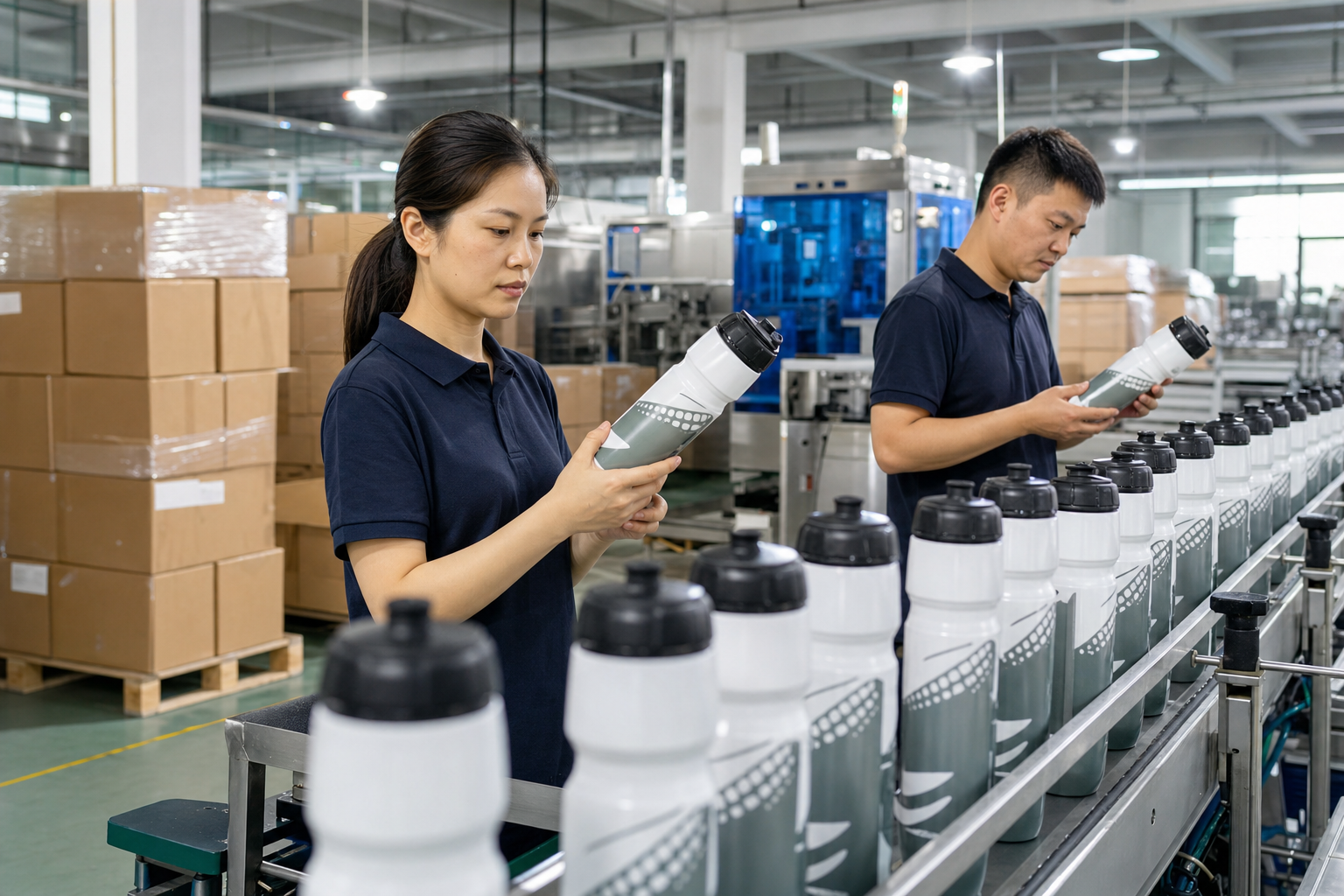
From our factory in Zhejiang, China, we see the same pattern across sport bottle for business orders, sport bottle for schools, and sport bottle for events: the use case sets the spec. A bottle for hikers needs a different cap and wall thickness than a bottle for employees or students, and that is not a small detail. We run 120,000 units per month, and QC pulled the sample again after a buyer flagged a 0.3 mm print shift, so we know what holds up in production, not just on a sample sheet.
Start With the Use Case
The right sport bottle for promotional gifts is a use-case decision first. We do not start with “best seller.” We start with where the bottle lives. A sport bottle for athletes or sport bottle for runners needs a locking lid, one-hand open, and a body that fits a bike cage or treadmill cup holder. For sport bottle for employees or sport bottle for business use, the spec can be simpler if it looks clean on a desk and passes dishwasher testing when you put that in writing. For sport bottle for schools and sport bottle for students, 450 ml or 600 ml is easier to carry, and a 32 g weight difference matters more than a thick wall. The buyer once asked for “premium feel” on a school giveaway; the math did not work.
For sport bottle for hotels, sport bottle for restaurants, and sport bottle for cafes, the print has to carry the brand without shouting. For sport bottle for events and sport bottle for conferences, we usually ship a mid-price 500 ml bottle with a wide print area and a cap the promoter can explain in 10 seconds at the handout table. On our Zhejiang line, the fast movers are the bottles with 3 to 5 parts, not the fancy ones with extra seals. QC pulled one sample with a silicone ring that slipped after two weeks of abrasion testing on the torque tester. A cap that looks cheap will hurt the campaign faster than saving USD 0.12 per unit.
Think in terms of result, not product label. If the bottle is for sport bottle for swag or sport bottle for marketing, you want repeat exposure on desks, in gyms, and in cars. If it is for sport bottle for retail or ecommerce, then carton size, barcode placement, and surface finish all matter. We run both jobs on the same factory floor, but the spec cannot be the same. One PO came in with “500ml” typed as “500mls”; the buyer flagged it before we cut the sample.
Choose Material and Capacity
For a sport bottle for promotional gifts, material choice sets the feel, unit price, and whether the order clears testing. Tritan is the premium pick on most lines because it stays clear after molding, takes impact well, and does not look like a cheap giveaway. PP is the lower-cost route for short lead times, and we ship it a lot when the buyer wants a simple campaign bottle. Stainless steel fits a sport bottle for fitness or a sport bottle for hiking if temperature retention matters, but the tooling fee goes up and freight weight jumps. For a light bottle for a sport bottle for kids or a sport bottle for children, plastic is the practical call; one 500 ml sample we ran came in at 62 g, and that makes a real difference in daily carry.
- 350 ml to 500 ml: good for children, schools, and compact giveaways.
- 500 ml to 750 ml: the safest size for most sport bottle for promo campaigns.
- 750 ml to 1,000 ml: better for gym, cycling, and outdoor use.
Wall thickness is a factory number, not a guess. On single-wall plastic bottles, 0.8 mm to 1.2 mm is common, depending on mold structure and resin flow. QC pulled the sample at 0.9 mm with a caliper, and it passed on paper, but the buyer still flagged it because the sidewall looked soft under hot-fill. Too thin, and the bottle deforms in heat or gets scuffed in transit. Too thick, and the cost goes up while the light-weight selling point disappears. For a sport bottle for companies ordering in bulk, a 650 ml bottle with a simple flip lid is often the right balance; it fits office desks, gym bags, and event handouts without forcing a strange shape or a high MOQ.
We manufacture in Zhejiang, China, and we hear the same request every week: one bottle that can cover schools, staff gifts, and retail sampling. The math does not always work. A buyer once sent a PO with “650ml” in the spec line and “600 ml” in the carton note, and that typo turned into a delay before pre-production. If the use case is mixed, keep the material and cap simple, then spend the budget on print quality or carton strength. A bottle that looks premium on the first day but cracks after 3,000 cycles is still a bad promotional item.
Decoration That Survives Use
Logo work is where a lot of sport bottle orders go sideways. The bottle itself can be fine, then the print starts chipping after a week in a gym bag or looks stretched across a 78 mm curve. For flat or mild curves, silkscreen is still the cheapest clean option for one-color and two-color logos. We run it a lot for sport bottle for giveaways and sport bottle for events when the buyer wants a sharp mark and a sane unit cost. Laser engraving is the right call on stainless steel: no fade, no ink to scratch off, and the line handles it cleanly for sport bottle for employees or premium retail gifting. UV printing is the better fit for gradients, small text, or multi-color art, but we always check abrasion resistance before we green-light mass production; last month QC pulled a sample after a 500-rub test and the edge haze showed up fast.
If the bottle is going outdoors, test the decoration after 50 to 100 dishwashing or wipe cycles, depending on the material. That is where cheap print fails. For campaigns tied to sport bottle for cyclists or sport bottle for hikers, a logo that stays readable matters more than a larger logo that scuffs off by lunch. We had a buyer push back on a 92 mm wrap print last quarter; the artwork looked strong on screen, then the curve pulled the letters off-center on the sample, and the scrap rate climbed. The math does not work if you chase size first. Choose the method for the bottle's life, not the mockup.
Ask for a signed decoration proof with logo size, Pantone reference, print position, and acceptable variation before production starts. That saves fights when you are 20,000 units into a Zhejiang order, and it catches PO typos like "Pantone 286 C" turning into "286C" before the line starts.
If you are comparing methods across products, our team usually points buyers to silkscreen vs laser engraving for custom drinkware and to custom logo drinkware options before they lock the artwork. We do that early, before the line books a 12-day run, because one wrong decoration choice can turn into a reprint on 304 stainless and stall the shipment.
MOQ, Lead Time, and Pricing
For a sport bottle for promotional gifts order, the business side matters as much as the bottle itself. Most buyers start with an MOQ between 500 and 3,000 units. Below 500 units, unit cost climbs fast because mold setup, print setup, and carton packing do not scale down well. Above 3,000 units, FOB pricing improves and you get more room for custom caps, gift boxes, or color-matched parts. For a 750 ml bottle with one-color silk screen, FOB China pricing often sits around USD 1.80 to 4.50 per unit, while stainless or multi-component designs can go higher. This is the wrong question to ask if you only look at unit price; the math has to include setup and waste on the line.
Lead time depends on what is already in the mold library. A standard bottle with existing tooling can ship in 15 to 25 days after sample approval and deposit. A new mold or heavily customized cap pushes it to 35 to 45 days, sometimes longer if you need a special finish. Our tooling room has seen a 28 mm cap turn into a 40 mm revision because the buyer flagged the closure torque on the first sample, and that added a week. If your campaign date is fixed, build in time for artwork sign-off, test prints, and carton approval. That is the part many sport bottle for companies and sport bottle for retail buyers miss.
Packaging also changes the economics. A plain polybag and bulk carton is fine for internal distribution, but if you need a sport bottle for swag or ecommerce, you may need a printed insert, barcode label, or retail box. Those details can add USD 0.12 to 0.65 per unit, depending on structure. We have shipped the same bottle in a 250 gsm gift box and a plain mailer, and the box version moved the carton size by 18 mm, which changed freight more than the buyer expected. If you are buying for a large campaign, ask for a landed-cost comparison, not just bottle price. The cheapest bottle can become the most expensive once you add freight, packing, and rework.
Quality Checks and Compliance
For Europe and North America, quality is not optional. A sample that looks clean on the desk can still fail at customs or in a retailer’s warehouse. Ask for material declarations, REACH conformity where relevant, and FDA-grade statements if the bottle will touch beverage in the US market. For stainless steel, we ask for the material grade and mill test reports. For plastics, confirm whether the resin is BPA-free and whether recycled content is in the blend. If the order is for a sport bottle for schools or a sport bottle for children, we run extra checks on odor, sharp edges, and cap retention force. QC pulled the sample and found a rough lip at 0.3 mm once; the buyer flagged it, and that batch stopped right there.
AQL should be written into the order. We usually start at AQL 2.5 for major defects and 4.0 for minor defects, with carton drop tests if the goods ship direct to distribution centers. Check leak resistance, lid cycle life, print adhesion, and the fit between caps and gaskets. Visual approval is not enough. A bottle can pass inspection on the table and still leak when pressure shifts in air freight or winter transit. The math does not work any other way. In our Zhejiang factory, we keep one rule: if a sample fails the sealing test, it does not pass, even if the logo print looks perfect.
When a buyer asks for a sport bottle for promotional gifts at scale, we push for a pre-production sample, then a sealing test on random pieces from the first run. That is how we ship without drama. One PO we saw had a 5000 pcs MOQ note, but the buyer typed the cap color code wrong, and the line caught it before packing. That is the right time to fix it, not after cartons leave Hangzhou.
Match the Bottle to the Campaign
The strongest campaigns match the bottle to the buyer, not just the logo. A sport bottle for gym use or fitness promos should feel tough in hand, with a grip-friendly body and a lid that pops open fast. We run a few 650 ml samples on the line with a rubberized sleeve and a 38 mm mouth; if the cap takes two hands, the buyer flags it. A sport bottle for runners or cyclists needs lower weight and a tight closure because bounce and vibration show weak parts fast. For hiking, a carabiner-ready cap or a larger loop works. For hotels or restaurants, the bottle should look cleaner and more giftable, since it sits on a desk or tray as a branded amenity, not sports gear.
For schools and students, safety and easy cleaning matter more than fancy print. For kids and children, we avoid tiny detachable parts and keep the lid simple to wash; QC pulled one sample last week because the straw clip had a sharp edge at 1.2 mm. For internal gifting, a sport bottle for employees can carry a quieter logo and a better insert carton, because the bottle supports morale and retention, not just ad spend. A sport bottle for businesses should never come from a random catalog pick. The math does not work.
Before you place the order, lock four points: audience, use frequency, budget ceiling, and delivery deadline. A PO typo on “5000 pcs” versus “500 pcs” has burned more than one buyer, and that kind of mistake slows the whole shipment. Once those four items are fixed, the spec gets much easier. If you want to cross-check product families, see our custom sports bottle options and our MOQ guide for bulk drinkware. For buyers comparing production capability in China, our factory capabilities page shows the tooling and QC setup we use in Zhejiang for export orders.
Get a quote for your next promo bottle order
Send your target quantity, logo file, and delivery date. We will match the right bottle, decoration method, and packing for your campaign.
Frequently asked questions
What is the best MOQ for a sport bottle for promotional gifts?
For most B2B buyers, 500 to 3,000 units is the practical range. At 500 units, you can test a campaign without overcommitting. At 1,000 to 3,000 units, the price per unit drops enough to make FOB China shipping workable. If you need a custom color, special cap, or printed gift box, expect the MOQ to move higher. In our Zhejiang production setup, standard promo bottles can usually be handled faster than fully customized tooling, so the best MOQ is the one that matches your event date, not just your budget.
Which material should I choose for sport bottle for business use?
If the bottle is for broad distribution, Tritan or PP is usually the practical choice. Tritan looks cleaner and feels more premium, which helps when the bottle is used for sport bottle for companies, conferences, or employee gifts. PP is lower cost and fine for lighter-use campaigns. If you want a more premium item with longer perceived life, stainless steel works better, especially for sport bottle for fitness or outdoor use. The right answer depends on whether the bottle is meant to be used daily, given once, or sold as retail.
How do I make sure the logo lasts on the bottle?
Choose the decoration method based on the material and usage. Silkscreen is efficient for one- and two-color logos on promo bottles, but it can wear if the bottle is handled roughly. Laser engraving is the most durable choice on stainless steel and is good for premium corporate gifting. UV printing works for complex artwork, but you should confirm abrasion resistance before mass production. Ask for a pre-production sample and a wear test. For an export order, I would also specify print position, Pantone reference, and acceptable tolerance in writing.
What compliance documents should I ask for?
For Europe and North America, ask for material declarations, REACH-related documentation where applicable, and FDA-grade statements if the bottle contacts beverages in the US market. For stainless steel, request the grade and test reports. For plastic, confirm BPA-free status and whether recycled content is used. You should also specify AQL inspection levels, usually 2.5 for major defects and 4.0 for minor defects. If you are shipping to a distribution center, ask for carton drop-test confirmation and leak-test results before release.
How long does production usually take in China?
A standard sport bottle for promotional gifts order with existing tooling often takes 15 to 25 days after sample approval and deposit. If you need new molds, a special cap, or custom packaging, 35 to 45 days is more realistic. Add time for artwork confirmation, sample revisions, and freight booking. If your launch date is fixed, do not cut the schedule too tight. In China, the bottle itself may be fast, but the approval chain is usually what adds days. A clear spec saves more time than rushing the factory.